Your Windows Know What Season It Is – Does Your Home?
Listen, nobody wakes up in March thinking, “You know what sounds fun? Deep cleaning my apartment.” But here’s the thing about living in New York: winter doesn’t just pass – it leaves evidence. Between the salt trucks on the FDR, construction dust from that never-ending project on your block, and whatever the MTA kicked up into the atmosphere, your home’s been marinating in six months of urban grime.
Spring in New York isn’t subtle. One week you’re layering like you’re headed to the Arctic, the next you’re cracking windows open for the first time since October, and – surprise – you can barely see through them. That film on your glass? That’s not character. That’s chemistry.
William Morris once said, “Have nothing in your house that you do not know to be useful or believe to be beautiful.” Well, right now, your windows are neither. And neither is that weird coating on your screens, or the gunk in your window tracks that’s been plotting against you all winter.
This isn’t about spring cleaning. This is about spring engineering – understanding what winter did to your home at a molecular level, and fixing it before summer locks it in for good. Because in this city, if you don’t take care of problems in April, they become emergencies in August.
Here’s what nobody tells you about spring in the five boroughs: it’s not just a season. It’s a deadline.
Step 1: The “Yellow Filter” Removal – Because Your Living Room Isn’t a Sepia Photograph
The Problem You Don’t Know You Have
You know that Instagram filter nobody uses anymore? The one that makes everything look jaundiced and sad? Congratulations – it’s been installed on your windows for free, courtesy of NYC winter air.
Here’s what actually happened while you were hibernating under three blankets: sulfur compounds from heating oil (yeah, buildings still burn that), nitrogen oxides from 50,000 cars idling on the BQE, and road salt particles that caught an updraft to your 24th-floor apartment combined into a thin, yellowish-gray film on your glass. According to the NYC Department of Health, fine particulate matter contributes to approximately 2,000 excess deaths annually in the city – those same particles are now decorating your windows.
This isn’t dirt you can see. It’s a chemical layer. And it’s doing something sneaky: it’s destroying your color perception.
What You’re Actually Looking Through
Ever notice how your ivory sofa suddenly looks… off? Like someone replaced it with the clearance version? That’s not the lighting. That’s refraction through contaminated glass.
Clean glass has a Color Rendering Index (CRI) of 100 – meaning it transmits light without distortion. Your windows right now? Maybe a 70. That’s like viewing your entire apartment through a dirty pair of sunglasses. Your art looks dull. Your paint colors look wrong. Even your coffee looks sadder.
And if you’re in Tribeca paying $8,000 a month for those floor-to-ceiling windows and that “natural light,” you’re currently getting about 70% of what you’re paying for.
The Fix
Professional window cleaning isn’t just soap and water – it’s chemical neutralization. The right cleaning solution breaks down that sulfur-oxide bond, strips the film, and restores your glass to actual transparency.
One client in Battery Park City told us, “I thought my apartment faced north. Turns out it faces south. I just couldn’t tell through the film.” That’s a $50 cleaning revealing a $500,000 view.
Spring is when the sun angle changes. You’ll notice the difference – or you’ll notice you need new throw pillows because the ones you bought last year suddenly look “wrong.”
Step 2: The Screen “Bio-Hazard” Flush – Your Air Filter Has Been Running Backwards
The Electrostatic Trap
Pop quiz: what’s the largest electrostatic surface in your apartment? Your screens. And they’ve been working overtime.
Those mesh fibers carry a static charge. All winter, they’ve been magnetically attracting microscopic particles: tire rubber from the Cross Bronx, de-icing chemicals from LaGuardia flight paths, diesel particulates from delivery trucks, and – the kicker – mold spores from every building facade in a six-block radius.
It’s not dust. It’s a concentrated sample of everything that floated through Midtown between November and March.
The Spring Trap
Here’s where it gets good: You survived winter. The temperature hits 65. You think, “Fresh air!” You crank that window open for the first time since Halloween, and guess what happens?
You’re pulling outside air through six months of accumulated pollutants. Your screen is now a filter – in the wrong direction. You’re basically aerating your living room with a concentrate of winter.
One environmental study found that high-traffic areas in NYC have 83% higher benzene levels and 45% higher formaldehyde levels than low-traffic zones. Your screen caught samples of both. And now you’re breathing them.
The Reality Check
That “spring cleaning” everyone talks about? For screens, it’s not optional. It’s epidemiology.
A wet rag doesn’t cut it. You need deep chemical cleaning – surfactants that break down oily residues, degreasers for the carbon deposits, and thorough rinsing. Think of it as dialysis for your windows.
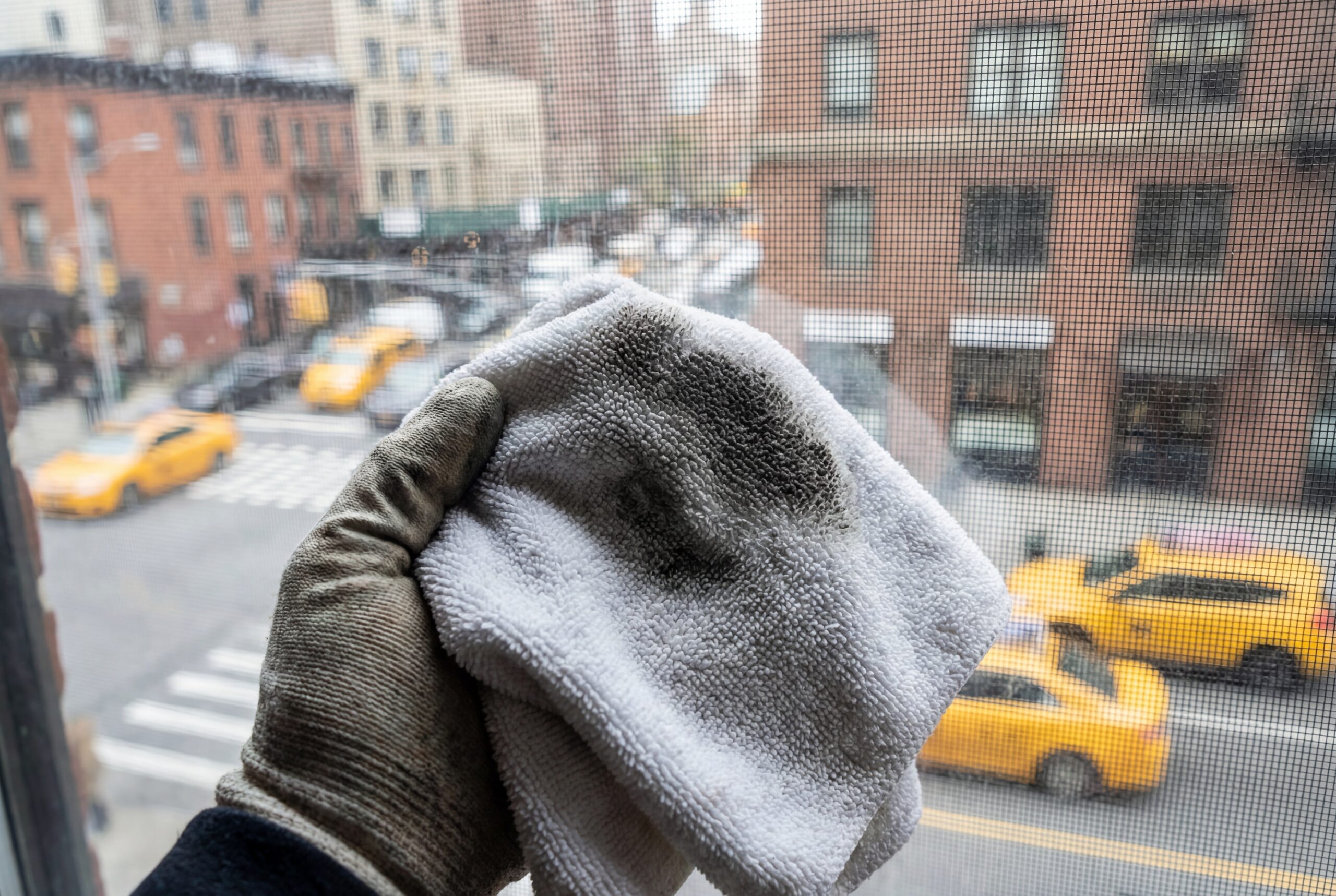
Here’s a test: take a white cloth. Wipe your screen. Look at the cloth. That grayish-black smear? That was going into your lungs the next time you opened that window.
Still think it can wait till next weekend?
Step 3: Lubricate Against “Summer Lock” – The $3,000 July Surprise
The Physics You’re Ignoring
Let’s talk about thermal expansion. Sounds boring. It’s not.
Your window hardware is metal. Metal expands in heat. In winter, it contracts. Between February and April, the temperature swing in New York can hit 60 degrees. That’s enough to change the molecular spacing in steel.
Now add salt. Not table salt – road salt. The stuff they dumped on the BQE that turned into aerosol, drifted up 30 stories, and settled into your window mechanisms. Salt plus moisture plus metal equals corrosion. Basic chemistry, terrible timing.
The July Scenario
Here’s how this plays out: It’s July. It’s 95 degrees. Your AC is broken (because of course it is). You need to open the window. You pull the handle.
Nothing.
The metal’s expanded. The corrosion’s created friction. The mechanism is frozen. You pull harder. Still nothing. You call the super. They shrug. You call a window repair company.
“Yeah, we can replace that hardware. Parts and labor, about $3,000. We can get someone out there in three weeks.”
It’s 95 degrees. You’re paying Con Edison $400 a month to air-condition the hallway because your window won’t close. This is your summer now.
The April Solution
Cleaning window mechanisms in April isn’t maintenance. It’s insurance.
The process is simple: remove the salt deposits with a mild acid solution, dry thoroughly, apply a high-temperature lubricant to all moving parts. Total time? Twenty minutes per window. Total cost? A fraction of emergency replacement.
One Upper West Side client learned this the hard way: “I ignored it in spring. By August, I had four windows that wouldn’t open and two that wouldn’t close. The repair bill was more than my monthly rent.” (And rent on the UWS isn’t cheap.)
Do this in April, when metal’s still contracted and mechanisms move freely. Wait till summer, and you’re not lubricating – you’re excavating.
Step 4: Solar Sensor Calibration – Why Your Smart Home Got Stupid
The Invisible Problem with Very Visible Bills
If you’re living in one of those glass towers in Hudson Yards or Chelsea with automated everything – motorized shades, smart lighting systems, auto-adjusting HVAC – congratulations: you live in the future. But your sensors are stuck in last November.
Smart home sensors work on light detection. Many are mounted behind glass or on exterior sills. That chemical film we talked about in Step 1? It’s not just blocking your view. It’s lying to your technology.
Your light sensor thinks it’s darker outside than it actually is. So your system compensates: lights on earlier, shades down sooner, HVAC ramping up because “it must be cloudy.”
Meanwhile, it’s a clear April afternoon, and you’re burning electricity like you’re hosting a rave.
The Numbers Don’t Lie (But Your Sensors Do)
Con Edison’s residential rates in Manhattan run about $0.30 per kWh during peak hours. If your lighting system is triggering two hours early every day because your sensors are reading through dirty glass, that’s 60 extra hours per month. Multiply that across your apartment’s lighting load, factor in HVAC inefficiency, and you’re looking at an extra $80-150 per month.
Not because you used more electricity. Because your home thinks it’s darker than reality.
One Financial District apartment had this exact problem: “Our electric bills jumped 40% over winter. The utility company couldn’t explain it. Turned out, the light sensors on our automated shade system were so filthy they thought it was perpetually overcast. Cleaning them dropped our bill back to normal.”
The Fix
Clean your sensors. It’s that simple. But you need to know where they are – and most people don’t.
If you’ve got automated systems, check your window frames, sill areas, and any exterior-mounted sensors. Clean the glass around them, clean the sensors themselves (carefully – no abrasives), and watch your systems wake up to reality.
Marie Kondo famously said, “The objective of cleaning is not just to clean, but to feel happiness within that space.” Hard to feel happy when your automated home is costing you an extra grand per year because it can’t see straight.
Step 5: Track “Abrasive” Extraction – The Slow-Motion Sabotage
The Dust That Costs Thousands
Look down at your window tracks. See that dust? That’s not dust.
New York construction generates approximately 2.5 million tons of debris annually – much of it concrete and granite. When they’re renovating the building next door (and they’re always renovating the building next door), they’re creating microscopic particles of rock. Those particles go airborne. They settle in your tracks.
Now you’re sliding a glass door across what’s essentially sandpaper.
The Engineering Reality
Sliding doors and windows run on rollers. Good rollers cost $200-300 per window to replace. But they’re not designed to roll over granite dust.
Every time you open your balcony door, you’re grinding those particles into the roller mechanism. It’s like putting beach sand in a bearing. The wheels wear down, the tracking gets uneven, the door gets harder to move, and eventually, the whole system fails.
The replacement timeline? Usually two to three years of regular use with contaminated tracks. The repair bill? Installation on a full-size sliding door can run $2,500-3,500.
The Solution (It’s Not Complicated, But It Matters)
Vacuum the tracks. Not with a regular vacuum – you need a shop vac or a strong handheld with a crevice tool. Get in there. Pull out everything: the dirt, the dead bugs, the Metro Card you dropped last summer, and most importantly, that concrete dust.
Then wipe with a damp cloth (not wet – you don’t want to create cement). Once dry, apply a silicone-based lubricant. Not WD-40 (that attracts more dirt). Actual track lubricant.
One Brooklyn Heights client put it perfectly: “I spent twenty minutes with a vacuum and saved myself three grand. Best return on investment I’ve had all year.” (And this guy works in private equity, so he knows ROI.)
This is preventative maintenance with a four-figure upside. Do it now, or pay later.
Step 6: Glass Corrosion Check – Your Last Chance Before It’s Permanent
The Chemical Countdown
Here’s something they don’t tell you when you sign that lease for the apartment with the “stunning views”: glass can die.
It’s called Stage 1 Corrosion, and spring is when it happens. Here’s why: Winter leaves alkaline deposits on glass (salt spray, building exhaust, construction residue). Spring brings acidic rain (NYC rain pH averages around 4.5 – that’s mildly acidic, thanks to atmospheric pollution). When those two meet on your window, they react.
The alkaline minerals start leaching out of the glass surface. You get white spots, cloudy patches, or a rainbow effect (called iridescence). It looks like a water stain. It’s not. It’s chemical etching.
The Point of No Return
Here’s the critical part: you have about 4-6 weeks to stop this.
In April and May, NYC gets stronger UV radiation as the sun angle changes. Those mild acid-alkaline reactions happening on your glass? UV accelerates them. The longer that contamination sits under spring sun, the deeper it etches into the glass structure.
By June, it’s permanent. No amount of cleaning will fix it because the damage is molecular. Your options become: live with foggy windows or replace the glass (at $800-1,500 per pane for double-pane insulated units).
The Empire State Building takes four months to clean with a dedicated crew of six professionals – and once they finish, they start over immediately. Why? Because maintaining glass isn’t optional. It’s structural preservation.
What You Should Do This Week
Get your windows professionally inspected and cleaned. Not “when you get around to it” – now, while the chemistry is still reversible.
Look for these warning signs:
White crusty deposits along edges
Rainbow patches that won’t wipe off
Areas where the glass looks cloudy or milky
Spots that seem to spread even after cleaning
If you see any of these, you’re already in early-stage corrosion. The clock is ticking.
One Upper East Side renovation project ignored this. By summer, eighteen windows needed full replacement. Cost: $47,000. The windows were only four years old.
Professional window cleaning can neutralize the pH of your glass, remove the chemical deposits before they etch, and protect the surface. For high-rise properties where access requires specialized equipment, companies like Big Apple Window Cleaning offer certified SPRAT rope access teams with the training and insurance coverage ($11 million) to handle complex facade work safely.
This isn’t cosmetic. It’s asset protection.
The Spring Reset – Why April Matters
New York doesn’t do seasons gently. We do hard transitions: freezing to sweltering, dark to bright, closed to open. Your home takes the impact.
Spring isn’t about making things pretty (though clean windows definitely help with those “natural light” claims in your apartment listing). It’s about maintenance windows – the narrow periods when problems are fixable before they become permanent.
These six steps aren’t optional extras. They’re what stands between “my apartment is great” and “my apartment needs $10,000 in repairs.”
The Timeline That Actually Works
Here’s the realistic schedule:
Early April: Window inspection and cleaning (catch corrosion early) Mid-April: Screen deep-cleaning (before you open windows for real) Late April: Mechanism lubrication (while weather’s still mild) Early May: Sensor calibration and final checks
Total time investment? Maybe four hours if you’re doing it yourself, less if you hire professionals. Total cost? A fraction of what you’ll pay in emergency repairs come summer.
For those in high-rise buildings or complex properties with restricted access, coordinating professional service now means avoiding the summer scheduling crunch – and the premium rates that come with emergency calls when your window won’t close during a heat wave.
The Bigger Picture
Your apartment is a system. Windows aren’t separate from your HVAC, your lighting, or your quality of life. When windows work right, everything downstream works better: lower energy bills, better air quality, actual enjoyment of the space you’re paying for.
And in New York, where you’re paying $50-100 per square foot annually just to exist in your apartment, every square inch should be working for you, not against you.
Spring is your reset button. The city’s giving you perfect weather – not too hot, not too cold – to fix what winter broke. Use it.
Because summer in New York waits for no one. And neither does corrosion, or mechanical failure, or compounding damage that starts small in April and becomes expensive in July.
Your windows know what season it is. They’re trying to tell you something.
Maybe it’s time to listen.
About the Author This guide was developed by the team at Big Apple Window Company, bringing 20+ years of NYC-specific window and facade maintenance experience to help homeowners and building managers protect their most valuable asset: the view. From landmark buildings to residential high-rises, we’ve seen what New York weather does to glass – and more importantly, we know how to fix it before it’s too late.
Follow our team's deals and coupons to stay on top of the hottest discounts and deals.
All of our official promotions, giveaways, and service information may be found on our social media.
Let's celebrate together!
Today is special - it's our 16th birthday! We thank you for your trust and choice and want to celebrate this day with you.
Get a 16% discount on main residential and commercial cleaning services!