
High-Rise Window Cleaning in NYC: What Building Owners Need to Know
Contents
- Why high-rise cleaning is different in NYC
- Access methods, and when each is used
- Rope access (SPRAT / IRATA)
- Suspended scaffolding (swing stage)
- Building Maintenance Units (BMU)
- Aerial and boom lifts
- Water-fed poles
- Safety and compliance: what you are responsible for
- How often should high-rise windows be cleaned
- What drives the cost
- How to vet a high-rise contractor (checklist)
- How this connects to facade compliance (Local Law 11 / FISP)
- Ready to schedule
DO YOU HAVE AN URGENT NEED?
Our fast response service can fix your urgent problem. We have teams ready for action.
AND GET A FREE QUOTE
Get monthly window insight
If you manage or own a high-rise in New York City, window cleaning is not a cosmetic line item. It is work performed at height, over public sidewalks, under OSHA and NYC Department of Buildings rules, and the liability often sits with the building. This guide explains how high-rise window cleaning actually works in NYC, what you are responsible for, and how to choose a crew that will not expose you to risk.
Why high-rise cleaning is different in NYC
A ground-floor storefront and a 40-story tower are not the same job. Above a certain height, crews cannot use ladders or poles. They depend on rope access, suspended scaffolding, or building-mounted equipment, and every one of those methods is regulated. Add NYC-specific factors: strong wind at elevation, pedestrian traffic below, tight scheduling around tenants, and facade anchors that the city requires to be tested and certified. A crew that is excellent on low-rise residential work may not be equipped or certified for a high-rise envelope.
Access methods, and when each is used
The right method depends on building height, facade design, and access points.
Rope access (SPRAT / IRATA)
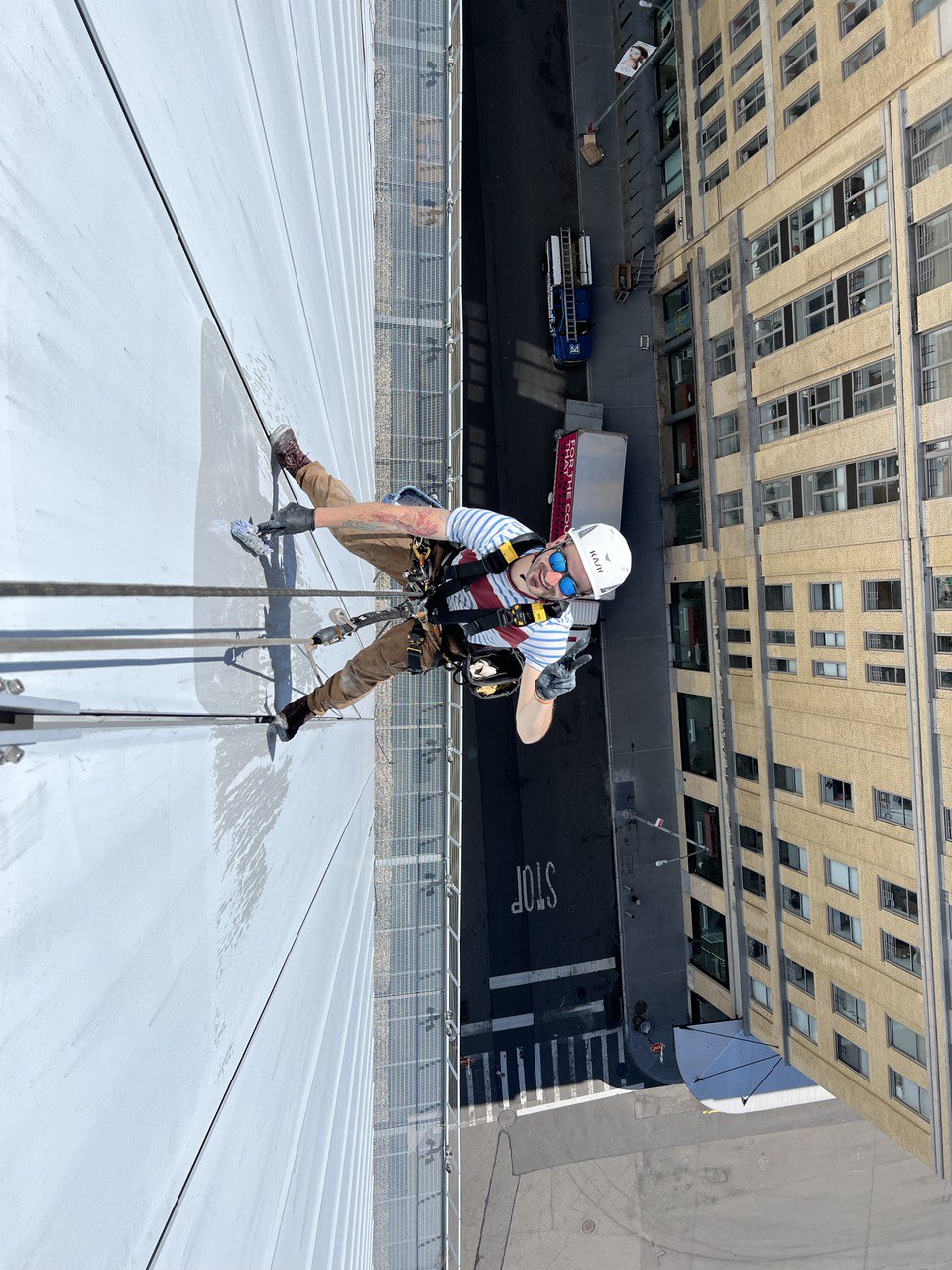
Technicians descend on certified ropes from the roof. Fast to deploy, low setup cost, and ideal for complex or irregular facades. Requires SPRAT or IRATA certified technicians and rated anchor points.
Suspended scaffolding (swing stage)
A motorized platform lowered from the roof. Best for full-building washes and large flat facades. Requires trained operators and compliant rigging.
Building Maintenance Units (BMU)
The permanent roof-mounted cranes you see on many modern towers. If your building has one, crews use it directly. It still requires trained operators and inspection.
Aerial and boom lifts
For mid-rise sections reachable from the street, lifts reach up to roughly 300 ft. Useful where roof access or anchors are limited.
Water-fed poles
For the lower accessible floors only. Pure water through a pole, no detergent, no ladders. Often combined with one of the methods above for a full building.
Safety and compliance: what you are responsible for
This is the part most owners underestimate. In NYC:
- Fall protection at height is governed by OSHA. Crews must use rated systems and follow documented procedures.
- Window cleaning anchors on the roof must be inspected and certified on a schedule under NYC DOB rules. Cleaning from a non-compliant anchor is both a safety and a legal exposure.
- Insurance and workers compensation matter to you directly. If an uninsured crew is injured on your building, the building can be drawn into the claim.
- Industry standards such as ANSI / IWCA I-14 define safe window cleaning practice. A serious contractor follows them.
The practical takeaway: hiring the cheapest crew without checking certification and insurance does not save money, it transfers risk onto the building.
How often should high-rise windows be cleaned
There is no single answer, but the drivers are consistent:
- Location and pollution: buildings near construction, bridges, or heavy traffic soil faster.
- Tenant profile: Class A office and luxury residential expect a higher standard than a warehouse.
- Season: spring and fall are common reset points after winter grime and summer pollen.
Many NYC commercial high-rises run on a quarterly cycle, with flagship or street-facing facades cleaned more often. The point is to set a schedule, not to react once the glass is visibly dirty.
High Rise Window Cleaning Services
What drives the cost
Pricing is not per-window guesswork. The main factors are:
- Height and the access method required (rope vs swing stage vs lift)
- Total glass count and facade complexity
- Frequency (a standing contract costs less per visit than one-offs)
- Anchor condition and any rigging setup
- Scheduling constraints (after-hours, tenant coordination, street permits)
A credible contractor will walk the building and quote against these, not give a flat number sight unseen.
How to vet a high-rise contractor (checklist)
Before you sign, confirm:
- Certification: SPRAT or IRATA for rope access, trained operators for scaffolding or BMU.
- Insurance: ask for a Certificate of Insurance. Confirm general liability and workers compensation, and that the limits fit a high-rise job.
- Anchor knowledge: the crew should ask about your roof anchors and their certification status before quoting.
- References and track record: other NYC high-rise buildings, ideally similar in height and facade type.
- Safety documentation: written procedures, not verbal assurances.
Red flags: no proof of insurance, vague answers about access method, no questions about your anchors, or a price that seems too low for the height involved.
How this connects to facade compliance (Local Law 11 / FISP)
High-rise window crews work inches from the facade. A good contractor notices cracked sealant, displaced brick, or staining that signals a larger problem, and can coordinate cleaning around your FISP cycle. Treating window cleaning and facade maintenance as one program, rather than two disconnected vendors, keeps the building envelope in better shape and avoids surprises at inspection time.
Ready to schedule
If you manage a high-rise in NYC and need a certified, insured crew, see our service for methods, coverage, and a building walkthrough.
Most NYC commercial high-rises run quarterly, with street-facing or flagship facades more often. Location, pollution, and tenant standard set the cadence.
Yes, when performed by SPRAT or IRATA certified technicians on rated, certified anchors. It is a standard, regulated method used on complex facades worldwide.
If the contractor is uninsured or uncertified, the building can be drawn into the claim. Always confirm general liability and workers compensation before work begins.
Yes. NYC requires window cleaning anchors to be inspected and certified on a schedule. A reputable crew asks about anchor status before quoting.
FURTHER READING
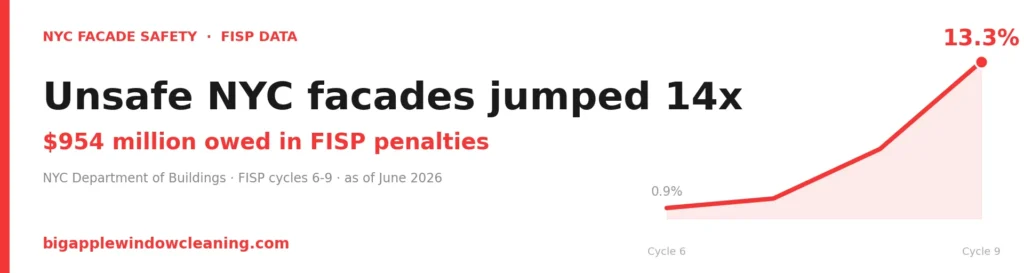
Unsafe NYC Facades Jumped 14x. The $954 Million Reason Owners Hide Them Instead of Fixing Them
On May 16, 1979, a 17-year-old Barnard student named Grace Gold was walking near Broadway and 115th Street when a piece of masonry broke loose from the eighth floor of a Columbia-owned building and killed her. Her death produced Local Law 10 of 1980, the first law in New York City requiring periodic facade inspections […]
Explore more
Roof Lantern Cleaning: A Professional Guide for New York Homeowners
Your roof lantern was supposed to flood the room with light. Instead, it is flooding the room with guilt every time you look up and see a layer of grime that could double as modern art. If you live in Brooklyn or Manhattan, you already know that city air does not play fair with glass […]
Explore more
House Facade Cleaning: A No-Nonsense Guide for Homeowners Who’d Rather Not Watch Their Walls Crumble
Your home’s facade does a thankless job. Day after day, it stands between your family and everything the urban environment throws at it – diesel exhaust from delivery trucks, pigeon droppings with the pH of battery acid, mysterious black streaks that seem to appear overnight, and that persistent green fuzz on the north-facing wall that […]
Explore more