
You’ve probably walked past a Tribeca penthouse or a Brooklyn townhouse and noticed a stunning skylight or glass atrium catching the afternoon sun. Maybe you own one yourself. Either way, here’s a question most New Yorkers don’t think about until it’s too late: when was the last time that glass got a proper cleaning?
Glass roof cleaning sounds straightforward. It isn’t. Not in this city.
What “Glass Roof” Actually Means in NYC
Before we get into the how and why, let’s talk about what we’re actually dealing with, because New York has its own vocabulary when it comes to overhead glass.
There are flat skylights built into brownstone rooflines in Park Slope and Cobble Hill – many of them original 19th-century features, installed above stairwells for ventilation and still doing their job over 100 years later. There are glass atriums crowning luxury condos in Tribeca and the Lower East Side, where natural light floods down through multi-story glass structures into living rooms and lobbies below. There are roof lanterns – those elegant pyramid-shaped glass structures you’ll find sitting atop renovated townhouses in the West Village or fitness centers in newer residential buildings. And then there are the retractable glass roofs in rooftop bars and restaurants across Manhattan that slide open on warm nights.
Every single one of these needs regular glass roof cleaning. And every single one presents access challenges that simply don’t exist in the suburbs.

What New York’s Air Does to Your Glass Roof
Here’s what actually lands on a glass roof in NYC over the course of a year, and it’s a lot more aggressive than a little dust.
Pigeons. New York City has one of the densest urban pigeon populations in the world, and glass roofs are flat, warm, and perfectly positioned for roosting. Unlike vertical windows where droppings slide down, a glass roof holds them. The uric acid in bird waste breaks down sealants and frames over time – and because glass roofs are horizontal, the accumulation happens faster than almost anywhere else on a building’s exterior.
Urban particulate matter. The city’s PM2.5 levels – those fine particles from vehicle exhaust, construction dust, and older building heating systems – create a persistent grey film on any outdoor surface. A glass roof, sitting horizontally and exposed to everything the sky drops, collects this material at a rate vertical windows simply don’t. The subway system adds its own contribution: fine metal particles from train brakes and diesel exhaust drift upward into the surrounding blocks.
Acid deposition. According to the New York State Department of Environmental Conservation, acid rain and dry acidic particles corrode metal and cause surfaces to deteriorate. For glass roofs specifically, this means accelerated breakdown of frames, flashing, and the sealants that keep everything watertight. Left untreated, what starts as a cleaning issue becomes a structural one.
Seasonal layering. Winter brings snow and ice that pool in low-drainage areas. Spring adds pollen and dirt runoff. Summer’s heat bakes accumulated grime into the glass surface. By fall, organic debris in the frames creates conditions for mold growth. In New York, glass roof cleaning isn’t a once-a-year consideration – it’s a genuine maintenance schedule.
The Self-Cleaning Glass Myth
If you have a newer skylight or glass roof, you may have heard the phrase “self-cleaning glass” and assumed that meant low or no maintenance. Not quite.
Self-cleaning coatings work through two mechanisms: a photocatalytic effect that uses UV light to break down organic material, and a hydrophilic coating that causes water to sheet evenly across the surface rather than bead. It’s impressive technology – and it genuinely helps. VELUX, one of the leading skylight manufacturers, notes that even self-cleaning skylights require professional cleaning every two to three years to maintain proper function.
In New York’s urban environment, that interval gets compressed. Pigeon droppings are too concentrated for photocatalytic coatings to fully neutralize. Carbon soot and heavy metal particles from city air don’t wash away with rain. Acid dry deposition accumulates between rainfalls. The self-cleaning coating is doing its job – it’s just that NYC’s contamination load is working overtime against it.

Why This Is Not a DIY Project
Let’s be direct about something. Glass roof cleaning from the exterior is not a job for a ladder and a bucket of soapy water.
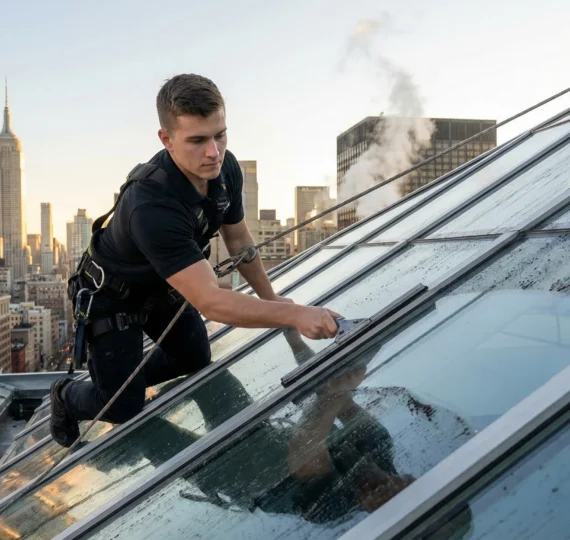
Glass roof panels are not load-bearing surfaces. Standing on or leaning against them – even when they appear solid – risks cracking or breaking the glass entirely. Many NYC rooftops have limited safe access points, irregular surfaces, and no established anchor positions for working safely at height. Add wet glass, a sloped surface, and the wind that comes with any elevated position in this city, and you have a serious fall hazard.
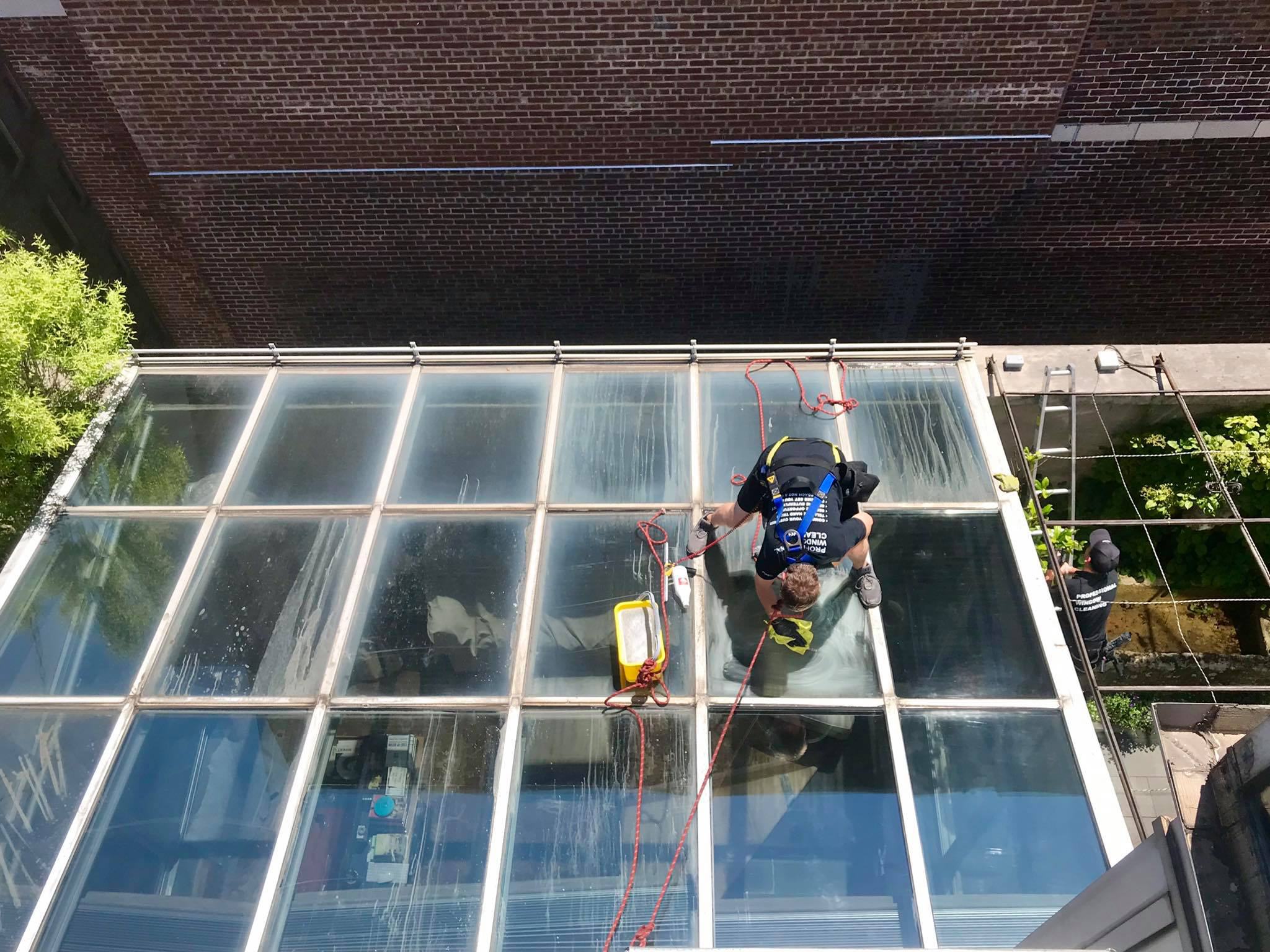
In New York, there’s also a regulatory layer that most people don’t consider. Any rope access work on a building requires a Suspended Scaffold Application (CD5) filed with the NYC Department of Buildings, and workers must be licensed riggers certified by the DOB. OSHA requires that Industrial Rope Access specialists hold SPRAT or IRATA certifications – and that dual rope systems (primary and safety) be used and logged within 24 hours of each use.
This is why Big Apple Window Cleaning – which holds SPRAT certification, carries $11 million in insurance, and has completed glass cleaning work on over 200 New York landmark buildings – approaches glass roof cleaning the way any serious high-access work in this city demands: with certified specialists, proper equipment, and the documentation to back it up.
What Professional Glass Roof Cleaning Services Actually Include
Good glass roof cleaning services go beyond wiping down the glass. Here’s what a proper job looks like:
Before any glass roof cleaning begins, a pre-cleaning inspection identifies the type and extent of contamination, checks the condition of sealants and flashing, and spots any cracks or damage – catching problems early prevents expensive repairs later.
Safe access is matched to the specific structure: rope access from certified roof anchors, boom lifts, or telescopic water-fed poles for lower-access installations. The right method depends on the building’s height, roof configuration, and the type of glass roof being cleaned.
The cleaning itself uses non-abrasive, pH-neutral cleaners that won’t damage self-cleaning coatings or frames – important, because ammonia-based products that work fine on regular windows can degrade specialized glass coatings.
Frame and seal cleaning is part of the job, not an afterthought. The channels and joints around glass roof panels accumulate the same grime as the glass, and neglecting them accelerates seal failure.
Both interior and exterior surfaces get cleaned. Indoor glass roof surfaces collect dust, condensation residue, and airborne particles just like the exterior – a complete job covers both sides for full clarity and light transmission.
Finally, a post-cleaning check reviews sealants, weep holes, and drainage channels. In New York’s weather, proper drainage on a glass roof isn’t optional.
How Often Does a Glass Roof in NYC Need Cleaning?
The standard recommendation for most residential skylights is once or twice a year. For New York City, that baseline shifts upward. Most properties with glass roofs benefit from cleaning two to four times per year, depending on location, exposure, and whether the building is in a high-pigeon-activity area.
Buildings near parks, water towers, or elevated subway lines tend to see faster contamination than those in more sheltered positions. A rooftop in Midtown faces different conditions than one in a quieter part of Carroll Gardens – and a proper glass roof cleaning service will assess your specific situation rather than apply a generic schedule.
A glass roof is one of the best features a New York property can have. Natural light, architectural character, a connection to the sky that most apartments in this city can only dream about. Keeping it clean isn’t just aesthetic – it protects the glass, extends the life of sealants and frames, and prevents the kind of slow damage that turns a cleaning bill into a repair bill.
If your skylight, atrium, or roof lantern hasn’t been professionally cleaned in more than a year, it’s probably overdue. Big Apple Window Cleaning offers professional glass roof cleaning services for residential and commercial properties across all five boroughs – both interior and exterior – with the certifications, insurance, and NYC-specific experience to do the job right.
Because in New York, even the sky has its own maintenance schedule.
https://www.google.com/maps?cid=10117434971902366926
420 Lexington Ave #2440, New York, NY 10170, United States