Every spring, thousands of New York City residents open their windows for the first time since October and immediately notice the same problem: a torn mesh, a bent frame, or a screen that no longer sits flush in the track. For homeowners with Andersen windows, that discovery kicks off a process that’s more involved than most people expect.
Replacement screens for Andersen windows are not a simple off-the-shelf swap. The system is engineered to tighter tolerances than generic windows, the hardware varies significantly between series, and one detail in particular – the way the mesh is held in the frame – catches most DIYers completely off guard. This guide covers everything you need to know before you order anything.
The Detail Nobody Tells You About: The Aluminum Spline
Standard window screens use a rubber spline – a flexible strip pressed into a groove to hold the mesh in place. When it wears out, you pull it out, swap the mesh, and roll in new spline. The whole job takes about twenty minutes.
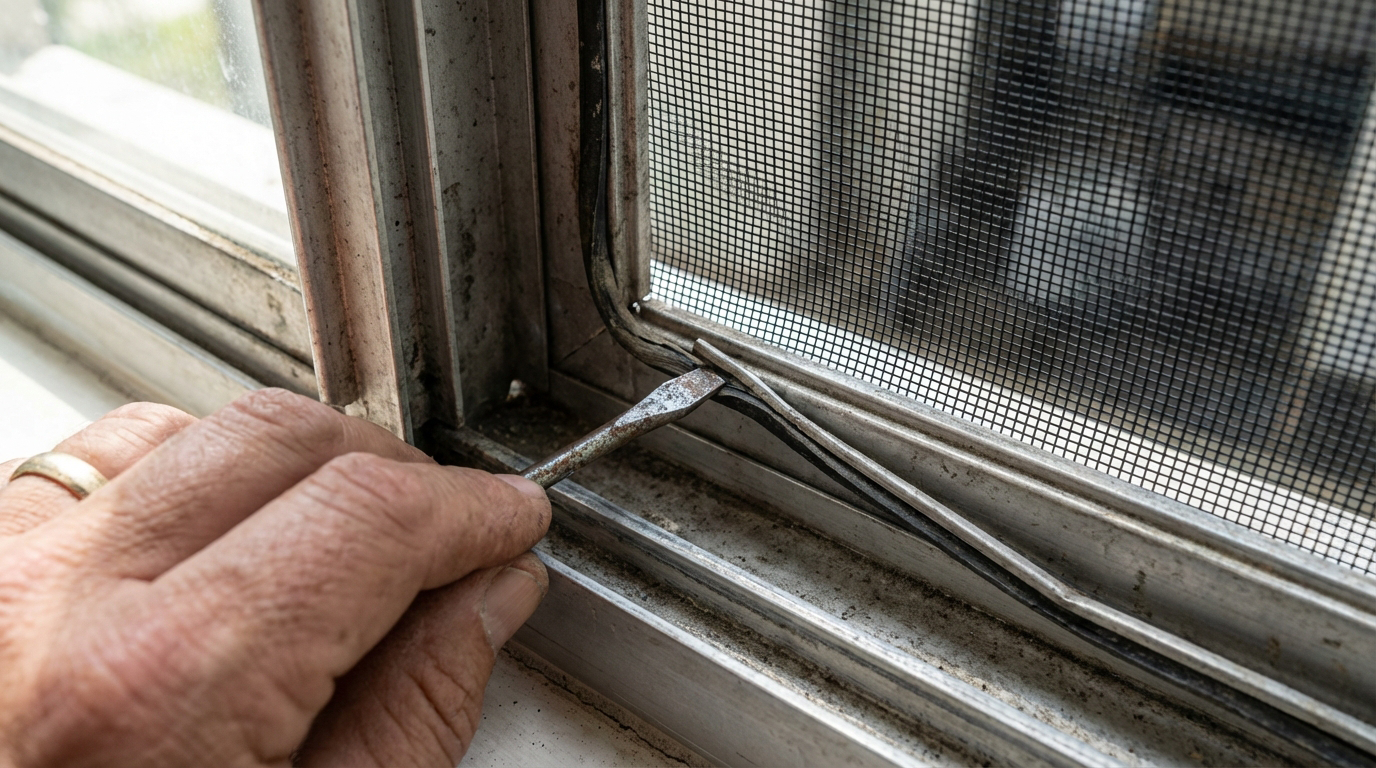
Andersen windows use an aluminum tube instead of rubber spline. When you remove it, it bends and curls, and reinserting it cleanly requires both experience and the right tools. Andersen’s official position is that they do not recommend rescreening their window screens and do not sell replacement mesh or spline separately – only complete, ready-to-install screens. This reflects a real engineering constraint, not just a sales strategy.
The practical implication for homeowners in Park Slope, Astoria, or Riverdale: if only the mesh is damaged but the frame is intact, rescreening is technically possible, but it requires know-how and patience that most people don’t have on hand. For most situations, ordering the correct replacement screen is the faster, more reliable path.
Step One: Know Your Series
Replacement screens for Andersen windows are series-specific. A screen from the 400 Series will not fit a 200 Series Narroline window, even if the outer dimensions look similar. Getting this wrong means sending the screen back and starting over.
| Andersen Series | Key Characteristics | Screen Availability |
| 400 Series | Most popular; wood interior, Fibrex® exterior; tilt-wash double-hung | Wide selection at Home Depot and parts store |
| 200 Series Tilt-Wash | Tilt latches on checkrail; different mechanism from 400 Series | Available; requires correct series ID |
| 200 Series Narroline® | Double-hung without tilt; vinyl jamb liner; no wash assist | Available; confirm no tilt before ordering |
| A-Series | Premium line; wood-veneer screen frames; Stone, White, Gold Dust frame colors | Wider color and finish options |
| 100 Series | Budget Fibrex composite; clean corners; modern look | Standard screens included with windows |
How to identify your series: Look for the Andersen logo etched into the glass in the interior bottom-right corner of the window. If you already have a screen, the model number is stamped directly on the frame – on the side, top, or bottom rail. That number alone is enough to search the Andersen parts store or find the right product at Home Depot without any measuring.
If there’s no existing screen to reference, measure the visible glass – the part of the glass you can actually touch – not the overall window frame. Take three measurements at different heights and use the smallest.
Step Two: Match Your Window Type and Hardware
Andersen windows come in four main styles – double-hung, casement, awning, and gliding – and each uses a different screen mounting system. Hardware type is where the most errors happen when people order replacement screens for Andersen windows without checking first.
| Hardware Type | Common Application | Notes |
| Face-mounted clips | Single-hung windows | Clips onto downward-facing flange on frame |
| Blade latch | Single-hung with horizontal slits at top | Blade rotates into slit to lock |
| Pin / bolt hardware | Casement, awning, slider | Requires pre-drilled holes in frame |
| Pin latch (vertical slit) | Andersen and Pella casement | Engages vertical slits on window sides |
| Loop latches + ball head screws | Older wood-frame windows | For non-track surface-mount install |
| Lever-type closure (side) | Older Andersen double-hung | Proprietary; hard to replicate with third-party screens |
Casement and awning windows are a special case: because they swing outward, screens mount on the inside rather than the exterior. Removing them means reaching the clips or pins from inside the room – straightforward on accessible lower floors, more complicated in upper-floor apartments.
Double-hung windows have screens mounted on the exterior. They always include a horizontal bar across the middle. If yours is a cottage-style window with unequal sashes, that bar is off-center, which means a standard screen won’t fit – you’ll need to measure both the top and bottom sash separately and contact Andersen directly.
What Makes This Harder in New York City
Replacing screens on Andersen windows is a different experience in an urban environment than it is anywhere else. A few NYC-specific factors are worth knowing upfront.
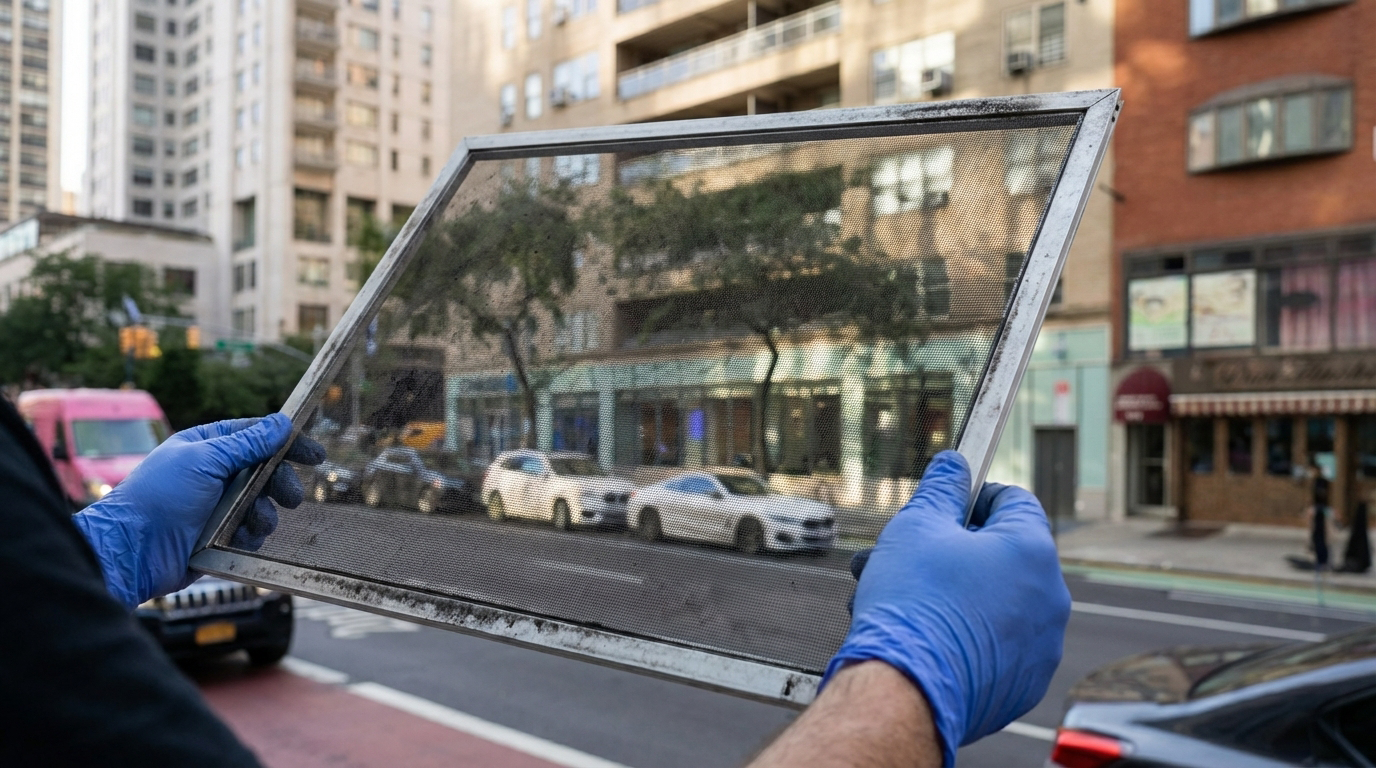
Urban grime moves faster. Screens in Jackson Heights or Williamsburg accumulate soot, pollen, and particulate matter at a much higher rate than screens in quieter areas. What might need cleaning once a year in a suburban setting needs attention every season in the city – sometimes more often if you’re near a construction site or a busy street.
Co-op board rules. Many Manhattan and Brooklyn co-ops treat screen frame color as part of the building’s exterior appearance. Before ordering screens in bronze or black when the rest of the building uses white, check with your building management. This is a common friction point that people discover after the screens arrive.
Child safety – an important distinction. Window screens are not window guards. Under New York City building codes, window guards are required on windows above the first floor in buildings with children under 10. A screen, no matter how sturdy, does not satisfy that requirement. When replacing screens on Andersen windows in family apartments, make sure window guards are already in place and that the new screen installation doesn’t interfere with them.
Tiny insects near green spaces. Standard aluminum mesh screens, even in perfect condition, have openings large enough for no-see-ums and gnats. If your apartment looks out toward Central Park, Prospect Park, or the waterfront in Red Hook, you’ll likely notice this in late spring and early summer. Andersen’s TruScene® upgrade addresses this directly.
Standard Screens vs. TruScene®: Choosing the Right Mesh
For most situations, standard aluminum mesh is the right call. It’s durable, affordable, keeps out the majority of insects, and is available in sizes that cover the full Andersen lineup. TruScene® is worth considering if any of the following apply:
- You deal with tiny biting insects regularly during warm months
- The view through the window matters to you (TruScene is 50% more transparent than standard mesh)
- You want maximum light and airflow – TruScene lets in roughly 33% more air than standard screens
- You’re upgrading and want screens that look nearly invisible from inside
One important caveat: TruScene screens cannot be repaired. The micro-fine stainless steel mesh is manufactured in a way that makes field repairs impossible. A torn TruScene screen needs to be replaced entirely, and the mesh is not sold in rolls at any hardware store. If you have pets or children who regularly push against screens, factor that into the decision.
When to Handle It Yourself vs. When to Call a Professional
Replacing screens on Andersen windows yourself makes sense when the screen is on an accessible lower floor, you’ve confirmed your series and hardware type, and your replacement screen is an exact match – ideally ordered using the stamped model number from the existing frame.
It’s worth bringing in a professional when the windows are externally mounted and high up, when the frames are older wooden Andersen units with lever-type hardware that third-party suppliers can’t replicate, when the frame itself (not just the mesh) is bent or damaged, or when your building requires coordinating with management for any window-related work.
Big Apple Window Cleaning handles a wide range of screen-related situations across all five boroughs, including older Andersen frames with non-standard hardware and buildings where access requires specialized equipment. A full overview of what’s covered is available on our window screen services page.
Quick Reference Before You Order
Before purchasing replacement screens for your Andersen windows, take five minutes to confirm the following:
Check the existing screen frame for a stamped model number – it’s on the side, top, or bottom rail and is the fastest way to identify the exact product you need. If no screen exists, measure the visible glass, not the window frame. Use the smallest of three height measurements taken at different points. For double-hung windows, measure one sash only if you’re ordering half-screens.
Confirm the frame color before ordering. Andersen offers white, stone, tan, and several wood-veneer finishes depending on the series. On a multi-window apartment, mismatched frame colors are immediately noticeable.
If you have casement windows, identify the hardware type before ordering from a third-party supplier. Proprietary pin and lever hardware on older Andersen casements is the most common reason third-party screens don’t fit even when the dimensions are correct.
Andersen windows are built to a higher standard than most, and their screen system reflects that same engineering precision – which also means replacement screens for Andersen windows require a more careful approach than a generic hardware-store swap. Know your series, confirm your hardware type, choose the right mesh for your environment, and measure the visible glass, not the frame.
For New York City homeowners dealing with high floors, older buildings, or windows that haven’t been serviced in years, a professional assessment is often the faster path to getting it right the first time. Done correctly, new screens make a meaningful difference – fresh air in, insects out, and no fighting with the AC through a summer that could have been spent with the windows open.
https://www.google.com/maps?cid=10117434971902366926
420 Lexington Ave #2440, New York, NY 10170, United States