

High-rise window cleaning in NYC
skyscrapers & tall buildings
Professional cleaning services for commercial towers and residential high-rises.

SPRAT & OSHA 100% certified in-house technicians
Complex Rigging expert BMU and davit operation
DOB Compliant we manage CD5 permits and paperwork
$11M Coverage strong liability protection for your property
The mechanics of
high-rise contamination
It’s not just aesthetics. It’s a building envelope issue that affects tenant satisfaction, property value, and long-term maintenance costs.
UNDERSTANDING “ATMOSPHERIC DEPOSITION”
Your high-rise building façade operates as a massive air filter in NYC’s urban environment. Vehicle exhaust deposits carbon particulates. Construction sites generate cement dust. Industrial facilities release sulfur compounds. NYC’s atmospheric pollution load – combined with 2,574 annual sunshine hours driving photochemical reactions – creates aggressive contamination that etches glass and oxidizes metal frames.
THE HIDDEN COSTS OF WAITING:
Tenant Satisfaction & Lease Renewals: Studies show access to natural light ranks #1 in employee workplace preferences. Commercial high-rise window cleaning directly impacts tenant retention. Buildings with visibly dirty façades can struggle with lease renewals and command lower per-square-foot rates than comparable clean buildings. Permanent Glass Degradation: Once mineral deposits and acid etching penetrate the glass surface, no amount of cleaning restores clarity: the glass has to be replaced. Building Envelope Failure: Water that gets past failed seals turns into interior repairs.
THE BIG APPLE access protocol
We don't use one-size-fits-all methods. We plan the right access method for your building's height, architecture, and operational constraints.
Schedule a site visit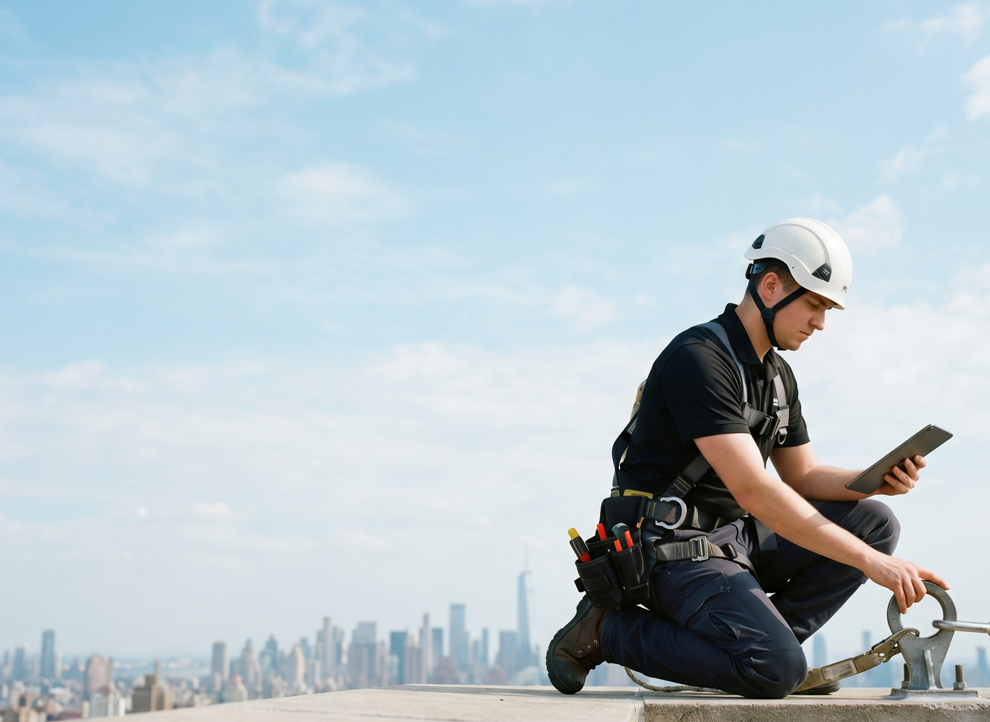
Engineered access planning
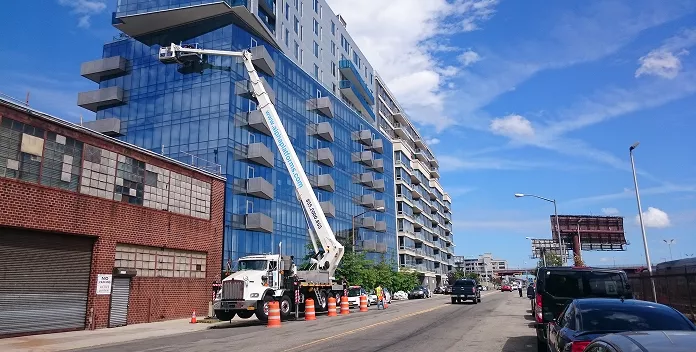
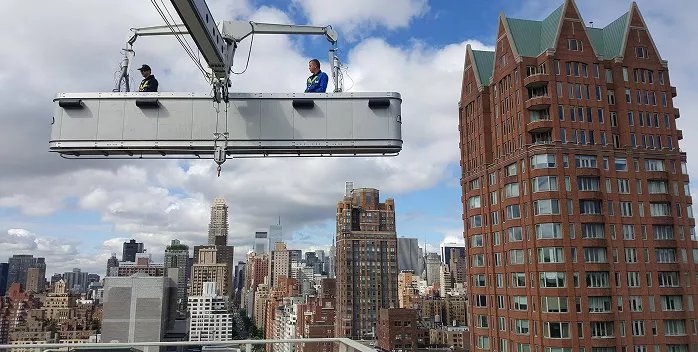
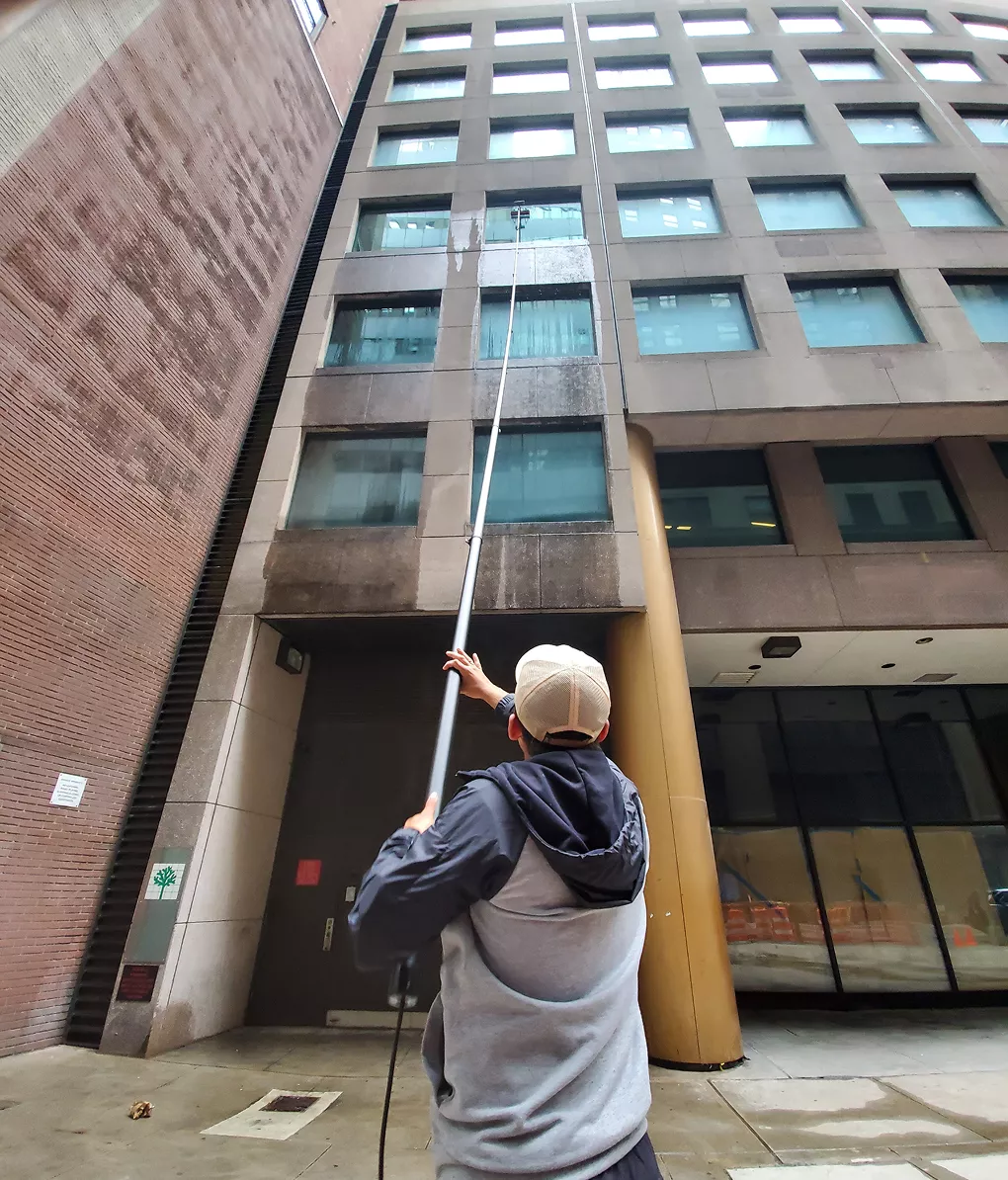
Our SPRAT-certified technicians assess your building's roof anchors, BMU systems, façade obstructions, and regulatory constraints. For high-rise window cleaning in NYC, we determine the safest and most efficient method: rope access for complex façades, aerial lifts up to 300 ft for mid-rise buildings, suspended scaffolding for full-building washes, or water-fed poles for accessible lower sections.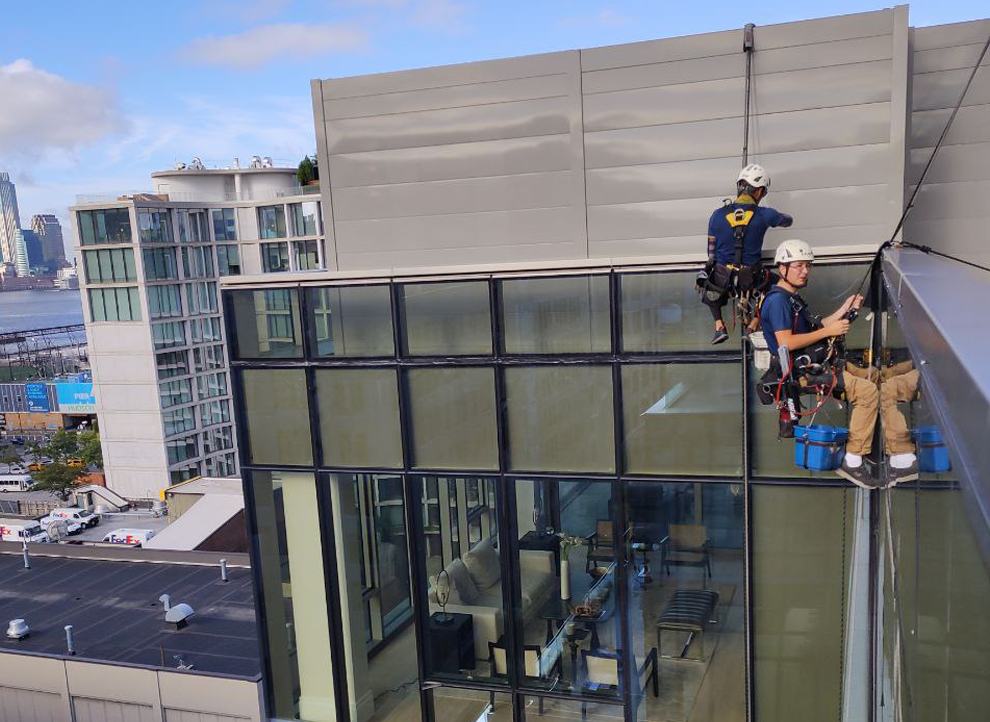
OSHA-compliant execution
We deploy access equipment in compliance with NYC Department of Buildings requirements and OSHA fall protection standards. Our SPRAT Level 2 and 3 technicians use redundant anchor systems, self-retracting lifelines, and continuous monitoring. For high-rise window cleaning, we coordinate roof access with building management, notify tenants of exterior work schedules, and set up ground-level safety perimeters. All equipment is inspected before each shift under ANSI Z359 standards.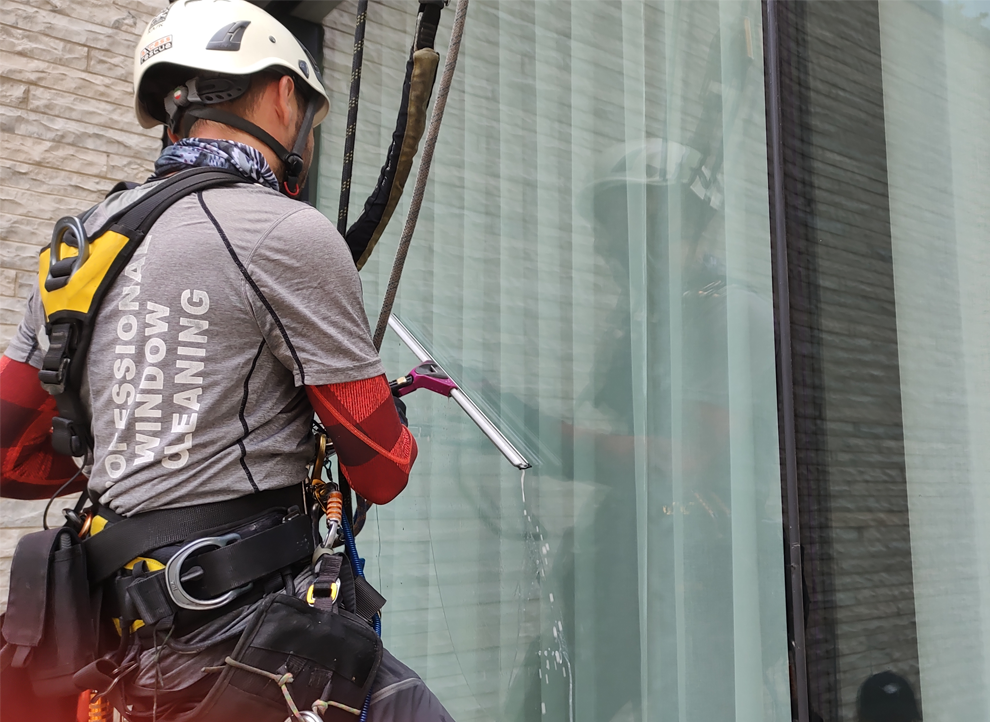
Precision cleaning & protection
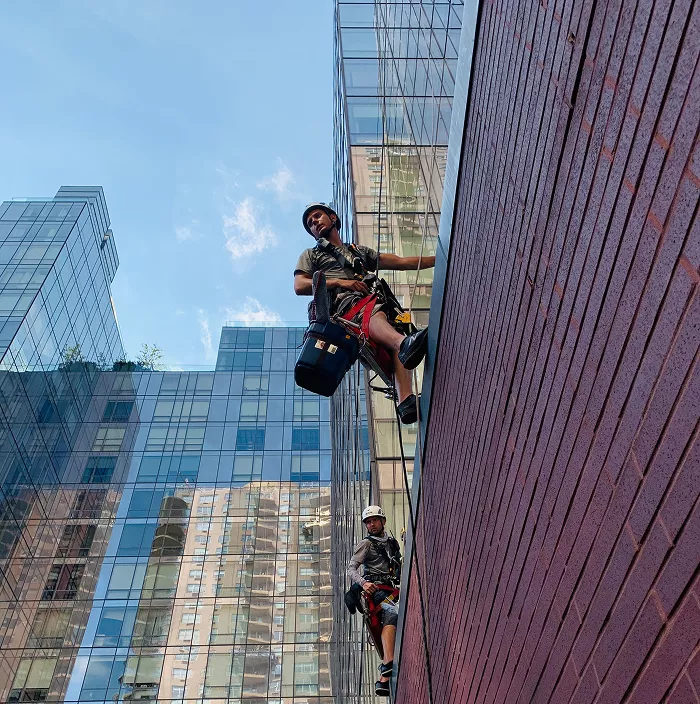
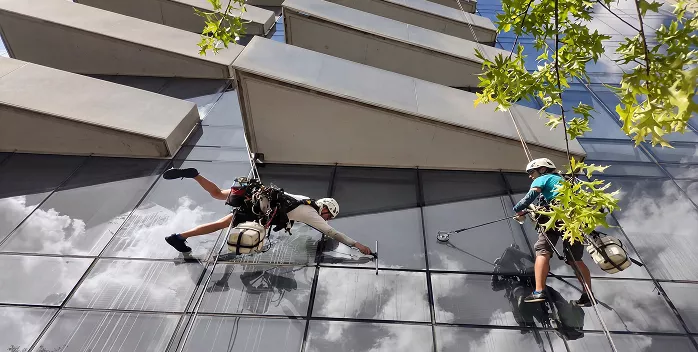
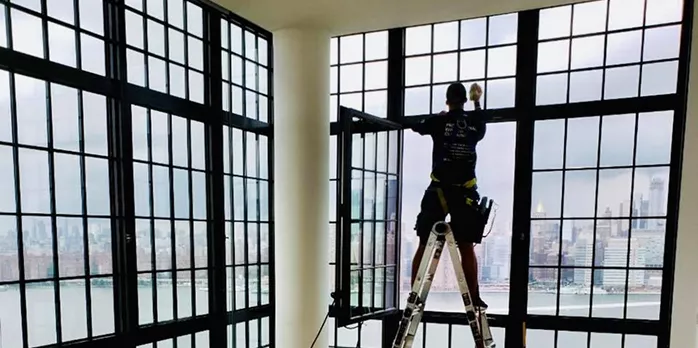
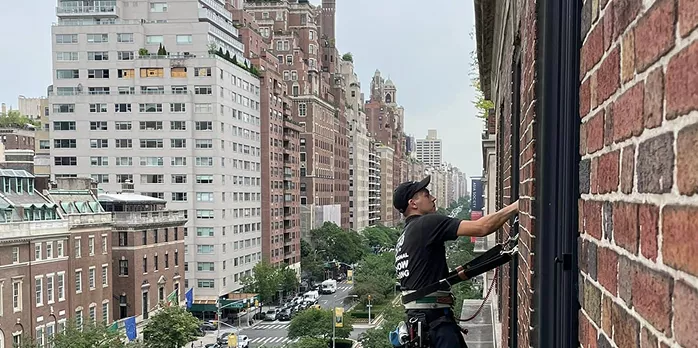
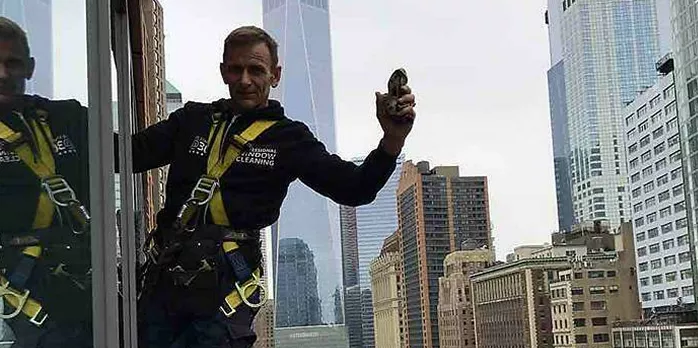
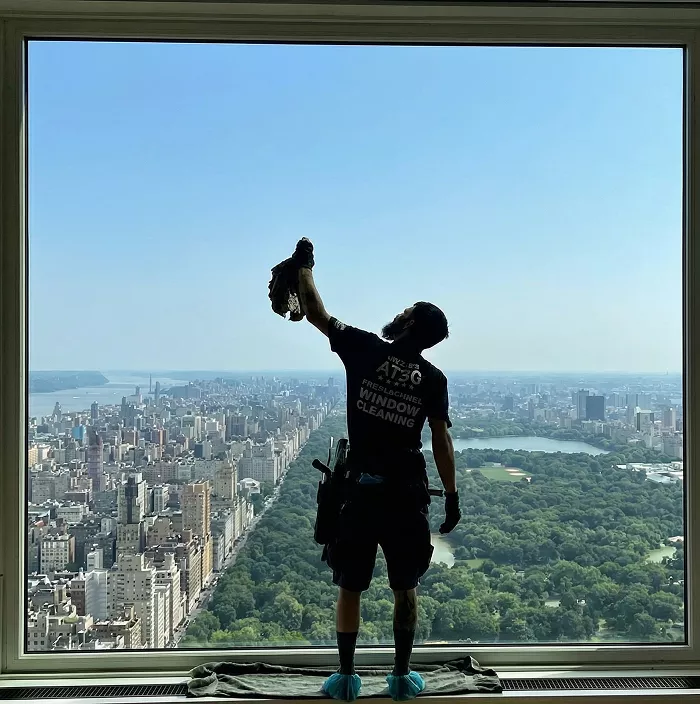
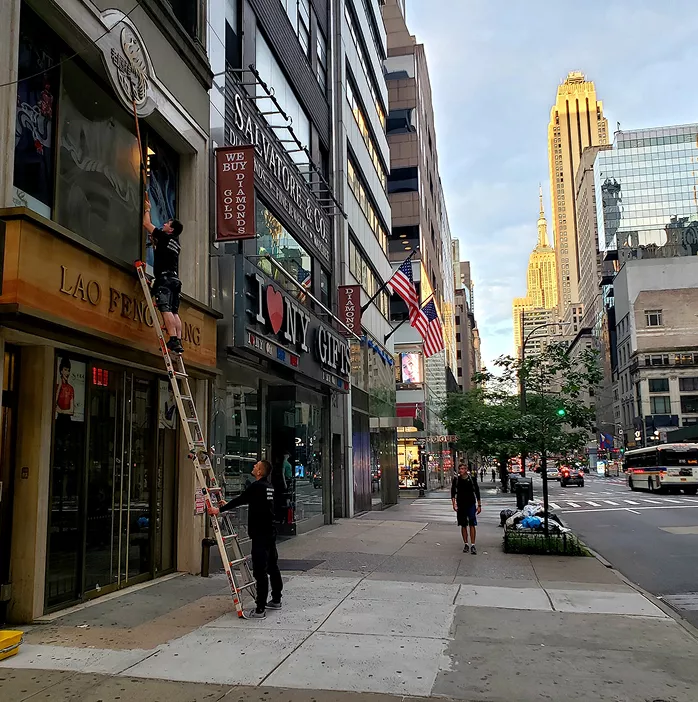
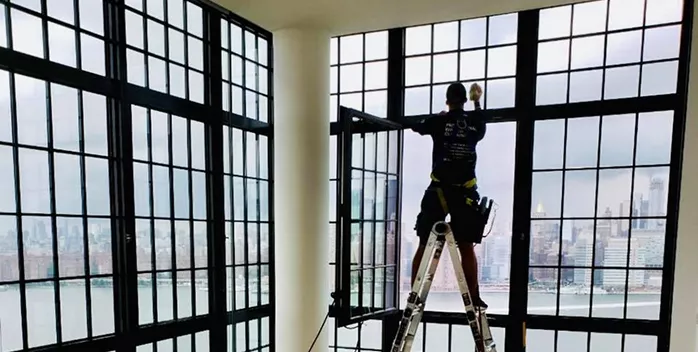
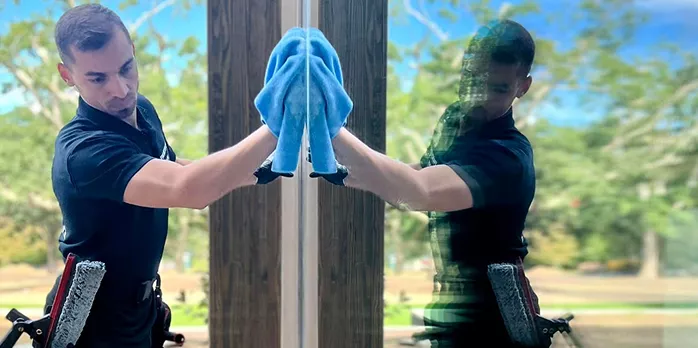
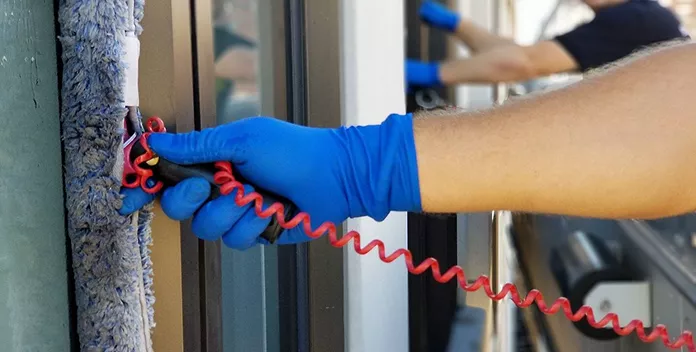
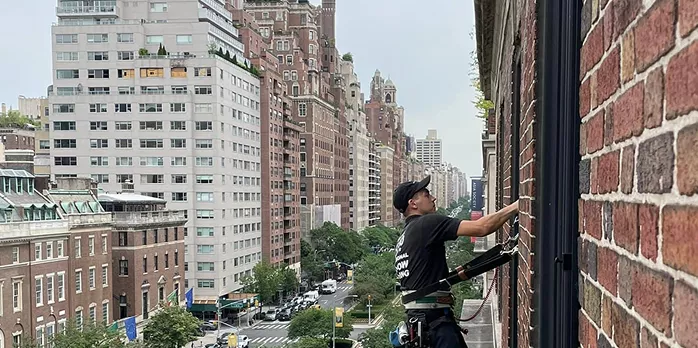
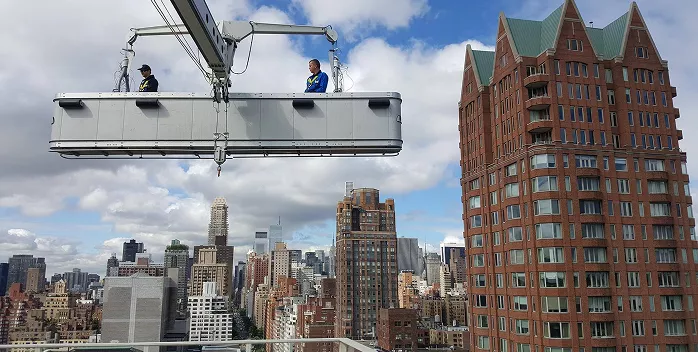
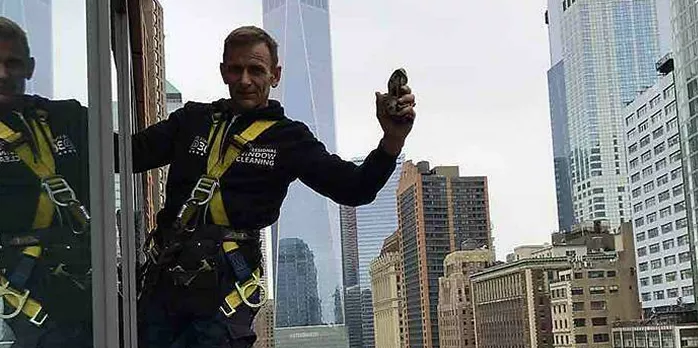
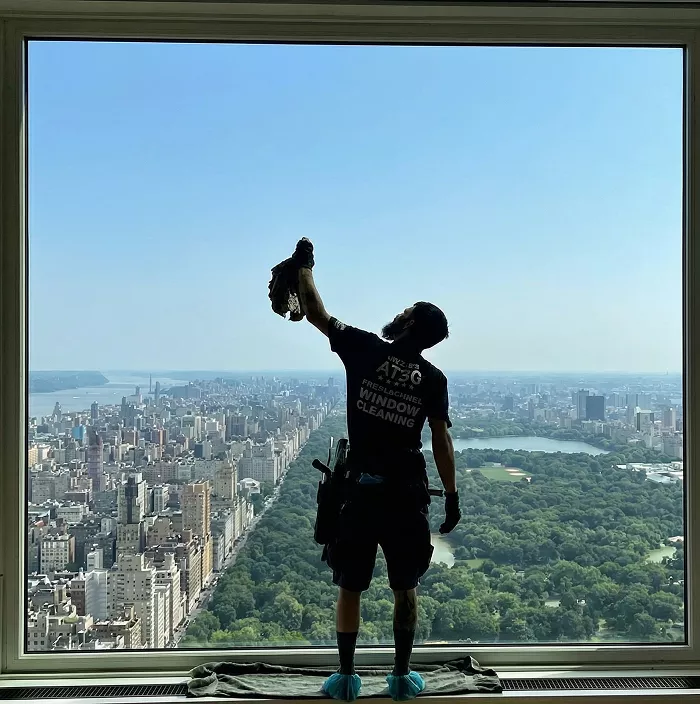
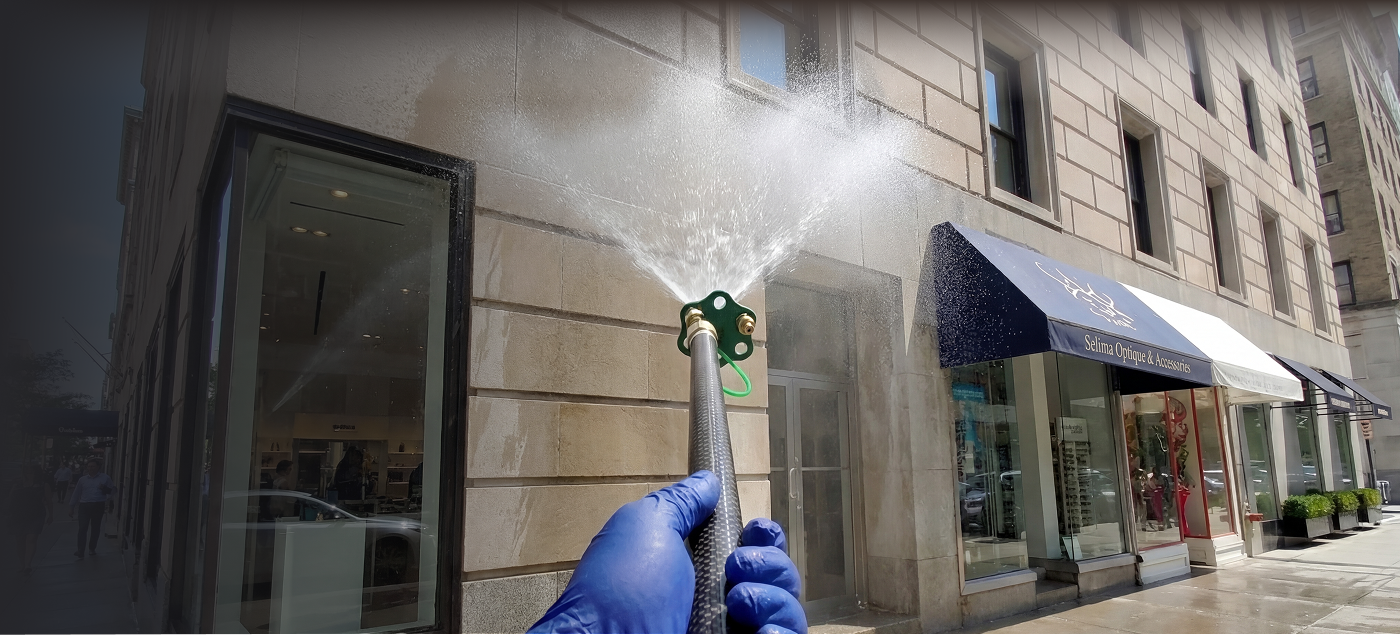
For high-rise window cleaning, we use purified water systems with zero mineral content that eliminate spotting. We apply professional-grade cleaning solutions that break down carbon deposits and oxidation without damaging Low-E coatings. We hand-detail frames, remove construction overspray, and inspect seals for damage.Big Apple Window Company at work
More than 2 decades of experience in property maintenance.
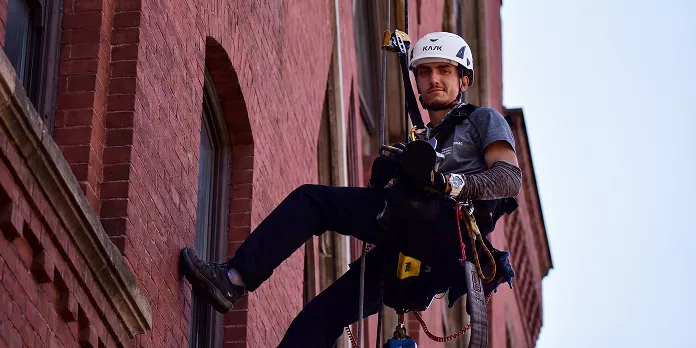
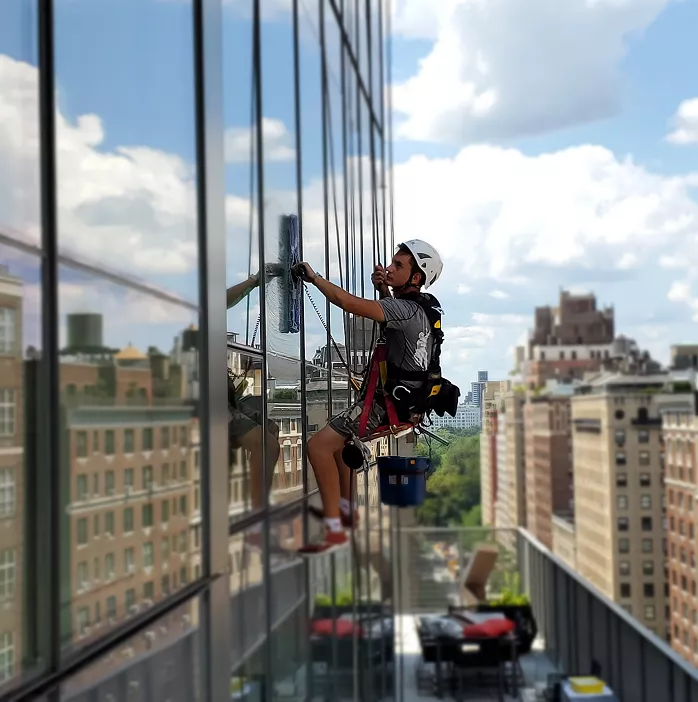
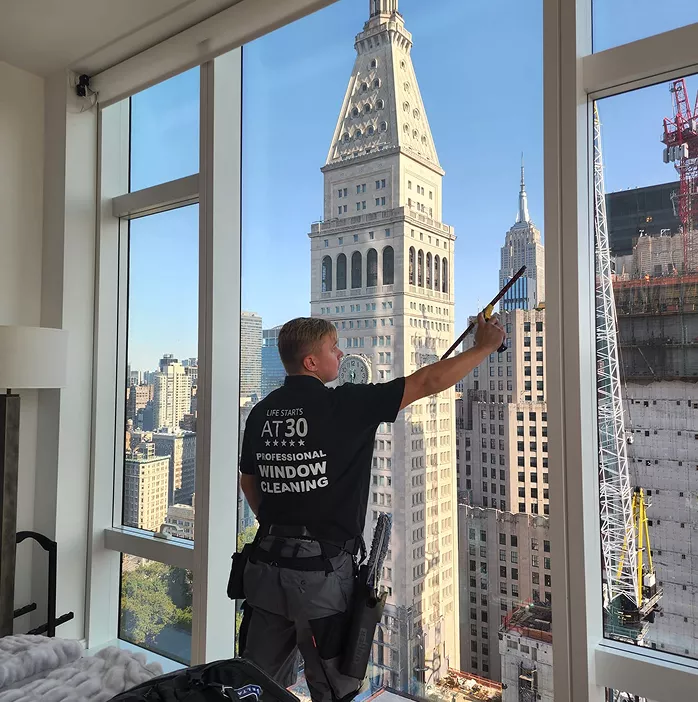
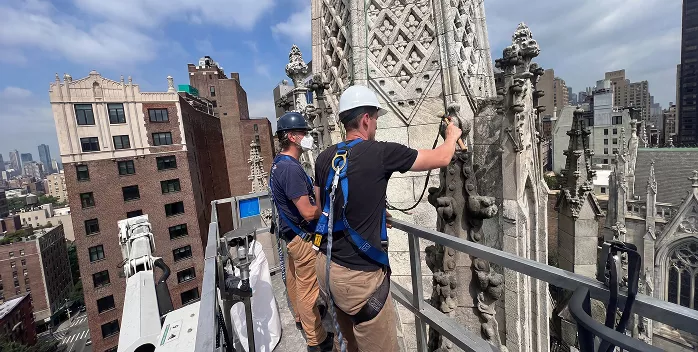
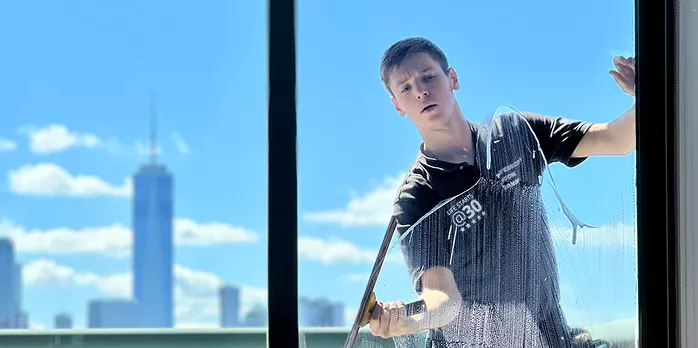
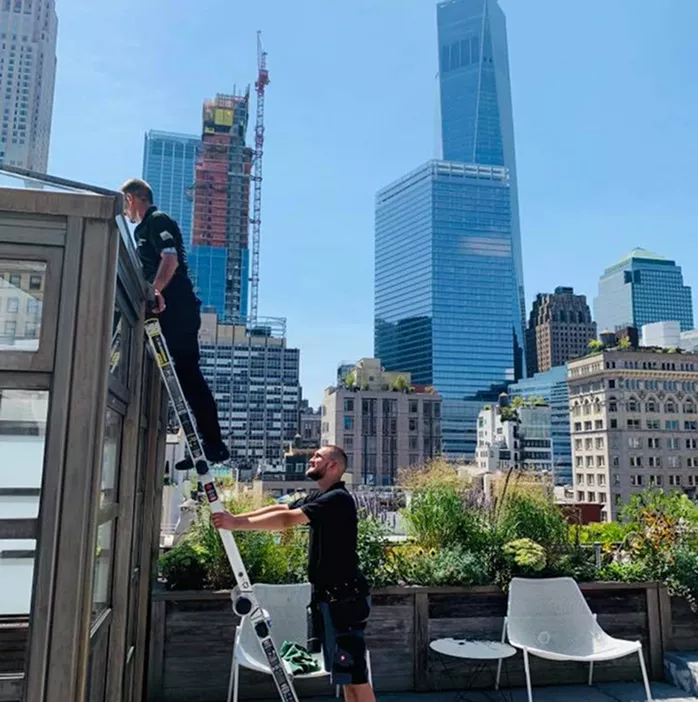
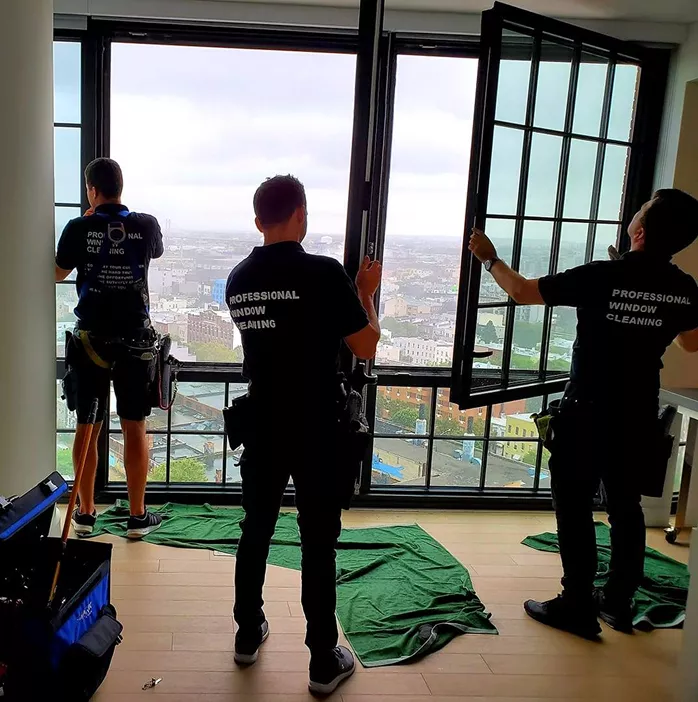
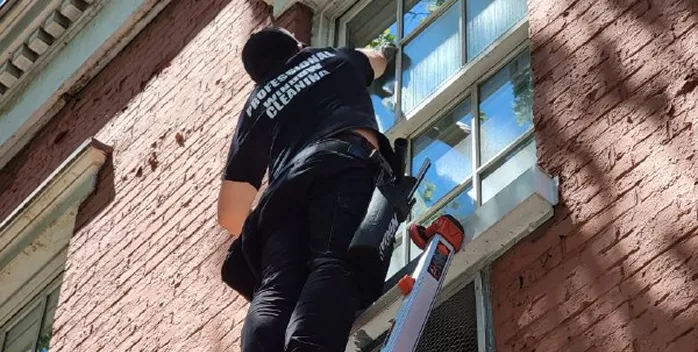
Restore building prestige
See the difference. We cleaned 40 stories of neglected façade and restored the building's architectural presence, without disrupting building operations.

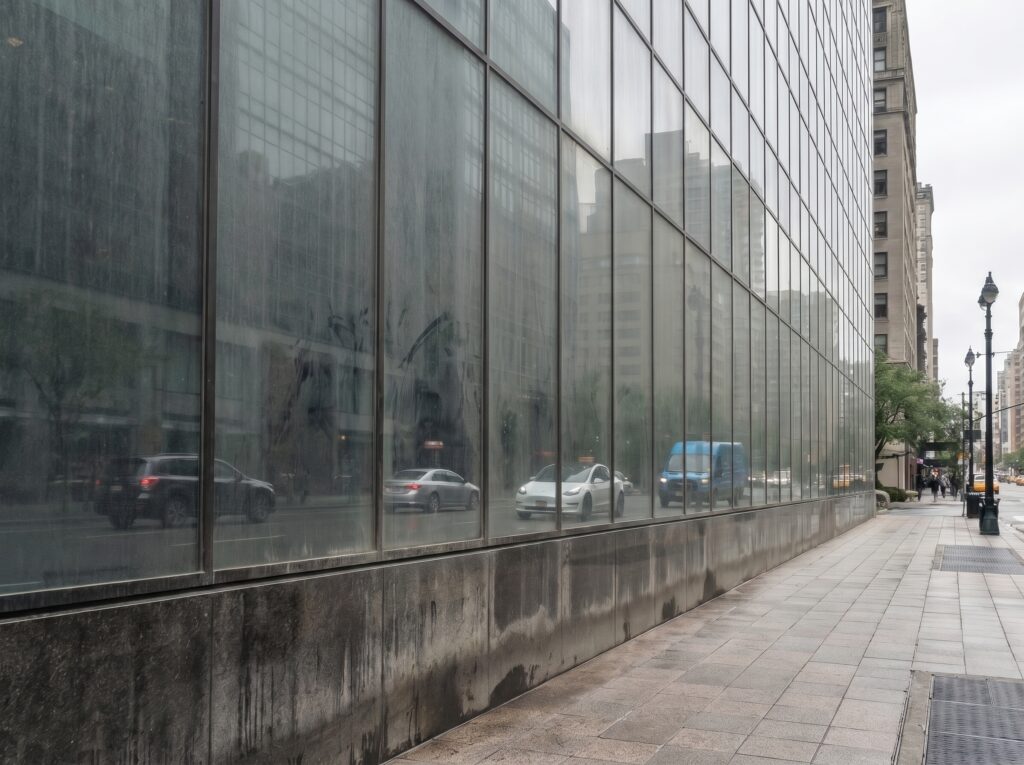 BEFORE
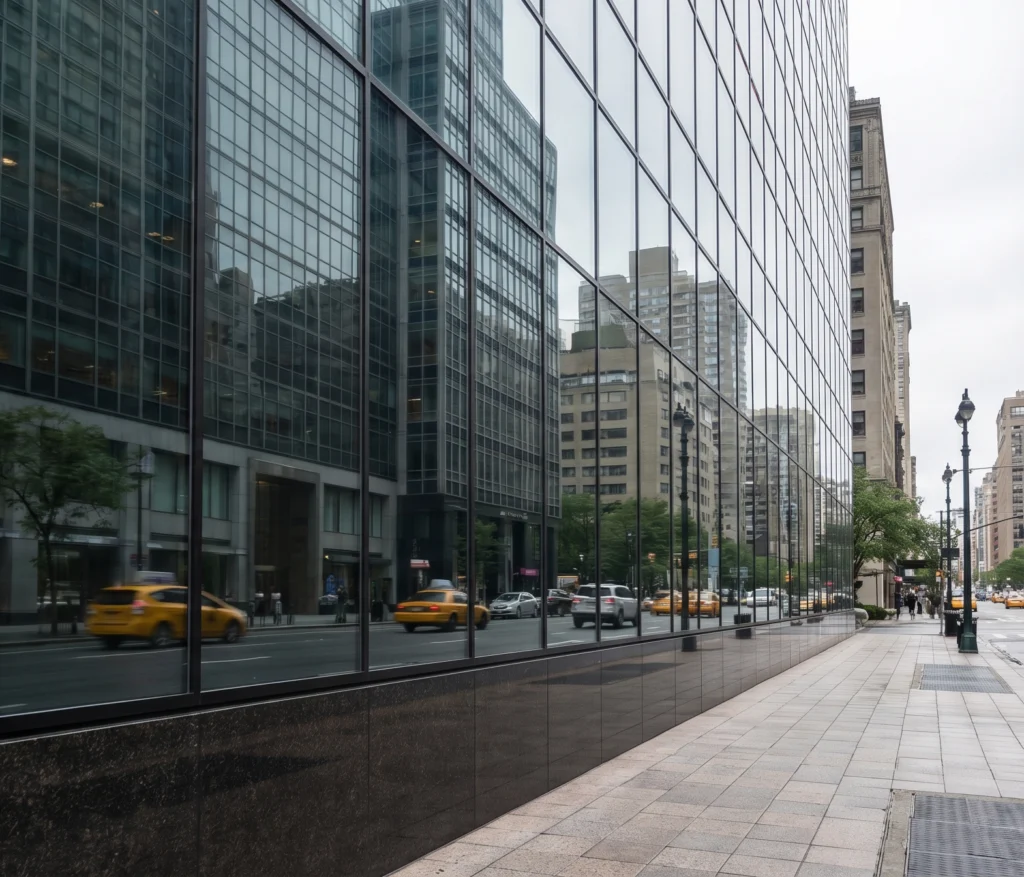 AFTER
AFTER
Engineering specifications & guarantees
Clear specs. Straight answers. Compare our specs against any high-rise window cleaning company in NYC. We don’t cut corners on safety, equipment, or liability coverage.

SPRAT certifications
Level 2 & 3 SPRAT technicians on staff. Our aerial lift operators hold IPAF certification. Our suspended scaffold crews are NYC DOB-licensed riggers. We don’t subcontract access to unqualified vendors.
Equipment standards
Owned Fleet, Not Rentals. We maintain truck-mounted lifts reaching 300 feet, BMU-compatible platforms, and complete rope access kits (CMC Rescue, Petzl Pro). For tall building window cleaning, this means no rental delays, no equipment shortages, and technicians working with gear they know inside and out.
Water purity
Deionized water only. Zero mineral content, so glass dries without spots.

Risk management
$11 Million Umbrella Coverage. Your property is protected by strong liability coverage, including NY Labor Law §240/241 protection with no Action Over exclusions. For commercial high-rise window cleaning, we provide certificates of insurance naming your building and management company as additional insureds.

SCHEDULE A ROOF AND ACCESS SURVEY
200+ NYC buildings on a regular schedule.
While we’re on-site
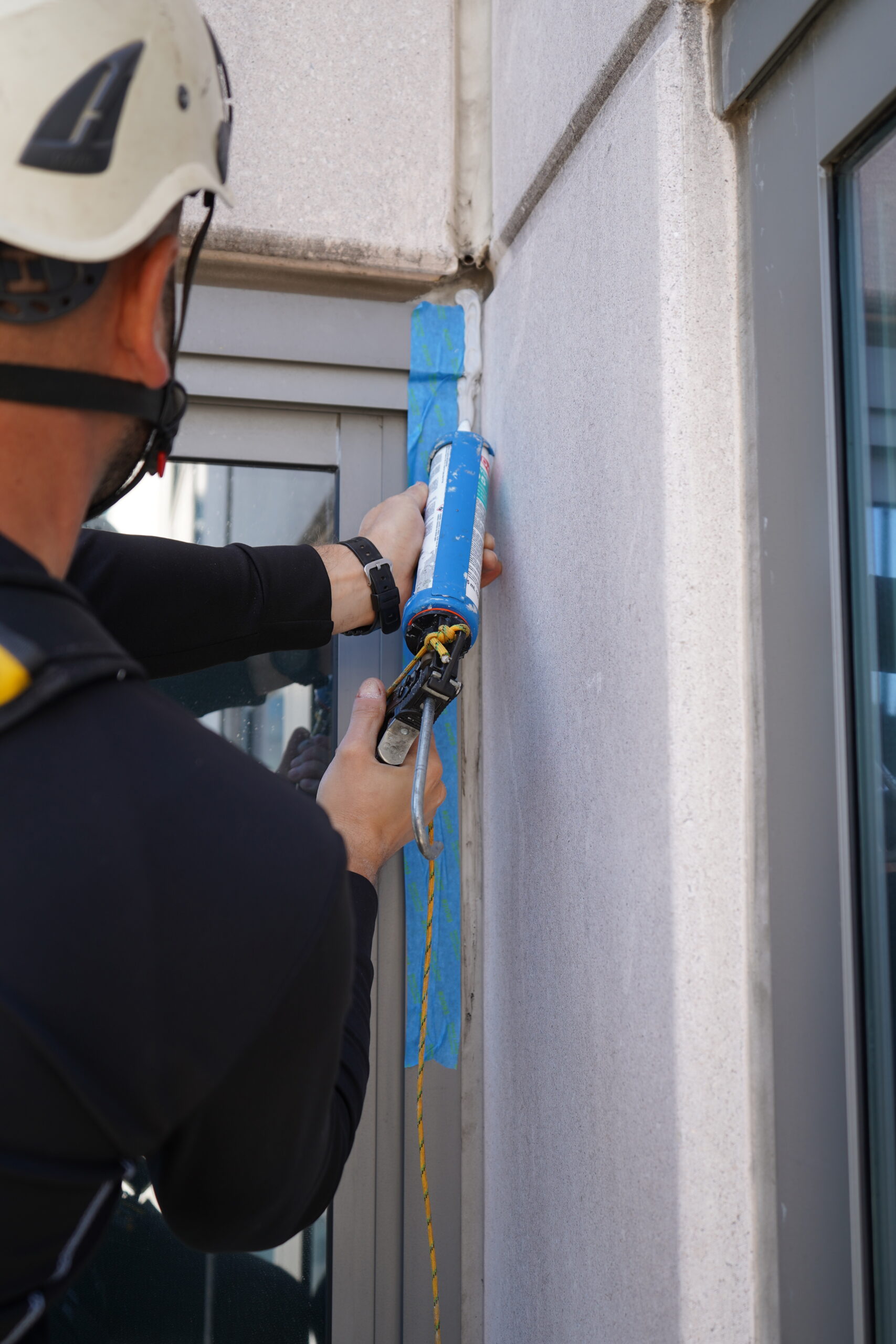
Our technicians are trained to spot façade issues during high-rise window cleaning service.
Useful information
-
How much does it cost to clean windows on a high rise building?
Cost depends on building height, window count, access method, and contamination level – which is why generic online quotes are misleading.
Ballpark commercial pricing (NYC, 2026):
- Mid-rise building (10-20 stories, rope access or lift): $0.75-$1.50 per window
- High-rise tower (20-50 stories, suspended scaffolding): $1.50-$3.00 per window
- Skyscraper (50+ stories, complex access): $2.50-$5.00+ per window
- Emergency/rush service: +50-100% premium
What drives the price: Building height and access complexity dominate the cost. A 40-story tower with rooftop anchor points and straightforward rope access costs far less than a 15-story building with architectural obstructions requiring custom rigging. Window count matters, but mobilization – getting crews and equipment on-site with proper permits and insurance – is the larger fixed cost. That’s why high rise window cleaning is typically bid as a building-wide project, not per-window retail pricing.
Contamination level affects pricing too. Post-construction cleaning with cement overspray and paint removal costs 3-5x more than maintenance washing. Frequency also matters: buildings on quarterly schedules cost less per visit than once-yearly deep cleans because the contamination hasn’t bonded to the glass.
The most accurate approach: request an on-site assessment. We evaluate roof access, identify anchor points, measure window count and sizes, assess contamination, and provide a firm quote – not a phone estimate that changes upon arrival. For commercial high rise window cleaning, this prevents budget surprises and ensures you’re comparing equivalent scopes when evaluating contractors.
-
How do people clean high rise windows - and what methods are safest?
High rise window cleaning uses four primary access methods, each suited to different building types and heights.
Access method Best for Height range Advantages Limitations Rope access (abseiling) Complex facades, irregular buildings Unlimited Fastest setup, reaches difficult areas, cost-effective Weather-dependent, requires roof anchors Aerial lifts (boom/scissor) Mid-rise, accessible perimeter Up to 300 ft Self-contained, no roof access needed Limited reach on tall buildings, street access required Suspended scaffolding (swing stage) Systematic full-building washes 10-100+ stories Covers large areas efficiently, weather-protected option available Slower mobilization, requires roof rigging Water-fed poles Lower sections, accessible areas Up to 70 ft Ground-based (safest), eco-friendly, fast Limited height, can’t detail frames closely Safety hierarchy: The safest method isn’t the one that keeps workers on the ground – it’s the one executed by properly trained, certified technicians with redundant safety systems. Our SPRAT-certified rope access teams use dual anchor points, self-retracting lifelines, and continuous monitoring. Our aerial lift operators hold IPAF certification. Our suspended scaffold crews are NYC DOB-licensed riggers.
The dangerous scenario is hiring window washers on skyscrapers who cut corners – using inadequate anchors, skipping equipment inspections, or working in unsafe wind conditions. In NYC, professional high rise window cleaning requires $11 million liability coverage and full OSHA compliance for a reason: the consequences of failure are catastrophic.
If you’re evaluating contractors, ask about certifications (SPRAT, IPAF, OSHA 30-hour), insurance limits (most carry $1-2M; we carry $11M), and equipment ownership (we own our fleet; many rent and hope it arrives on schedule). These factors matter more than per-window pricing.
-
What is high rise window cleaning - and when does a building need it?
High rise window cleaning is specialized facade maintenance requiring certified technicians, engineered access systems, and compliance with NYC Department of Buildings regulations. It’s not just “window washing at elevation” – it’s a safety-critical operation with specific training, equipment, and insurance requirements.
When buildings need it: Most commercial towers require quarterly or semi-annual cleaning to maintain appearance and prevent permanent glass degradation. NYC’s atmospheric pollution – vehicle exhaust, construction dust, industrial emissions – creates aggressive contamination that etches glass if left unwashed. The timeline depends on exposure: buildings near highways or construction zones need more frequent service than those in residential areas.
Signs you’re overdue:
- Visible film or streaking that tenants complain about
- Reduced natural light penetration (often 30-50% loss in severe cases)
- Hard water staining or mineral deposits that won’t wash off with rain
- Tenant lease renewal resistance citing building appearance
- Property management receiving complaints about “dirty building”
Regulatory requirements: While NYC doesn’t mandate window cleaning high rise buildings frequency (unlike facade inspections under Local Law 11), many commercial leases specify cleanliness standards. Buildings seeking LEED certification or Energy Star ratings need regular cleaning to maintain measured daylighting performance. Insurance carriers sometimes require scheduled maintenance as a condition of coverage for high-value properties.
The cost of waiting: Postponing tall building window cleaning doesn’t save money – it accelerates permanent damage. Acid rain etching, mineral bonding, and seal degradation compound over time. What could be a $5,000 maintenance wash becomes a $50,000 glass restoration project or worse, full window replacement. Schedule-based cleaning is preventative maintenance; emergency cleaning after years of neglect is damage control.
-
How to clean very high up windows - can I do it myself or do I need professionals?
Short answer: anything above second-story height requires professionals.
DIY high rise window cleaning isn’t just inadvisable – it’s illegal in most NYC buildings and violates your property insurance. Here’s why attempting it creates far bigger problems than it solves:
Safety violations: NYC Department of Buildings regulations prohibit building occupants from performing exterior work above 6 feet without fall protection systems, safety training, and insurance. Your homeowner’s or commercial property insurance specifically excludes coverage for injuries sustained during “professional services” performed by non-professionals. If someone gets hurt, you’re personally liable – and a fall from height typically results in catastrophic injury or death.
Equipment inadequacy: Extension poles, ladders, and “reach tools” marketed for high windows are designed for residential homes, not high-rise buildings. They can’t safely reach past 20-30 feet, can’t navigate around facade projections, and can’t access inward-opening or fixed windows. Suspended platforms, rope access systems, and aerial lifts require specialized training, regular inspection, and certification – not just rental and hope.
Damage risk: Amateur cleaning damages windows constantly. Wrong cleaning solutions etch Low-E coatings (permanently). Improper squeegee technique scratches glass. Forcing stuck windows breaks seals and cracks panes. What you “save” on professional skyscraper window cleaning gets spent 10x over fixing damage from DIY attempts.
The professional alternative: Certified high rise window cleaning services include liability insurance, OSHA-trained technicians, engineered access systems, and proper cleaning solutions. The cost is far less than most building owners fear – and infinitely less than emergency room bills, glass replacement, or wrongful death lawsuits.
If your building is taller than you can safely reach from the ground with a standard extension pole (typically 2-3 stories), call professionals. Your insurance carrier, your tenants, and your legal liability all depend on it.
-
How does window washing work on tall buildings - what's the actual process?
Window washing high rise buildings follows a systematic process from planning through execution.
Phase 1 – Site assessment & access planning: Our SPRAT-certified team inspects your building’s roof anchors, BMU systems, and facade obstructions. We identify the optimal access method (rope access, aerial lift, suspended scaffolding) based on height, architecture, and operational constraints. We coordinate with building management for roof access permits, notify tenants of exterior work schedules, and file required DOB paperwork for suspended scaffolding if needed.
Phase 2 – Equipment mobilization & safety setup: On cleaning day, we establish ground-level safety perimeters, deploy access equipment following OSHA protocols, and conduct pre-shift equipment inspections per ANSI Z359 standards. For rope access, this means rigging redundant anchor systems and testing fall protection. For suspended scaffolding, it means certifying hoist systems and confirming load ratings. All work stops if wind speeds exceed safe thresholds (typically 25 mph for rope access, 35 mph for scaffolding).
Phase 3 – Systematic cleaning: Skyscraper window washing proceeds section by section. Technicians apply professional-grade cleaning solution that breaks down carbon deposits and oxidation without damaging Low-E coatings. They scrub frames to remove grime buildup, squeegee glass using overlapping strokes that prevent streaking, and detail edges with towels. For severe contamination, we use purified water systems (reverse osmosis, 0 TDS) that eliminate mineral spotting.
Phase 4 – Inspection & documentation: As technicians work, they inspect weatherseals, note damaged glass or frames, and photograph issues for building management. This catches problems early – before small seal failures become water infiltration disasters. We provide post-service reports documenting completed areas and any concerns flagged.
Timeline: A typical 30-story building with 1,000 windows takes 2-5 days depending on access method and crew size. Rope access is fastest (2-3 days). Suspended scaffolding is slower but more thorough (4-5 days). Buildings are fully operational throughout – we work exterior-only, so tenants aren’t disrupted.
-
What is changing in high-rise window cleaning in 2026?
The biggest shift in 2026 is that machines have finally joined the crews, and the technology behind high-rise window cleaning has changed more in two years than in the previous two decades. New York is the proving ground: the Ozmo system from Skyline Robotics now cleans a 45-story Class A tower at 1133 Avenue of the Americas, near Bryant Park, after clearing approval from the New York State Department of Labor. It mounts robotic arms on a roof-suspended platform and uses Lidar, computer vision and force sensors to judge how much pressure the glass can take. Its makers say it cleans roughly three times faster than a manual crew, and the New York City rollout is the first full-time deployment of an autonomous window-cleaning robot anywhere.
Why now? The trade is aging. Industry data shows about 75% of window cleaners in the United States are over 40, and only 9% are between 20 and 30. Automation fills a labor gap while keeping people off the most dangerous drops.
A few trends worth knowing as a building owner:
Trend What it means in 2026 Where it fits Robotic platforms Roof-rigged robotic arms wash flat curtain wall faster and keep crews off the rope Tall, repetitive glass facades Inspection drones Pre-survey footage maps problem areas before a crew mobilizes Facade audits, hard-to-reach setbacks Pure-water systems Reverse-osmosis, 0 TDS water dries spotless without detergent Mid and lower sections, eco-conscious clients AI facade logs Photos tagged and tracked between visits to flag seal failures early Preventive maintenance programs The honest caveat: robots love flat, uniform glass. Landmark facades, setbacks, terracotta-and-glass mixes and irregular geometry still need certified humans on rope and stage. The future is humans and machines on the same building, not one replacing the other.
A clean glass tower is a quiet flex. In a city where everyone is selling the view, a streak says more about a landlord than any brochure ever could.
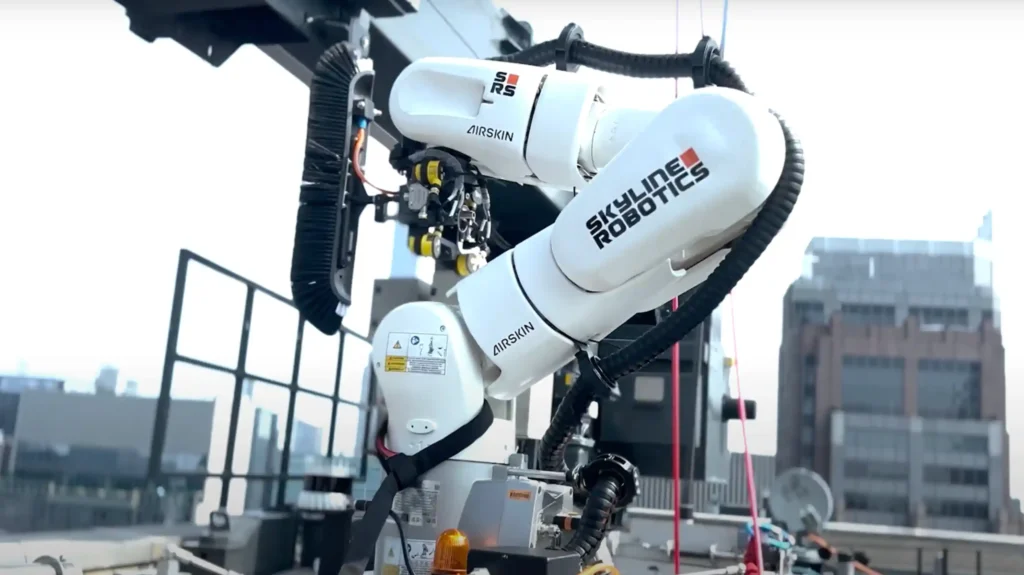
The Ozmo system by Skyline Robotics at work above Manhattan. Robotic platforms are one of the biggest shifts in high-rise window cleaning in 2026. Photo: Skyline Robotics.
-
When is the best time of year to clean a glass skyscraper facade in New York?
Glass can be cleaned in any season, but two windows of the year give the cleanest, longest-lasting result: spring and fall. The reason is temperature. Most professionals agree the sweet spot for streak-free work is roughly 50 to 75 F (10 to 24 C). In that band the cleaning solution evaporates at the right pace – fast enough to dry clear, slow enough not to flash off and leave streaks.
For a New York tower, the calendar has a logic of its own:
Season Condition Smart move Spring Winter road salt, soot and freeze-thaw grime sit baked on the glass Schedule the deep, full-building wash here – it resets the facade for the year Summer Heat dries solution too fast; smog films the glass Work early morning or late afternoon; book a light maintenance pass Fall Mild, dry, low sun Clean before the freeze to strip contaminants that etch over winter Winter Freezing temps, short daylight, wind limits Spot service with freeze-resistant solution; pause above safe wind speed New York adds its own twist. Winter sidewalk and road salt kicks up onto lower floors, the freeze-thaw cycle drives moisture and minerals into micro-scratches, and spring pollen can recoat a fresh facade within days. That is why the strongest programs book the main high-rise window cleaning as a spring deep clean, add a fall protective wash, then handle the rest on a quarterly cadence.
Window cleaners are the only New Yorkers who genuinely root for a boring forecast. No wind, no glare, no surprise downpour - that is our perfect day.
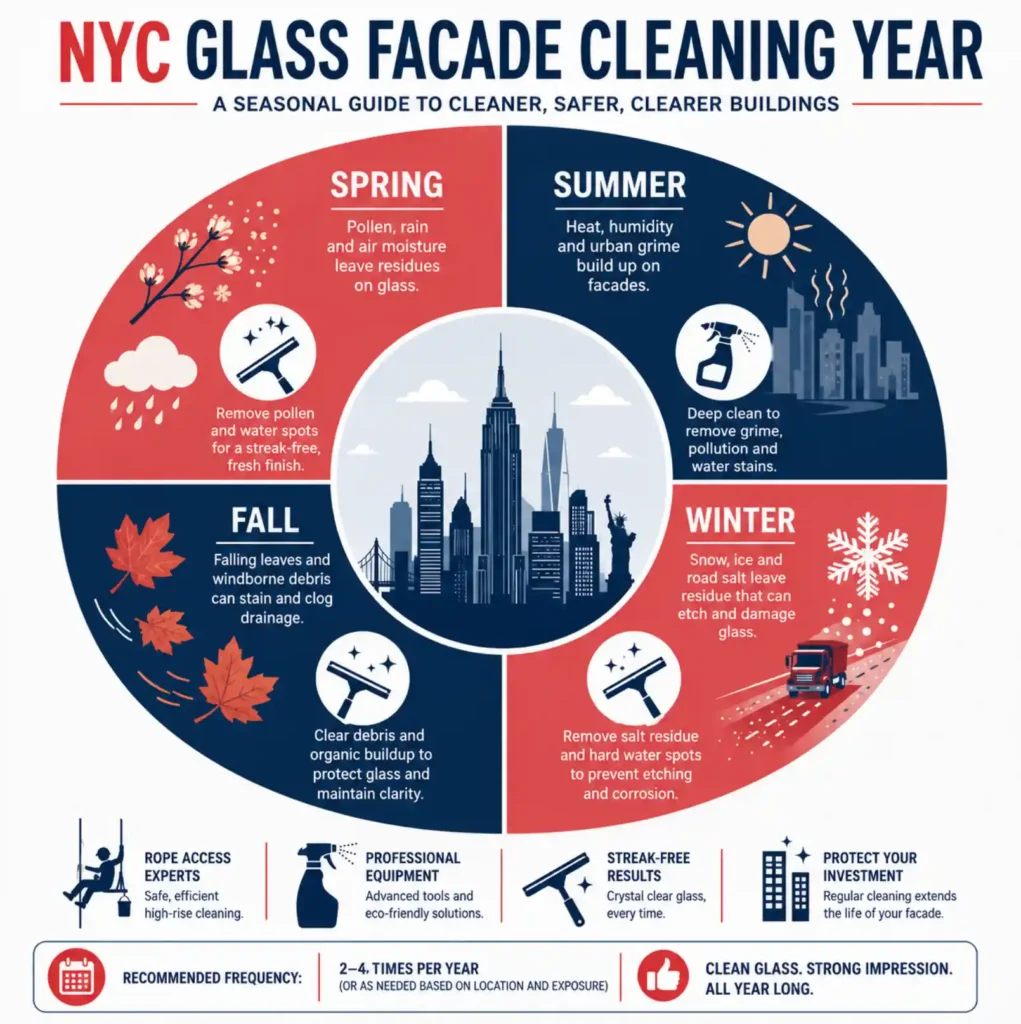
Clean glass, strong impression, all year long. What each New York season does to a glass facade – and the smart move for it.
-
Which New York skyscrapers have the most demanding glass?
People ask which towers are the hardest to keep clear. Below is a curated look at the New York buildings that define the skyline and the glass challenge each one presents. Some are the kind of facade our crews are built for; others we would be proud to take on.
Tower Address What it is The glass challenge One World Trade Center 285 Fulton St, Manhattan Tallest in the Western Hemisphere (1,776 ft) Faceted, tapering curtain wall that catches light on every face; extreme height and security One Vanderbilt One Vanderbilt Ave, Midtown 1,401 ft tower beside Grand Central Angled setbacks and a terracotta-and-glass skin over a busy transit hub 30 Hudson Yards 30 Hudson Yards, Manhattan Home of “The Edge” sky deck Cantilevered, sloped glass that overhangs the street below 432 Park Avenue 432 Park Ave, Billionaires’ Row Slender 1,396 ft residential tower Exposed concrete grid of oversized square windows; brutal wind at altitude 111 West 57th St 111 West 57th St, Midtown One of the world’s slenderest towers Feathered terracotta-and-glass setbacks on a razor-thin profile Central Park Tower 217 West 57th St, Midtown Among the tallest residential towers Sheer height and a fully reflective curtain wall Hearst Tower 300 West 57th St, Midtown Diagrid tower on a 1928 landmark base Triangular diagrid frame above a protected Art Deco podium Bank of America Tower One Bryant Park, Midtown One of the greenest skyscrapers Vast floor-to-ceiling insulating glass with delicate Low-E coatings Seagram Building 375 Park Ave, Midtown Mies van der Rohe landmark, 1958 Historic bronze mullions and amber glass that need patina-safe care Lever House 390 Park Ave, Midtown Pioneering 1952 curtain-wall landmark One of the city’s first glass curtain walls; landmark sensitivity The Spiral 66 Hudson Blvd, Hudson Yards Tower wrapped in planted terraces Setback gardens that interrupt the glass plane on every floor The Brooklyn Tower 9 DeKalb Ave, Brooklyn Tallest tower in Brooklyn Hexagonal floor plate and a dark facade that shows every streak Each of these reads as a different job: a faceted supertall is not a slim grid tower, and a landmark bronze curtain wall is nothing like a modern Low-E glass box. Matching the access method and the cleaning chemistry to the architecture is the whole craft.
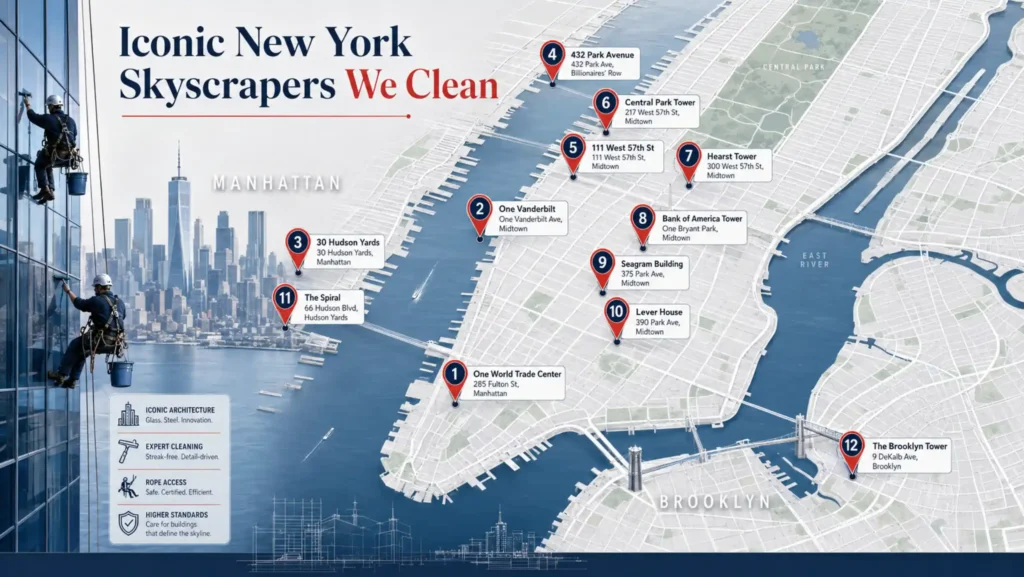
Twelve of the towers that define the New York skyline – and the glass challenge each one presents.
-
Which New York neighborhoods have the most high-rises - and do you work in all of them?
New York has more than 6,400 high-rise buildings, and the overwhelming majority sit in Manhattan. The reason is literally underfoot: Midtown and Lower Manhattan rest on shallow, solid bedrock that can carry the foundations of a supertall, which is why the skyline clusters where it does. That concentration is exactly why high-rise window cleaning in New York is a citywide discipline rather than a single-neighborhood trade.
Three Manhattan clusters hold most of the towers:
- Midtown – the single largest concentration of skyscrapers in the city and the largest business district in the United States. It splits into Midtown East around Grand Central (One Vanderbilt, the new JPMorgan headquarters, Seagram, Lever House), Billionaires’ Row along 57th Street (432 Park, 111 West 57th, Central Park Tower, One57), and the Times Square core.
- Lower Manhattan / Financial District – the original high-rise district, anchored by One World Trade Center and the towers around Wall Street.
- Hudson Yards / Far West Side – the newest cluster, a whole neighborhood of glass towers raised over the West Side rail yard, including 30 and 10 Hudson Yards and The Spiral.
The skyline is no longer Manhattan-only. The outer boroughs are rising fast, and that is where a lot of the next decade’s glass will be:
Cluster Borough What is there Midtown & Lower Manhattan Manhattan The densest skyscraper core in the country Downtown Brooklyn Brooklyn The Brooklyn Tower, the borough’s first supertall, plus The Hub Long Island City Queens Skyline Tower, the tallest building in New York outside Manhattan Mott Haven Bronx A growing wave of waterfront high-rises North Shore Staten Island Emerging mid- and high-rise development Nassau & Suffolk corridors Long Island Office and mixed-use towers beyond the city line Wherever the glass goes up, it has to be kept clear, and that is the case for hiring a citywide operator rather than a one-borough crew. Big Apple Window Cleaning runs high-rise window cleaning across all five boroughs and Long Island, so a portfolio spread across Midtown, Downtown Brooklyn and Long Island City can sit under one contract and one standard.
Every new tower is a fresh set of windows that will never wash themselves. New York keeps building up - we keep it clear.
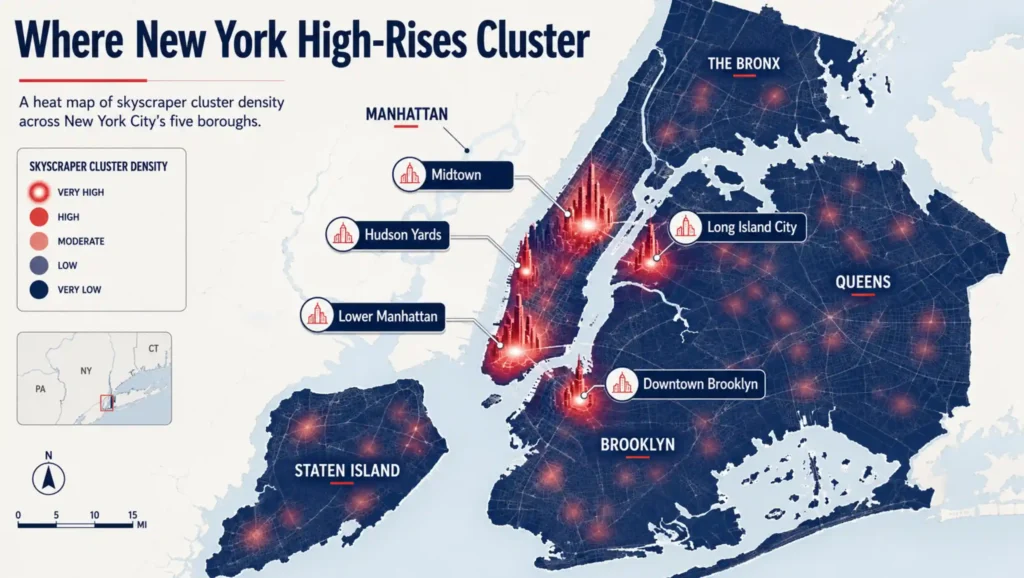
Where New York’s high-rises cluster – from the Midtown and Lower Manhattan core to the rising skylines of Hudson Yards, Long Island City and Downtown Brooklyn.
-
How does Local Law 11 (FISP) affect high-rise window cleaning in New York?
Local Law 11, now run as the Facade Inspection Safety Program (FISP), requires buildings taller than six stories to have their exterior walls inspected on a recurring five-year cycle by a qualified professional. It is a safety law about falling masonry and facade integrity, not a cleaning law – but the two overlap more than most owners expect.
Here is the connection. The same rope-access and suspended-scaffold crews that clean your glass are already moving across every inch of the facade, at arm’s length, on a schedule. A trained technician washing a window is also the closest set of eyes you will ever get on your cracked sealant, spalling stone, corroded anchors and failing gaskets. Smart buildings treat the wash as a free first-pass inspection and feed what the crew sees into their FISP file before the formal cycle comes due.
Two practical points for New York property managers:
- Suspended scaffold and rope work to clean a tall facade requires the same DOB paperwork (including CD5 permits) and the same anchor and davit certifications that facade work demands. Coordinating cleaning with your FISP timeline saves you from rigging the building twice.
- A documented cleaning program creates a paper trail of facade condition over time, which is exactly the kind of evidence that makes a FISP filing smoother and a surprise “unsafe” designation less likely.
You still need a licensed inspector for the official FISP report. But pairing window cleaning with facade awareness turns a cost center into early-warning maintenance.
-
Why do New York high-rise windows get dirty so fast?
A glass tower is, in effect, a vertical air filter. It stands in the path of everything the city throws upward, and in a dense, traffic-heavy environment that adds up fast. The grime on a Manhattan facade is rarely just dust – it is a layered cocktail.
What actually lands on the glass:
- Traffic carbon. Exhaust soot from the streets below rises and clings, especially on lower and mid floors near busy avenues.
- Construction dust. With the skyline always under construction, fine cement and silica dust travels and settles on nearby facades.
- Air-conditioning condensate. Window and through-wall units drip mineral-laden water that streaks the glass beneath them.
- Rooftop water tank overflow. New York tap water is actually soft, so the mineral spots you see usually come from external sources – tank overflow, facade runoff and condensate – not the city supply.
- Road salt. In winter, salt spray from streets and sidewalks travels up onto lower floors and dries into a haze.
- Freeze-thaw cycles. Moisture works into micro-scratches, freezes, expands and drives contaminants deeper into the surface.
Left alone, this is not just ugly. Acid etching and mineral bonding move from “wash it off” to “resurface or replace” surprisingly quickly, and replacement glass runs many times the cost of routine care. The buildings that stay clearest are the ones whose high-rise window cleaning schedule matches their exposure – a tower over the FDR or beside an active construction site simply needs more frequent attention than a quiet side-street address.
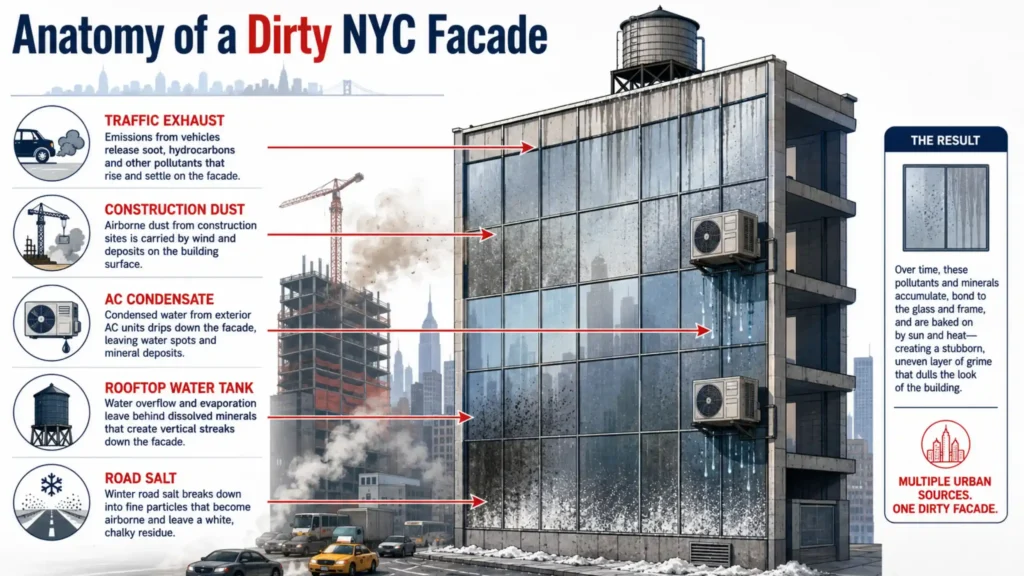
Multiple urban sources, one dirty facade. What actually lands on a New York glass tower between cleanings.
-
Rope access, swing stage, boom lift or water-fed pole - which method fits my building?
There is no single best method, only the right method for a given building’s height, facade and street access. A 12-story pre-war co-op with stone setbacks and no roof anchors is a completely different problem from a 50-story modern curtain wall. Here is how the four main approaches compare for New York work.
Method Best for Reach Why it wins Watch-outs Rope access Complex, irregular or landmark facades Effectively unlimited Fast to set up, reaches awkward geometry, light footprint at street level Needs certified roof anchors; pauses in high wind Suspended scaffold (swing stage) Systematic full-building washes 10 to 100+ stories Covers large flat faces efficiently, can be weather-shielded Slower to mobilize; needs roof rigging and permits Boom / aerial lift Mid-rise with open street access Up to ~300 ft Self-contained, no roof access needed Needs curb space and a clear perimeter – tight on many blocks Water-fed pole Lower floors and accessible sections Up to ~70 ft Ground-based and safest, pure water, eco-friendly Limited height; cannot detail frames closely In practice high-rise window cleaning on a single New York tower often uses two or three of these methods on the same job – poles for the podium, a swing stage for the flat tower faces, and rope access for the setbacks and ornament a stage cannot reach. The decision starts with a roof and street survey, not a price sheet. That is why a credible quote follows a site visit, never a phone guess.
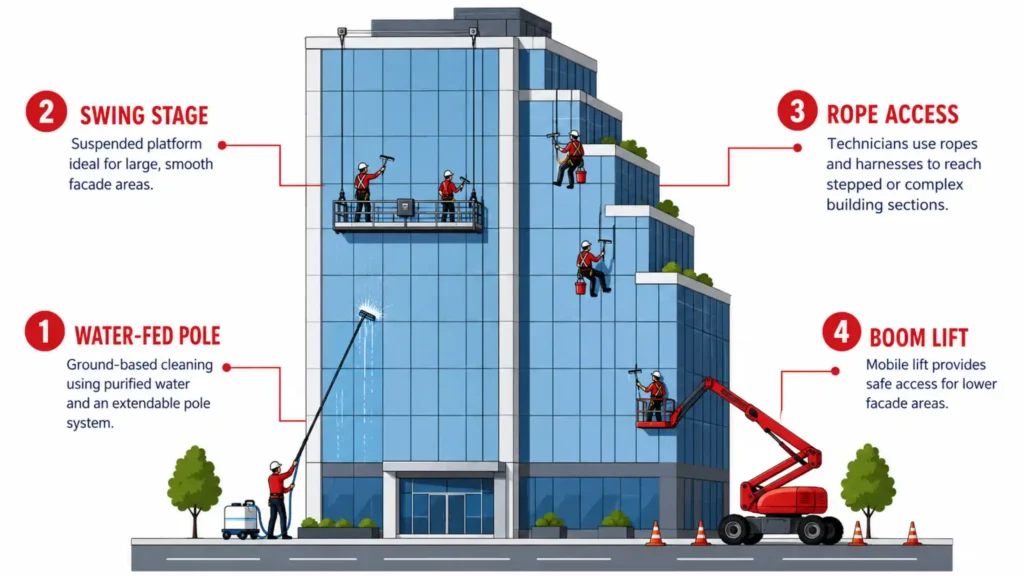
Four ways to reach a glass facade – water-fed pole, swing stage, rope access and boom lift. The right method depends on the building’s height, shape and street access.
-
What should a New York property manager check before hiring a high-rise window cleaning company?
The gap between a reputable contractor and a risky one is not the price per window – it is what stands behind the crew when something goes wrong hundreds of feet up. Before you sign, run this checklist.
- Certifications. Look for SPRAT (rope access), IPAF (aerial lifts) and current OSHA training. These are not nice-to-haves on a facade; they are the difference between a controlled drop and a tragedy.
- Insurance limits. Many crews carry $1 to $2 million. For a tall New York facade that is thin. Confirm umbrella coverage and ask for a certificate of insurance that names your building and management company as additional insureds.
- NY Labor Law 240/241. New York’s Scaffold Law puts heavy liability on owners for elevation-related injuries. Make sure the policy includes 240/241 protection with no Action Over exclusions, or that liability can land on you.
- DOB compliance. Suspended scaffold work needs the right Department of Buildings paperwork, including CD5 permits, plus valid anchor and davit certifications. A contractor who manages this for you is worth more than one who leaves you to chase it.
- Owned equipment. Crews that own their fleet are not waiting on a rental that may not show up on schedule.
If a quote is dramatically lower than the rest, that is usually the sound of one of these line items being skipped.
Two guys, a bucket and a ladder is a great price right up until it is the most expensive decision a building ever made. On a high-rise, cheap and uninsured is not a saving, it is a deferred invoice.
For owners and managers who want all of this handled under one roof – certified crews, owned equipment, $11M coverage and the permit paperwork – that is exactly the standard Big Apple Window Cleaning is built around.
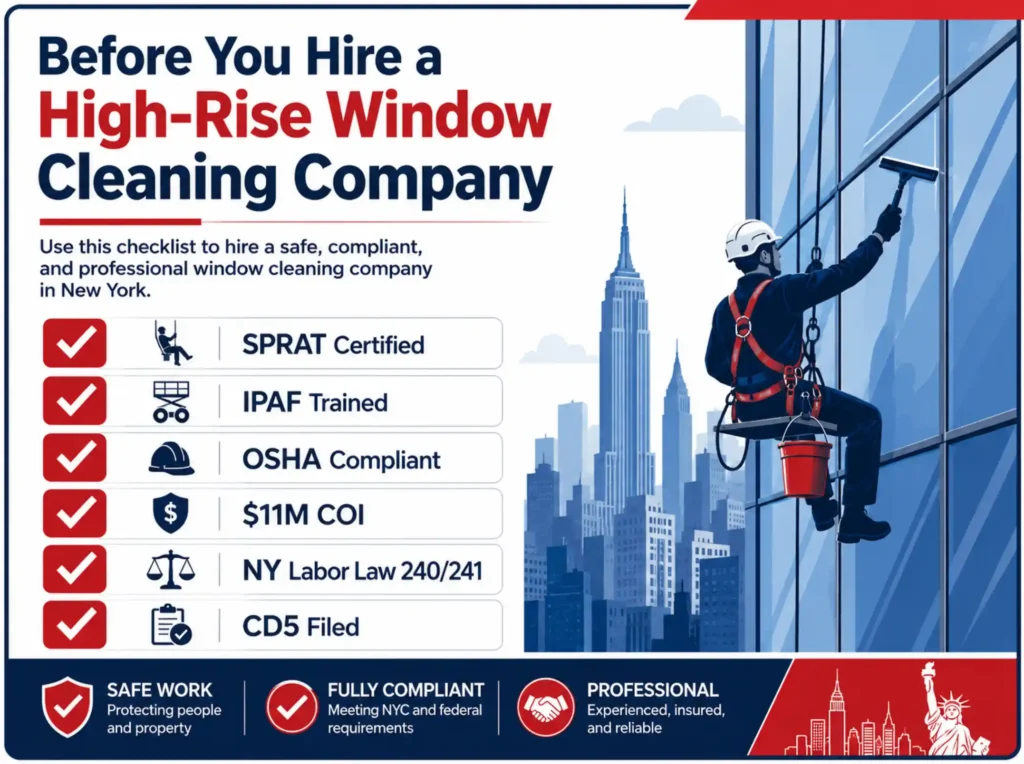
Before you sign: the six things every New York building owner should confirm before hiring a high-rise window cleaning company.
