
Your Building Replaced the Windows and Left You With No Screens: Whose Bill Is It, and How to Get Custom Screens (NYC)
By bigapplewindows
Contents
- You are not crazy, and you are not stuck: the "screen orphan" problem explained
- If that is you, this page answers the three questions you actually have, in order:
- No legal lecture, no fluff. Let us go.
- Whose bill is it? What actually governs who pays in a co-op or condo
- So instead of guessing, do this:
- If you rent: what your lease probably says about screens
- How a custom screen actually gets made for a casement or crank-out window
- Brand traps: Andersen splines and Pella Rolscreens that leave you stranded
- Rescreen or replace? A quick decision guide
- How to measure without eating the cost of a wrong order
- Getting the tech legally into your building: the COI most people forget
- What custom screens cost in NYC (and why aggregator prices mislead)
- Here is what published national cost guides report for professional screen work:
- Your next three steps
DO YOU HAVE AN URGENT NEED?
Our fast response service can fix your urgent problem. We have teams ready for action.
AND GET A FREE QUOTE
Get monthly window insight
You are not crazy, and you are not stuck: the “screen orphan” problem explained
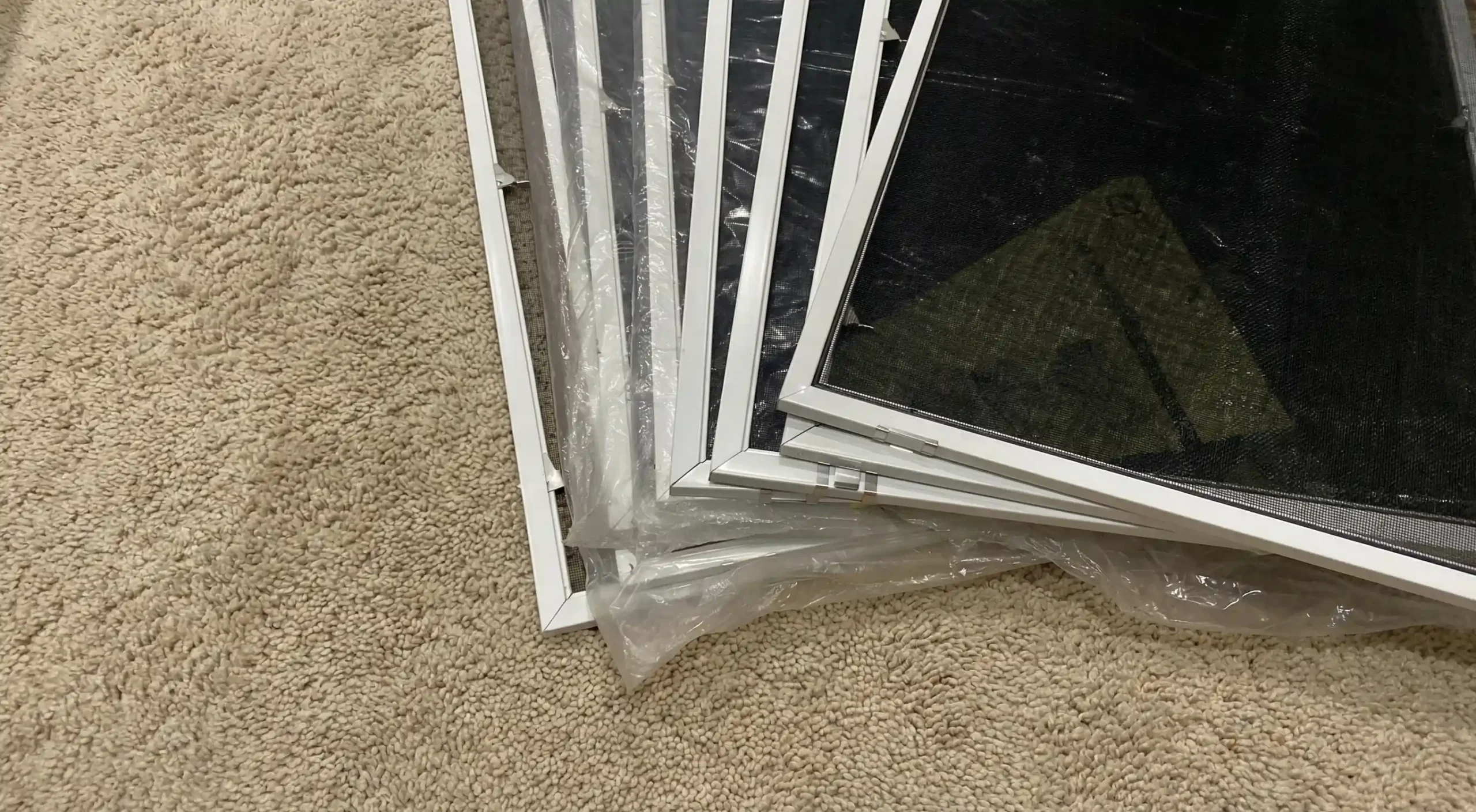
It usually happens like this. Your building runs a window replacement project, the crew swaps your old slide-up windows for shiny new casement or crank-out windows, and then they leave. No screens. No paperwork. No phone number for where to buy screens that fit. You open the window for air and now it is bugs, or a bird, or a nervous moment with a cat on the sill.
This is common enough that it made the local news. CBS reported on a Harlem high-rise where management replaced the old slide-up windows with casement windows and, as residents described it, did not provide new screens or information on how to buy them custom built. People were left with open windows and no way to close off the gap.
If that is you, this page answers the three questions you actually have, in order:
- Whose bill is this, really?
- How does anyone make a screen for a weird crank window behind the operator?
- How do I get a person into a doorman or managed building to measure and install?
No legal lecture, no fluff. Let us go.
First question: is a screen even possible for these windows? (Yes)
The most common belief we hear is that casement and crank-out windows simply cannot be screened. That is not true. What is true is that they cannot be screened with anything you grab off a hardware-store shelf.
Here is the mechanical reason. On a casement window, the sash swings out (or in) on a hinge, and a crank operator drives it. So the screen has to sit on the interior side, inside the window frame, and it has to clear the crank handle and the operator arm. That is why a standard rectangular screen “won’t fit”: it is not made to mount inside behind the hardware. A screen built for a casement is a different animal: it is a custom-sized frame with the mesh tensioned to fit that specific opening, designed to sit behind the crank without fouling it.
Awning windows (hinged at the top, crank out at the bottom) and inward-opening casements have the same logic. The screen goes on the room side, sized to the opening, cleared for the hardware. It exists. It just has to be measured and built for your window rather than pulled from a bin.
So the panic of “there is no screen for this window” is really the discovery that you need a custom screen, not a stock one. That is a solvable problem, and the rest of this page is how to solve it.
Whose bill is it? What actually governs who pays in a co-op or condo
This is the part everyone gets wrong, in both directions. Some people assume the building must pay because the building removed the screens. Others assume they are on their own because it is “inside my apartment.” Neither assumption is a rule.
The honest answer: in a New York co-op, responsibility for windows and screens is governed by your proprietary lease, and often an alteration agreement or the building’s house rules on top of it. There is no single citywide default that decides it for you. Two buildings on the same block can split this differently.
No screens, a torn screen, or a casement you cannot screen?
Answer 3 questions. Get a plain-English read on who likely pays, the right fix, and how to get an insured tech into your building. Not legal advice.
This tool is general guidance, not legal advice. In a co-op or condo, your proprietary lease, declaration, bylaws, and any alteration agreement control who pays. Read the document or ask your board or managing agent in writing.
So instead of guessing, do this:
- Read your proprietary lease (co-op) or the bylaws and declaration (condo). Look specifically for the words “windows” and “screens,” and for the line that divides what the corporation maintains from what the shareholder maintains. Industry guidance from co-op and condo publications is consistent that this responsibility is lease-specific, not universal.
- Ask the managing agent or board in writing who is responsible for screens after the building’s own window replacement project. Ask them to point you to the clause. Getting it in writing matters, because if the building performs a repair that the shareholder is actually responsible for, the co-op is generally entitled to bill the shareholder back. You want to know which side of that line you are on before anyone starts work.
- If your building is landmarked or in a historic district, check whether exterior-visible changes need Landmarks Preservation Commission review. Interior-mounted screens are usually the low-risk case here, but confirm rather than assume.
We are not your lawyer, and this is not legal advice. It is the practical path: the document decides, so find the document. If the building replaced the windows as a building-wide capital project and left screens out of scope, the “who pays for the screens” question is a board conversation, and the answer lives in your lease.
One more practical note: even when you end up paying for your own screens, the building still controls access and approval. That is a separate lever, and it is where a lot of these projects stall. More on that below.
If you rent: what your lease probably says about screens
If you are a tenant, check your lease language before you assume the landlord owes you screens. Many NYC leases contain a clause along the lines of “landlord is not obligated to provide screens,” often followed by “screens provided upon request at the expense of the tenant.” In plain terms: you may be allowed to have screens, but you may be the one paying for them, and you may need permission to install anything that modifies the window.
If you cannot drill or permanently modify the window, you have two realistic routes: a no-damage custom screen sized to your opening that mounts with tension or removable brackets, or a temporary adjustable kit as a stopgap. A custom screen is the durable fix; the kit is the “I need something tonight” bridge.
How a custom screen actually gets made for a casement or crank-out window
Here is the process, demystified, so you know what you are buying.
- Measure the opening, not the old screen. For a casement, the screen fits inside the window frame behind the crank, so the measurement is the interior opening dimensions plus a read on how much clearance the operator arm and handle need. This is why a photo of your window with the crank open is worth as much as the numbers.
- Identify the frame system, if it has one. Some windows have a channel or clips the screen is meant to seat into. If your window is a known brand (Andersen, Pella, and others), the model line changes how the screen mounts. If the brand is unknown or the window is old, the screen gets built to the opening rather than to a catalog part.
- Build the frame to size. A custom shop cuts the frame stock to your dimensions, corners it, and tensions the mesh (fiberglass for general use, aluminum or heavier mesh where you want more durability or pet resistance).
- Fit and adjust on site. The screen is seated, checked against the crank throw, and adjusted so it holds without blocking the operator.
The reason “just order one online” so often fails on casements is steps 1 and 4. A mail-order panel cannot see your crank, and it cannot come back to adjust the fit. That is the gap a local custom job fills.
Brand traps: Andersen splines and Pella Rolscreens that leave you stranded
Two brands generate most of the “I am stuck” messages, for two different reasons.
Andersen. Older Andersen insect screens use a metal spline that holds the screen in place, and it has a built-in springiness. DIYers report the same thing over and over: the spline bends when you pull it, and once it is out, it does not want to go back. Andersen’s own guidance is that once the aluminum insect screen spline is removed it cannot be re-inserted, and they do not recommend rescreening those. So people ask the reasonable question: do I have to buy a whole new screen just to fix the mesh? Often, on those older units, yes. Some original Andersen screens also came with proprietary clips or hardware that is not easy to source, which is another reason a custom-built replacement can be simpler than hunting a discontinued part. If you want to order a true Andersen match, you will need the series and size (their codes look like CN, CW, CX, and so on), and getting that wrong is an expensive reorder.
Pella. The classic Pella pain is the roll-up Rolscreen on older casements. When it shreds or stops retracting, owners discover that Pella no longer makes replacements for many of the older roll screens. So you are stuck between a manufacturer part that no longer exists and a custom screen. In practice the custom fixed screen is frequently the way out.
The theme across both brands: the manufacturer path is a dead end for a lot of older windows, and a custom-built screen sized to your opening sidesteps the discontinued-part problem entirely.
Rescreen or replace? A quick decision guide
Not every screen problem is a new-screen problem. Use this to sort it:
- Rescreen (just new mesh) if: the frame is straight and sits flat, the corners are tight, and the issue is a sag, a small tear, or worn spline. Most loose or sagging screens are a spline problem, not a frame failure.
- Replace the whole screen if: the frame twists when you remove it, will not sit flat, keeps popping out, has a large hole or a long rip, or is an older Andersen unit where the spline cannot be reused. Screens with large holes or rips are better replaced than patched.
- Go custom if: the window is a casement, awning, or inward-opening unit, the brand is unknown or discontinued, or the opening is an odd size. This is the “there was never a stock screen for this” case.
A small tension tear on a straight aluminum frame can genuinely be a ten-minute DIY rescreen. A casement with no screen at all, in a managed building, is not that job, and pretending it is will cost you a wasted afternoon and possibly a wrong-sized order.
How to measure without eating the cost of a wrong order
The rule the DIY forums repeat is “measure twice, order once,” and it exists because casement and behind-the-crank measurements are unforgiving. If you are gathering numbers before you call anyone:
- Measure the interior opening width and height, in three places each (top, middle, bottom for width; left, center, right for height), and use the smallest of each.
- Note the crank and operator clearance: how far the handle sticks in, and how the arm travels.
- Photograph the window open and closed, with a tape measure in frame for scale.
- If there is any brand marking on the sash or hardware, photograph that too.
If a pro is doing the measuring, this is exactly the risk they take off your plate, because a field measure means the fit is their responsibility, not yours.
Getting the tech legally into your building: the COI most people forget
Here is the step that quietly kills these projects. You solved the screen. You solved who pays. Then the front desk asks the vendor for a certificate of insurance naming the building as additional insured, and the small screen shop cannot produce one, or cannot produce one that satisfies a Manhattan managing agent. Now nobody is getting in.
For a co-op or condo, access is a paperwork question as much as a screen question. A doorman or managed building will typically require, before anyone touches a window:
- A certificate of insurance (COI) that names the building (and often the managing agent) as additional insured.
- Coverage limits and language the managing agent will actually accept.
- Sometimes a signed vendor agreement or a scheduled access window.
This is where a vendor built for NYC buildings matters more than a general handyman. Big Apple Window Cleaning works inside managed buildings as its core business and can provide a COI naming the building as additional insured within 24 to 48 hours. Its coverage totals 11 million dollars (a 10 million umbrella on top of 1 million general liability, plus 1 million workers comp and 1 million auto), with zero height limitations and no Action Over exclusions, and its crews are OSHA and SPRAT rope-access trained. For a board or managing agent, that is the difference between “approved, schedule it” and “your vendor’s paperwork is short, we cannot let them up.”
If you want to understand exactly what your board should be checking on any vendor’s certificate before they approve access, we wrote a full checklist for that, linked below. It is the single most useful thing you can hand your managing agent to speed up approval.
What custom screens cost in NYC (and why aggregator prices mislead)
If you have searched for a price, you have probably seen national aggregator numbers like “screens from $25.” Those are for stock, off-the-shelf rectangular panels, and they are misleading for exactly the situation you are in. A custom screen for a casement, sized and fitted behind the crank, in a Manhattan building that requires insured access, is a different product.
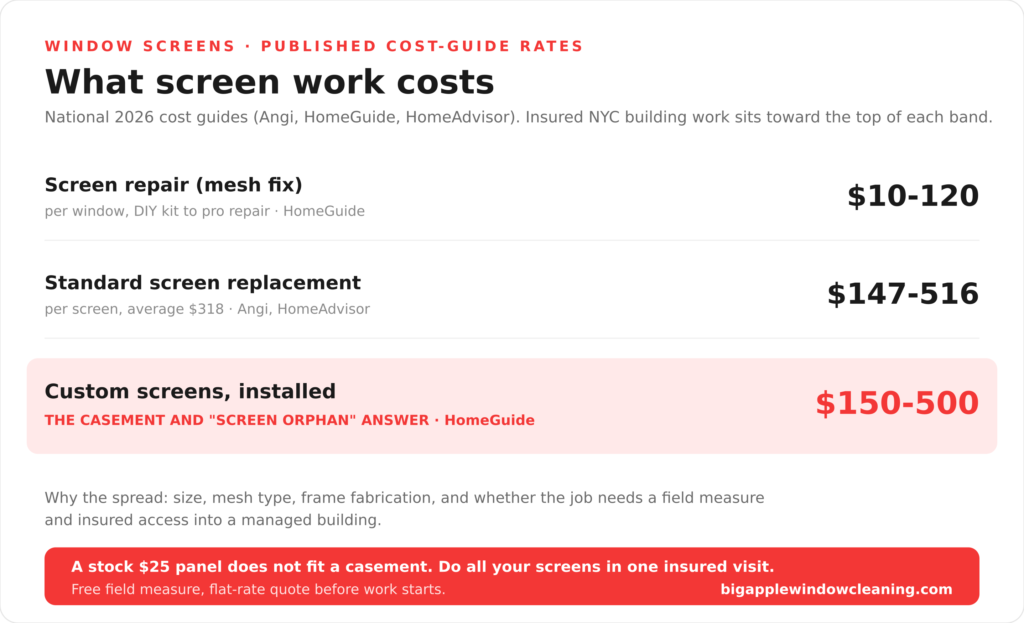
Here is what published national cost guides report for professional screen work:
– Screen repair (new mesh in an existing frame): $10 to $120 per window (HomeGuide)
– Standard screen replacement: $147 to $516 per screen, averaging around $318 (Angi, HomeAdvisor)
– Custom screens, installed: $150 to $500 per window (HomeGuide)
Insured work inside managed NYC buildings tends to sit toward the upper part of those bands, because the job includes a field measure, fabrication to your opening, and the insurance paperwork your building requires.
Two economics notes. First, a visit minimum applies to small jobs, so a single screen is priced by the visit, not by the sticker. Second, that usually works in your favor here: if the building replaced every window, you likely need several screens, and one measured, insured visit for all of them costs less per screen than repeat trips. We measure at your home for free and quote flat-rate before any work starts, so you get an exact number, not an estimate.
Your next three steps
- Find the document. Pull your proprietary lease (co-op), bylaws (condo), or lease clause (renter) and locate the windows-and-screens responsibility line. Ask the board or managing agent in writing if it is unclear.
- Capture your windows. Measure the interior openings and photograph each window open and closed with the crank visible. This is what any custom shop needs to quote accurately.
- Line up an insured vendor. For a managed building, confirm the vendor can produce a COI naming the building as additional insured before you schedule. That one check prevents the most common last-minute cancellation.
You are not stuck with open windows and a bird in the living room. A screen for your casement exists, the “who pays” question has an answer in your building’s own paperwork, and the access hurdle is a solved problem for a vendor built to work inside NYC buildings.
It depends on your building’s proprietary lease and any alteration agreement, not on a citywide rule. Responsibility for windows and screens in a NYC co-op is lease-specific, so read the clause that divides what the corporation maintains from what the shareholder maintains, and ask the board or managing agent in writing. If the building replaced windows as a capital project but left screens out of scope, whether the building covers the screens is a board conversation grounded in your lease. This is practical guidance, not legal advice.
Yes. It cannot be a stock hardware-store screen, but a custom screen sized to your interior opening and built to clear the crank and operator arm mounts on the room side and works. The reason people think casements cannot be screened is that the standard rectangular panels do not fit behind the hardware, not that no screen exists.
Often not, on older units. Older Andersen insect screens use a metal spline that Andersen says cannot be re-inserted once removed, so they do not recommend rescreening those, and some used proprietary hardware that is hard to source. Many older Pella Rolscreens have been discontinued and are no longer replaced by the manufacturer. In both cases a custom-built screen sized to your opening is frequently the cleaner fix than chasing a dead part.
Those low prices are for stock, off-the-shelf rectangular panels, not a custom screen measured and fitted behind a casement crank and installed in a building that requires insured access. Published cost guides put professional screen replacement at $147 to $516 per screen and custom screens at $150 to $500 installed, while simple mesh repairs run $10 to $120 per window. We measure at your home for free and give an exact flat-rate quote before any work starts, and multi-screen projects are quoted with volume discounts.
FURTHER READING

How to Clean the Outside of Your Apartment Windows in NYC
In most New York apartments the outside of the glass is cleaned from inside. Double-hung windows put in since the 1980s usually tilt in, and once the sash tilts, the outside face is a foot from your hands. When a window won’t tilt, the reason is usually a seized latch or a dead balance, not […]
Explore more
Six Windows, One $350 Minimum: Three Ways NYC Residents Get Exterior Glass Cleaned Without Overpaying
If you asked for a quote on your apartment and the number came back higher than you expected for six windows, nothing went wrong. You are running into a visit minimum, and in New York most apartments sit below it. Ours is published: $350 for residential work. That is not a markup for small jobs. […]
Explore more
How Much Does Window Cleaning Cost in NYC? Real Prices by Building Type
The Short Answer: What NYC Window Cleaning Actually Costs A condo owner above the 20th floor asked Reddit whether the $100 per window his building’s cleaner charges is fair. The top reply: that “sounds insane.” Meanwhile, a Brooklyn brownstone owner on a local forum remembered paying $12 to $15 per window, then got quoted double […]
Explore more