
Foggy Glass in Your NYC Co-op or Condo: Whose Bill Is It and How to Fix It
By bigapplewindows

Contents
- The two questions foggy glass actually raises
- Why the glass fogs: a failed insulated glass seal
- Whose bill is it? Reading responsibility in a co-op vs a condo
- The email to send your managing agent before you spend a dollar
- What if you rent? What your landlord owes you (and the caulk trick to watch for)
- What if there is no board? Brownstones and landmarked buildings
- Repair, replace the glass only, or replace the whole window?
- Is defogging worth it, or is it a gimmick?
- Is foggy glass actually hurting you, or is it just ugly?
- Getting past the building: board approval and the Certificate of Insurance (COI) gate
- Why the COI is the part that stalls most co-op and condo jobs
- What to check before you hire anyone
DO YOU HAVE AN URGENT NEED?
Our fast response service can fix your urgent problem. We have teams ready for action.
AND GET A FREE QUOTE
Get monthly window insight
The two questions foggy glass actually raises
If you own an apartment in a New York City co-op or condo and the glass in one of your windows has gone cloudy, milky, or streaked with what looks like permanent condensation trapped between the panes, you are almost certainly asking two things at once:
- Whose bill is this, mine or the building’s?
- Do I have to replace the whole window, or can someone just fix the glass?
Most articles answer one and ignore the other. This page answers both, in plain English, and then walks through the part that quietly stalls more co-op and condo jobs than any pricing dispute: getting a contractor your building will actually let in the door.
None of this is legal advice. Your proprietary lease, condo bylaws, and offering plan control the final answer on responsibility. But you can walk into that conversation informed instead of guessing.
Why the glass fogs: a failed insulated glass seal
Almost every window in a building newer than the 1980s uses an insulated glass unit, or IGU: two panes of glass sealed around the edge with a spacer and a dry, sometimes argon-filled, gap in between. That sealed gap is what makes the window insulate.
When the edge seal fails, humid air gets in. Warm days and cold nights push that moisture through its cycle, and you get the classic look: fog that comes and goes with the weather, a milky haze, or in older failures, a permanent mineral film where moisture has actually etched the inner surface of the glass.
Two things follow from this, and they matter for everything below:
- The frame and sash are usually fine. The failure is in the glass unit, not the window as a whole.
- The fog is a symptom of a broken seal. Any fix that does not restore a real seal is temporary by definition.
Whose bill is it? Reading responsibility in a co-op vs a condo
This is the question co-op and condo owners actually search first, and for good reason. It changes whether you spend your money or the building spends its money.
The general rule people quote: in a co-op, anything you can touch on the interior finish side is the shareholder’s responsibility, and structural elements belong to the co-op. Owners get stuck because a window sits right on that line. Is the glass an interior finish you touch, or part of the building envelope?
The honest answer is that it depends on your documents, and windows lean toward the building more often than people expect. In many NYC co-ops, the windows are treated as part of the building and are the co-op’s responsibility to maintain and replace, precisely because they are part of the exterior envelope. In others, the proprietary lease explicitly assigns glass or windows to the shareholder. One reader who wrote to a NYC co-op advice column found exactly this gap: management told her the windows were her responsibility under the proprietary lease, but when she actually read the lease, it appeared to be management’s job. That mismatch is common, and it is why you read the document instead of trusting the first verbal answer.

How to actually find your answer:
- Co-op owners: read the proprietary lease section on repairs and maintenance, and check any house rules or board resolutions on windows. Look for the word “windows” specifically. If it is silent or ambiguous, the building’s managing agent and the co-op’s counsel interpret it, and you can ask for that interpretation in writing.
- Condo owners: read the bylaws and the declaration. Windows in condos are frequently defined as common elements or limited common elements, which can shift responsibility to the condo association or the board even when the window only serves your unit. Again, the exact language governs.
Two realities worth naming so nothing surprises you:
- Even when the building is responsible, shareholders can still end up paying indirectly, through an assessment or a draw on reserves, if the board addresses windows building-wide. Several owners have raised exactly this fear.
- Buildings sometimes fix windows one unit at a time rather than all at once. If that piecemeal approach leaves you waiting, ask what recourse and timeline the board will commit to, in writing, especially heading into winter when a defective window becomes a habitability argument.
If you conclude the building owes the fix, put it in writing to management and reference the specific lease or bylaw language. If you conclude it is yours, keep reading.
The email to send your managing agent before you spend a dollar
If you are a co-op shareholder or condo owner, do not open the fight verbally at the front desk. Send this, and make the building commit in writing:
Subject: Failed insulated glass seal, Unit [X], responsibility determination
The insulated glass unit in my [living room] window has a failed seal: permanent condensation between the panes. Before I arrange repairs, please confirm in writing:
- Which paragraph of the proprietary lease [or declaration/bylaws] assigns responsibility for a failed insulated glass unit, as distinct from a cracked pane.
- Whether the building has an approved vendor list or required specifications for window glass work.
- Whether a glass-only replacement within the existing frame requires an alteration agreement, or is treated as a repair.
- The building’s certificate of insurance requirements for any vendor entering the premises.
Please treat the thermal-performance loss from the failed seal as a repair matter rather than a cosmetic one.
Two things this email accomplishes. First, it forces the building to cite an actual clause instead of a habit. Second, questions 2 through 4 matter even if the answer to question 1 is “it’s yours,” because in a co-op or condo you cannot simply call a glass shop the way a homeowner in Westchester can. The building controls who gets in the door, and the control mechanism is insurance paperwork. More on that below.
On alteration agreements specifically: whether a glass-only swap needs one is building-specific. Many buildings treat like-for-like glass replacement as a repair that skips the alteration process entirely, but some managing agents run everything through it. Ask; do not assume in either direction.
What if you rent? What your landlord owes you (and the caulk trick to watch for)
If you rent, the repair obligation generally sits with your landlord, and your leverage depends on how bad the problem actually is.
Fog between panes, on its own, is the weakest version of the claim: the window functions, and a landlord can argue it is cosmetic. Where tenants gain real traction is when the failed seal comes with company: condensation feeding mold on the surrounding wall, drafts you can feel, or water leaking in at the corners. One NYC tenant asked a lawyers’ forum whether it was even legal for the landlord to respond to condensation, mold, and leaking corners by caulking the window edges and calling it done. That caulk-and-ignore move is common, and it treats the symptom while the unit keeps failing.
The playbook: document everything with dated photos, request the repair in writing, and if mold or water intrusion is present and ignored, escalate through 311 to HPD. A written trail converts “the tenant complained once” into a record a landlord cannot easily wave away.
What if there is no board? Brownstones and landmarked buildings
If you own a brownstone, there is no board to argue with. The fear is different: owners in landmarked districts who replaced windows and then received a Landmarks violation after the fact, or owners paralyzed between historically accurate wood windows and unfamiliar composites.
The distinction that saves most foggy-glass owners: replacing the glass alone, in kind, inside your existing sash and frame is a very different animal from replacing the window. Like-for-like glass work that changes nothing visible about the window’s appearance is generally treated as ordinary repair rather than the kind of alteration that triggers Landmarks review. Replacing whole windows on a street-facing facade in a historic district absolutely does trigger review. If your building is landmarked or in a historic district, confirm the specific scope with LPC or your architect before any work starts. A ten-minute confirmation is cheaper than a violation.
Repair, replace the glass only, or replace the whole window?
Here is the part homeowners most want to hear and most rarely get told clearly: you usually do not have to replace the entire window.
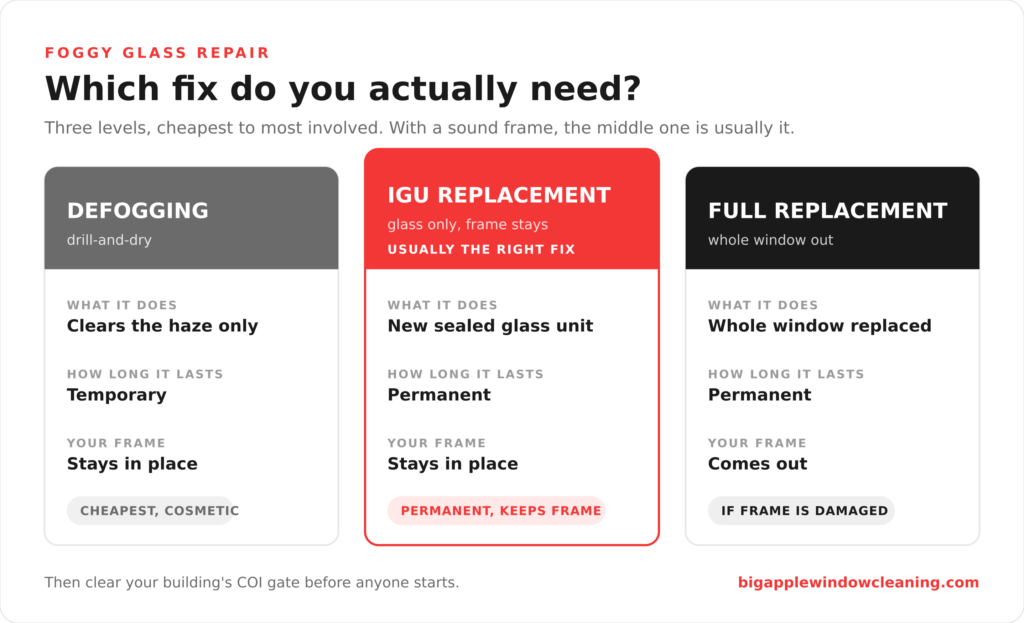
There are three levels of intervention, from least to most invasive:
- Defogging (drill-and-dry). A technician drills small holes, clears the moisture, and adds a valve or defogging insert. It clears the look of the fog. It does not rebuild the original sealed, gas-filled unit, so treat it as cosmetic and potentially temporary. More on whether it is worth it below.
- IGU replacement (glass only). The single most common permanent fix. The failed insulated glass unit is swapped for a new one while your existing frame and sash stay in place. New seal, new gap, restored insulation, without the cost and disruption of tearing out the whole window. This is what most people want when they say “can you just replace the glass?”
- Full window replacement. Warranted when the frame or sash is rotted, warped, or damaged, when you are upgrading the entire window for performance, or when a co-op or condo standardizes windows building-wide and requires matching units.
For a foggy window with a sound frame, option 2 is usually the right target. Reserve option 3 for when the frame itself is the problem, or when your building requires it.
A NYC-specific wrinkle: in prewar and landmarked buildings, replacement glass or units often have to match approved specifications, size, Low-E coating, and gas fill, and preserving the original frame and sash can be a requirement rather than a preference. That is another reason glass-only replacement is attractive here: it keeps the historic frame intact.
Is defogging worth it, or is it a gimmick?
Owners are right to be suspicious. A widely-read DIY forum thread is literally titled asking whether defogging double-pane windows is a gimmick, and the skepticism is fair.
The honest framing:
- Defogging removes the visible haze. If your only goal is to stop looking at cloudy glass and you want the cheapest path, it can do that.
- Defogging does not restore the factory seal or the gas fill. The seal is still broken. Moisture can return, and you have not recovered whatever insulation value was lost.
So it is not a scam, but it is not a permanent seal repair either. If you want the window to actually perform like a sealed unit again, replacing the IGU is the durable answer. If you want a low-cost cosmetic fix and accept it may not last, defogging is a legitimate, eyes-open choice, though you will need a defog-specific outfit for it. Our own repair is glass-only IGU replacement, the permanent fix that restores a real sealed unit while keeping your frame.
Is foggy glass actually hurting you, or is it just ugly?
Reasonable question, because the answer determines whether you spend anything at all.
- Often it is primarily cosmetic. Condensation trapped between the panes is mostly a looks problem, and in many cases the measurable energy penalty is modest.
- But not always. If the failed seal has let the insulating gas escape, or if the low-emissivity coating has started to corrode where moisture reached it, you do lose real performance. Persistent, worsening fog and visible etching or filming are the signs it has moved past cosmetic.
Practical read: a faint, occasional haze on one window is low urgency. Heavy, permanent fog with mineral etching, especially across multiple windows, is worth fixing both for appearance and for the performance you have quietly lost.
Getting past the building: board approval and the Certificate of Insurance (COI) gate
Say you have settled it. It is your bill, you want the glass unit replaced, you have picked an approach. In a house, you would just book someone. In a NYC co-op or condo, there is one more gate, and it is the step that surprises people.
Before a contractor can do work in most co-op and condo buildings, your managing agent requires a Certificate of Insurance (COI) that names the building, and often the managing agent and board, as additional insured, and it typically has to be submitted 48 to 72 hours in advance. Some jobs also need board or alteration-committee sign-off depending on scope.
This is normal, and it exists to protect the building. But it is also where jobs die, because plenty of glass and handyman outfits either cannot produce a compliant COI at all, cannot get one issued fast enough, or carry policies with exclusions that your management company will reject.
For co-op and condo work specifically, the practical sequence is:
- Ask your managing agent for the building’s exact COI requirements and any alteration-agreement forms, before you schedule anything.
- Confirm your contractor can produce a COI naming your building as additional insured, and how quickly.
- Confirm the policy has no exclusions that your management will bounce.
Whose bill is it, and what is the right fix?
Answer 3 questions. Get a plain-English read on responsibility, the right repair path, and a checklist to hand your managing agent. Not legal advice.
This tool is general guidance, not legal advice. Your proprietary lease, condo declaration, and bylaws control the final answer on responsibility. Read the document, or ask your managing agent for the board's interpretation in writing.
Why the COI is the part that stalls most co-op and condo jobs
This is where the choice of contractor stops being about price and starts being about whether the work can happen at all.
Big Apple Window Cleaning was built around exactly this friction. For co-op and condo work, the relevant facts are concrete and verifiable:
- 11 million dollars in coverage, structured as a 10M umbrella, 1M general liability, 1M workers compensation, and 1M auto.
- A COI naming your building as additional insured, issued in 24 to 48 hours, which is inside the window most managing agents require.
- No Action Over exclusions, the kind of policy carve-out that management companies specifically screen for and reject.
- Zero Height Limitations and OSHA plus SPRAT-trained rope access, which matters when a building is tall or the window is hard to reach.
The point is not the size of the number for its own sake. It is that the number and the policy language are what your managing agent checks before anyone touches your window, and being able to clear that check in a day or two is the difference between the job happening this week and the job stalling for a month. If you have ever had a contractor bounced by management for a bad COI, you already know why this is the real gate.
If your fix is glass-only, whole-window, or restoring etched or scratched glass, the same insurance backing applies across the work: see foggy glass repair and IGU replacement in NYC, full window replacement, and glass restoration for etched or filmed panes. The full policy breakdown and sample COI details live on the insurance and Certificate of Insurance page.
What to check before you hire anyone
Use this as your short checklist:
- Read your proprietary lease or condo bylaws and settle who pays before you spend.
- Ask for the glass-only (IGU) option if the frame is sound. Do not let anyone default you to a full window you may not need.
- Decide defog vs replace on purpose. Defog for cheap and cosmetic, replace the unit for permanent.
- Get your building’s COI requirements in writing first, then confirm your contractor can meet them, fast, with no disqualifying exclusions.
Answer those four and a foggy window goes from a stressful unknown to a scheduled, half-day fix.
It depends on your proprietary lease. In many NYC co-ops windows are treated as part of the building envelope and are the co-op’s responsibility, but some leases assign the glass or windows to the shareholder. Read the repairs and maintenance section of your proprietary lease, look for the word windows specifically, and if it is silent or ambiguous, ask the managing agent for the board’s interpretation in writing. Condo owners should check the bylaws and declaration, where windows are often defined as common or limited common elements. This is not legal advice.
Usually yes. Foggy glass is caused by a failed seal in the insulated glass unit (IGU), and the frame and sash are typically still fine. Replacing the IGU restores a proper sealed unit while keeping your existing frame in place, which costs less and is far less disruptive than a full window replacement. Full replacement is warranted mainly when the frame or sash is damaged, or when your building requires standardized windows.
It is not a scam, but it is not a permanent seal repair either. Drill-and-dry defogging removes the visible haze, so it can work if you want the cheapest cosmetic fix. It does not restore the original seal or gas fill, so the moisture can return and any lost insulation is not recovered. For a durable fix that performs like a sealed unit again, replace the insulated glass unit instead.
Most NYC co-op and condo buildings require any contractor to submit a Certificate of Insurance (COI) naming the building, and often the managing agent and board, as additional insured, typically 48 to 72 hours in advance. It protects the building. It is also where jobs stall, because many small glass and handyman outfits cannot produce a compliant COI quickly, or carry policies with exclusions management will reject. Confirm your contractor can meet your building’s exact COI requirements before you schedule.
FURTHER READING


How to Clean the Outside of Your Apartment Windows in NYC
In most New York apartments the outside of the glass is cleaned from inside. Double-hung windows put in since the 1980s usually tilt in, and once the sash tilts, the outside face is a foot from your hands. When a window won’t tilt, the reason is usually a seized latch or a dead balance, not […]
Explore more
Six Windows, One $350 Minimum: Three Ways NYC Residents Get Exterior Glass Cleaned Without Overpaying
If you asked for a quote on your apartment and the number came back higher than you expected for six windows, nothing went wrong. You are running into a visit minimum, and in New York most apartments sit below it. Ours is published: $350 for residential work. That is not a markup for small jobs. […]
Explore more
Your Building Replaced the Windows and Left You With No Screens: Whose Bill Is It, and How to Get Custom Screens (NYC)
You are not crazy, and you are not stuck: the “screen orphan” problem explained It usually happens like this. Your building runs a window replacement project, the crew swaps your old slide-up windows for shiny new casement or crank-out windows, and then they leave. No screens. No paperwork. No phone number for where to buy […]
Explore more