
Unsafe NYC Facades Jumped 14x. The $954 Million Reason Owners Hide Them Instead of Fixing Them
By bigapplewindows
Contents
DO YOU HAVE AN URGENT NEED?
Our fast response service can fix your urgent problem. We have teams ready for action.
AND GET A FREE QUOTE
Get monthly window insight
On May 16, 1979, a 17-year-old Barnard student named Grace Gold was walking near Broadway and 115th Street when a piece of masonry broke loose from the eighth floor of a Columbia-owned building and killed her. Her death produced Local Law 10 of 1980, the first law in New York City requiring periodic facade inspections of buildings taller than six stories. After a 1998 building collapse on Madison Avenue, the law was expanded to cover every exterior wall and recodified as Local Law 11, the program New Yorkers now know as FISP.
The law was written to stop falling masonry from killing people. Four decades later, its most visible product is not repaired masonry. It is scaffolding. The city is wrapped in roughly nine thousand sidewalk sheds, and beneath a large share of them sit the same unrepaired facades the law was meant to fix. To understand why, it helps to look at what the data actually shows, and at the strange economics the law accidentally created.
The facades are failing faster, and the data proves it
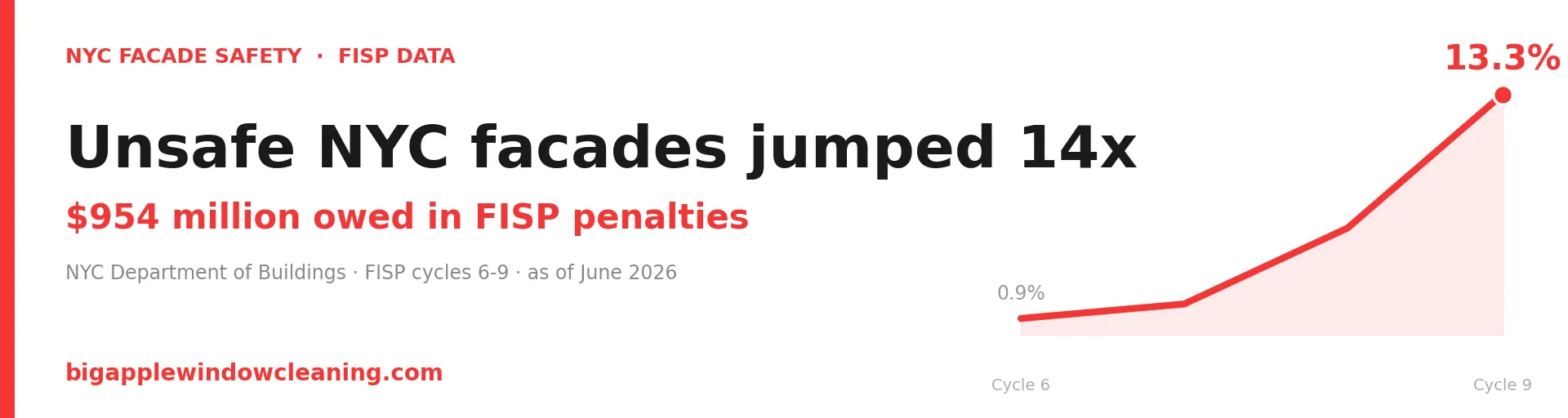
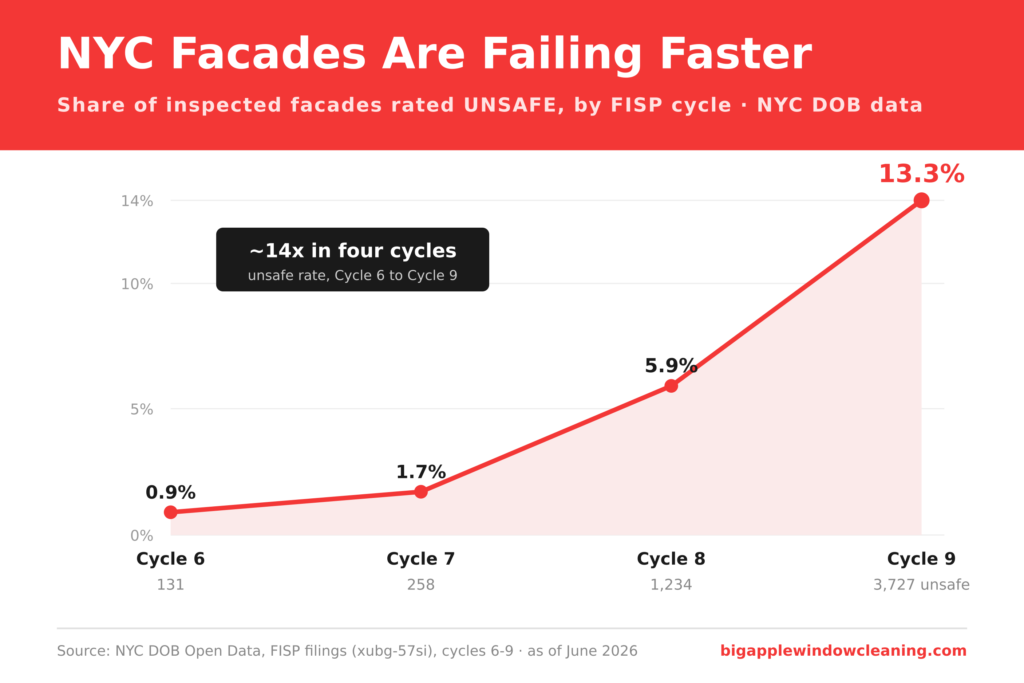
Most coverage of FISP reports a single cycle and moves on. Looking across cycles tells a different and more alarming story. Using the NYC Department of Buildings open dataset, we tracked the share of filed facades rated UNSAFE over the last four completed inspection cycles. In Cycle 6, 131 buildings were rated unsafe, just 0.9 percent of filings. By Cycle 7 it was 258 buildings, 1.7 percent. In Cycle 8 it jumped to 1,234 buildings, 5.9 percent. And in Cycle 9 it reached 3,727 buildings, 13.3 percent of all filed facades.
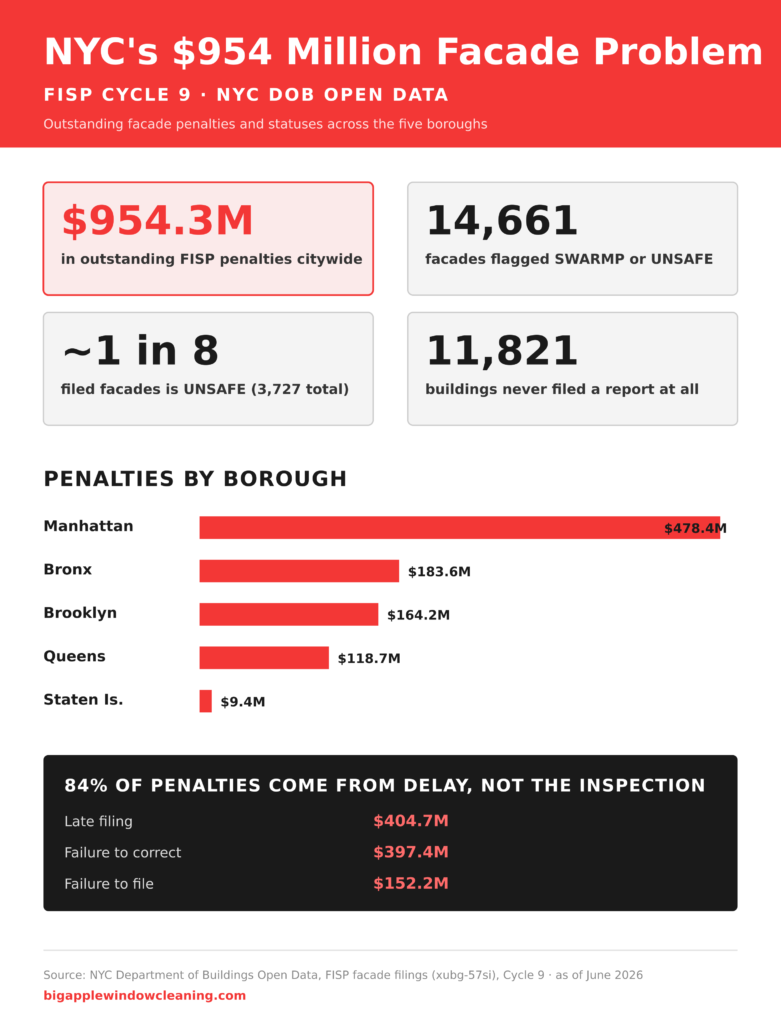
In four cycles the unsafe rate rose roughly fourteenfold. This is not random decay. It is a building stock that is aging past the point where a five-year inspection cycle keeps up, combined with an incentive structure that rewards waiting. Today 14,661 facades carry a recognized repair obligation, and 11,821 buildings did not file at all.
The hidden math: a shed is cheaper than the repair
Here is the part almost no one says out loud. For a building owner, the cheapest legal response to a failing facade is usually not to fix it. It is to put up a sidewalk shed and wait.
A full masonry facade restoration can run into the hundreds of thousands of dollars, or more on a tall building. A sidewalk shed, by contrast, is a monthly rental. The penalties for letting the condition sit have historically been smaller than the cost of the repair itself. So the rational move, on a spreadsheet, is to shed the building, absorb the fines, and defer the work. The numbers confirm that owners do exactly this: New York’s outstanding FISP penalties total $954 million, and 84 percent of that total comes from late filing and failure to correct, not from the inspection. The money is the price of delay.
The sheds tell the same story from the street. According to the city, sidewalk sheds stay up for an average of 498 days, and more than 230 sheds have stood for over five years. A shed is not a step toward a repair. For many buildings it has become the repair, a permanent way to satisfy the law’s safety requirement without ever addressing the wall behind it.
This is the deep irony of FISP. A law written to prevent the next Grace Gold now, in thousands of cases, simply hides the hazard behind a green plywood tunnel and leaves it there. The city did not build a facade repair program. It built a facade concealment program, and the data is the receipt.
The law mandated the inspection, then outlawed the cheap way to do it
There is a second contradiction worth naming. Inspections themselves are expensive, because reaching a facade by hand or by suspended scaffold is labor and risk. Drones are the obvious efficiency: faster, safer, and far cheaper for the visual portion of an inspection. Yet for decades New York effectively banned them. A 1948 avigation law made it unlawful to operate drones over the city, and only recently has the city moved to allow them for tasks like facade inspection. New York spent decades requiring a costly inspection while prohibiting the technology that would have made it affordable. Roughly a third of facade inspectors now use drones where permitted, and broader adoption is one of the few levers that could lower the cost of compliance rather than the cost of delay.
Other cities are not the explanation
It is tempting to assume New York’s problem is simply that it regulates more than other cities. The opposite is closer to the truth. Boston has required facade inspections since 1995 for buildings over 70 feet. Chicago’s ordinance, dating to 1996, applies to buildings over 80 feet and in some respects demands more hands-on inspection than New York does. Philadelphia has its own periodic inspection regime. New York’s law is among the oldest and broadest in the country, and it still produces the worst visible backlog. The differentiator is not the strength of the inspection mandate. It is the design of the incentives around the repair.
What would actually work
If the core problem is that delay is cheaper than repair, the fixes follow directly. The first is to make delay more expensive than the repair. Under the city’s Get Sheds Down effort, penalties now reach roughly $6,000 a month for sheds standing beyond 180 days, with tougher treatment for sheds up three years or more. Penalties tied to time under a shed, not just to filing, change the math. The second is to lower the cost of doing it right, by allowing drones and modern inspection technology to reduce the one cost owners cannot avoid. The third is to reward getting ahead of it. Proactive facade cleaning and maintenance, where a SWARMP condition is caught before it slides to unsafe, is dramatically cheaper than emergency stabilization, sheds, and accumulating fines. The data shows the cliff clearly, because the SWARMP buildings that are ignored become the unsafe buildings of the next cycle.
For owners and for co-op and condo boards, the lesson in the data is the same one the city is slowly building into law. The expensive outcomes come from waiting. A facade addressed on schedule is a manageable line item. A facade left under a shed is a liability that compounds, cycle after cycle.
Check your building before the next deadline
Every figure above comes from public NYC Department of Buildings data, and your own building is in it. Use our free FISP compliance checker to see your building’s current status, cycle, and any open conditions before they become the expensive kind.
Methodology and sources: facade status and penalty figures computed by Big Apple Window Cleaning from NYC Department of Buildings Open Data (FISP facade filings, dataset xubg-57si), cycles 6 through 9, as of June 2026. Sidewalk shed figures from the NYC Mayor’s Office. Historical background and the drone law from public records.
FURTHER READING
How to Clean the Outside of Your Apartment Windows in NYC
In most New York apartments the outside of the glass is cleaned from inside. Double-hung windows put in since the 1980s usually tilt in, and once the sash tilts, the outside face is a foot from your hands. When a window won’t tilt, the reason is usually a seized latch or a dead balance, not […]
Explore more
Six Windows, One $350 Minimum: Three Ways NYC Residents Get Exterior Glass Cleaned Without Overpaying
If you asked for a quote on your apartment and the number came back higher than you expected for six windows, nothing went wrong. You are running into a visit minimum, and in New York most apartments sit below it. Ours is published: $350 for residential work. That is not a markup for small jobs. […]
Explore more
Your Building Replaced the Windows and Left You With No Screens: Whose Bill Is It, and How to Get Custom Screens (NYC)
You are not crazy, and you are not stuck: the “screen orphan” problem explained It usually happens like this. Your building runs a window replacement project, the crew swaps your old slide-up windows for shiny new casement or crank-out windows, and then they leave. No screens. No paperwork. No phone number for where to buy […]
Explore more