Commercial Facade Cleaning: What Every Building Owner in New York City Needs to Know

By Dayne Watkins

05.06.2026
8–12 minutes
read
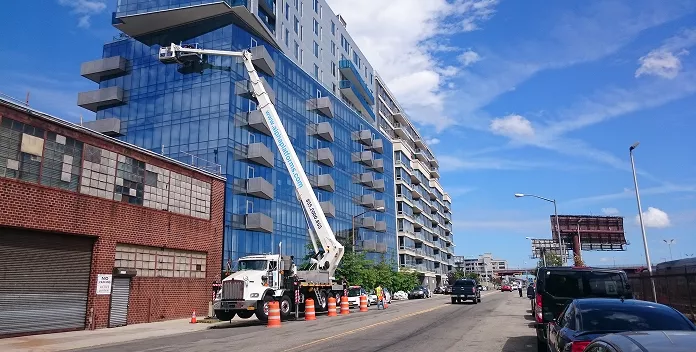
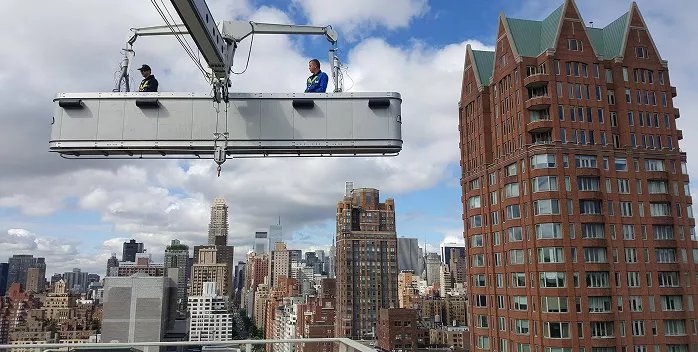
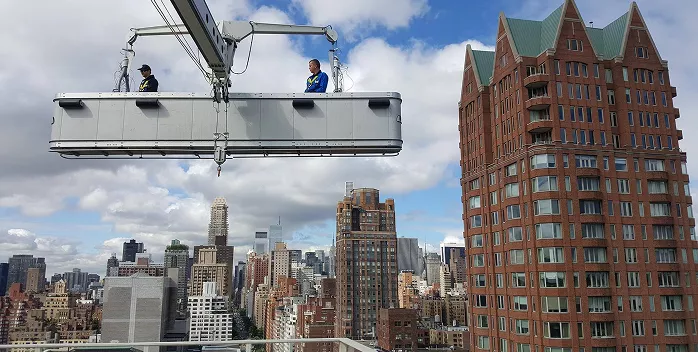
Boom lift extending to reach the upper floors of a high-rise residential tower with curved balconies and glass curtain wall facade

DO YOU HAVE AN URGENT NEED?

Our fast response service can fix your urgent problem. We have teams ready for action.

CALL NOW 212-365-8007

AND GET A FREE QUOTE

Get monthly window insight

    Your building talks about you before you ever open your mouth. A grimy exterior covered in soot, pigeon souvenirs, and mysterious streaks tells visitors, tenants, and potential buyers exactly one thing – nobody here cares. Research shows it takes roughly seven seconds to form a first impression, and in a city where commercial real estate competition is absolutely ruthless, those seven seconds can cost you a lease or a sale.

    Boom lift extending to reach the upper floors of a high-rise residential tower with curved balconies and glass curtain wall facade
    A boom lift reaches toward the upper floors of a modern high-rise – the curved balcony stack and glass curtain wall are the kind of architectural combination that makes facade access a precision operation, not just a cleaning job.

    Commercial facade cleaning is not a vanity project. It is a strategic investment in structural health, regulatory compliance, and long-term property value. Yet the majority of building owners treat it like an afterthought – something they will get around to eventually, right after fixing the elevator that has been making that noise since 2019.

    This guide breaks down everything you need to know about commercial facade cleaning in the context of New York City’s unique regulatory landscape, building stock, and environmental challenges.

    Why Your Facade Is Slowly Eating Itself

    Here is something most people do not realize: dirt is not just ugly. It is destructive. Airborne pollutants settle into porous materials like brick and limestone, trapping moisture underneath. That moisture expands during freeze-thaw cycles – and in New York City, those cycles happen dozens of times every winter. The result is spalling, cracking, and accelerated deterioration that turns a cosmetic issue into a structural emergency.

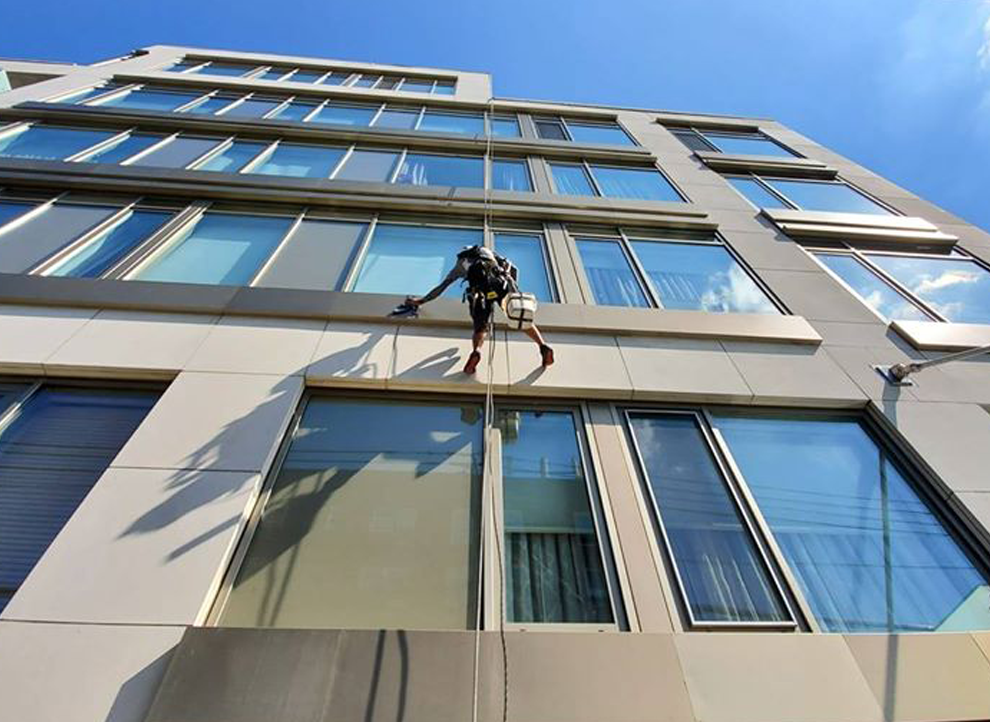
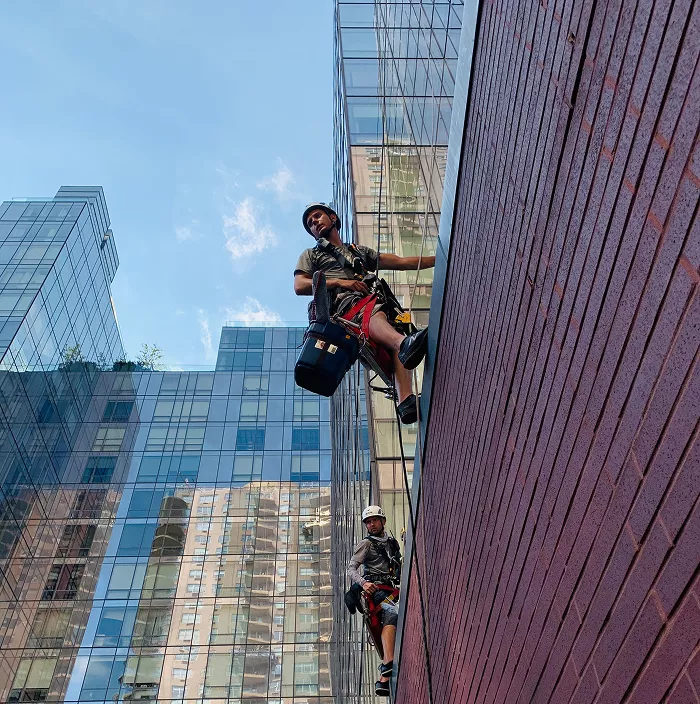
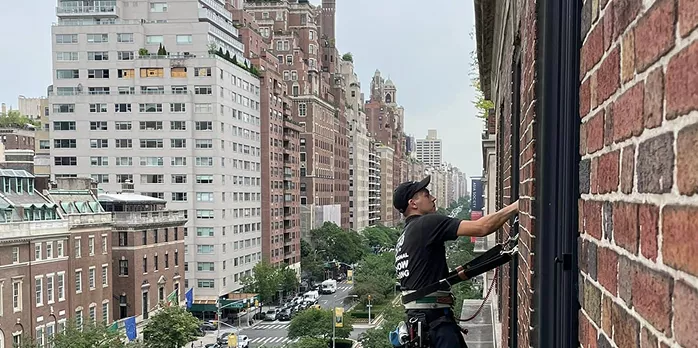
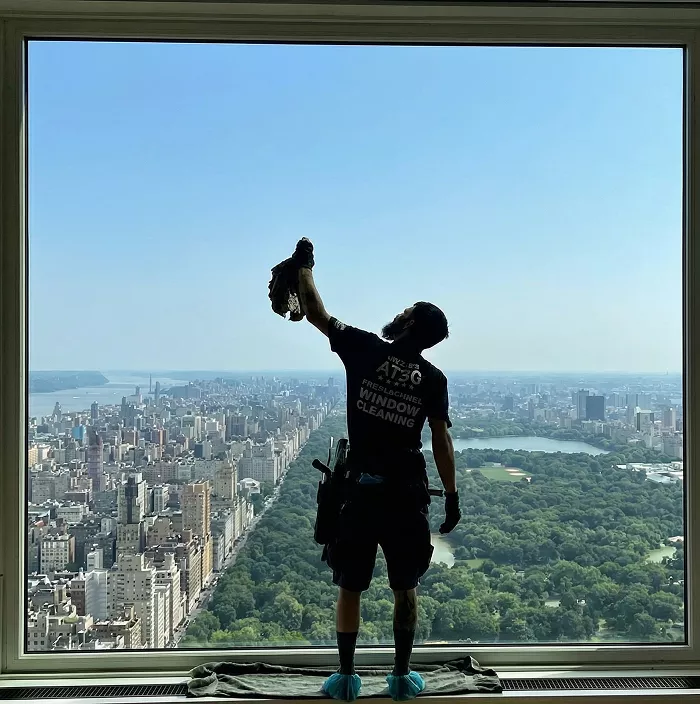
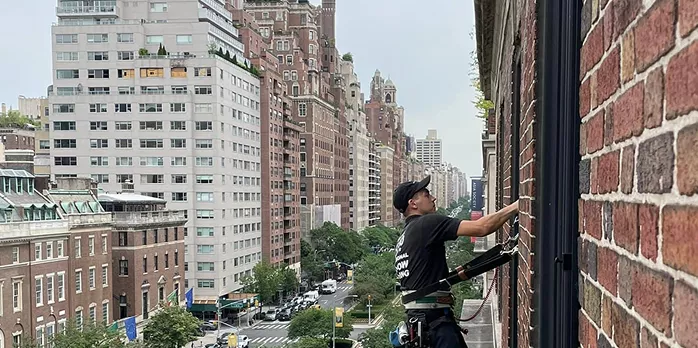
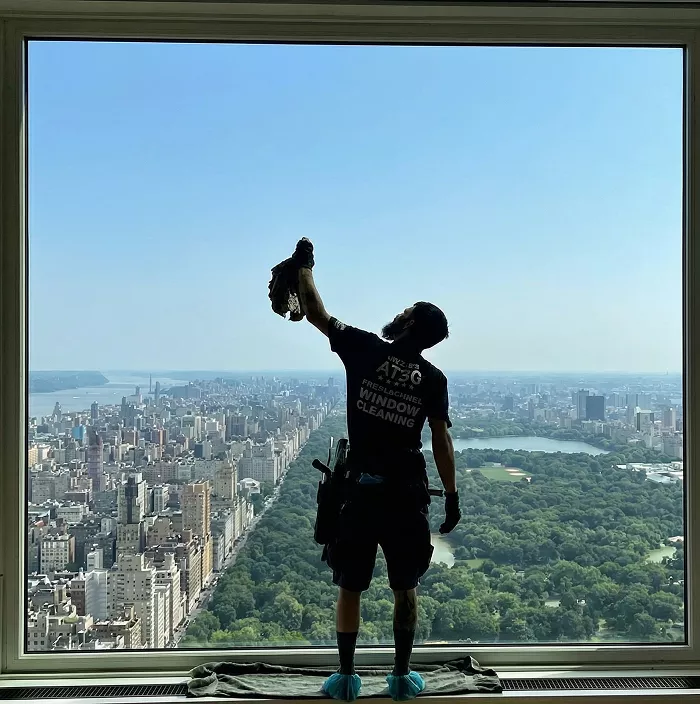
    Three rope access window cleaners descending the brick and glass facade of a mid-rise Manhattan residential building in autumn
    Three rope access technicians work the facade of a Manhattan residential building simultaneously – no scaffolding, no sidewalk shed, no disruption to the street below. This is how a building stays ahead of its Local Law 11 inspection cycle.

    On glass curtain walls, accumulated grime reduces thermal performance. Dirty facades absorb more solar heat, which raises indoor temperatures and puts extra strain on cooling systems. During winter months, buildup holds moisture along window ledges and parapets, increasing the risk of ice formation near building entrances.

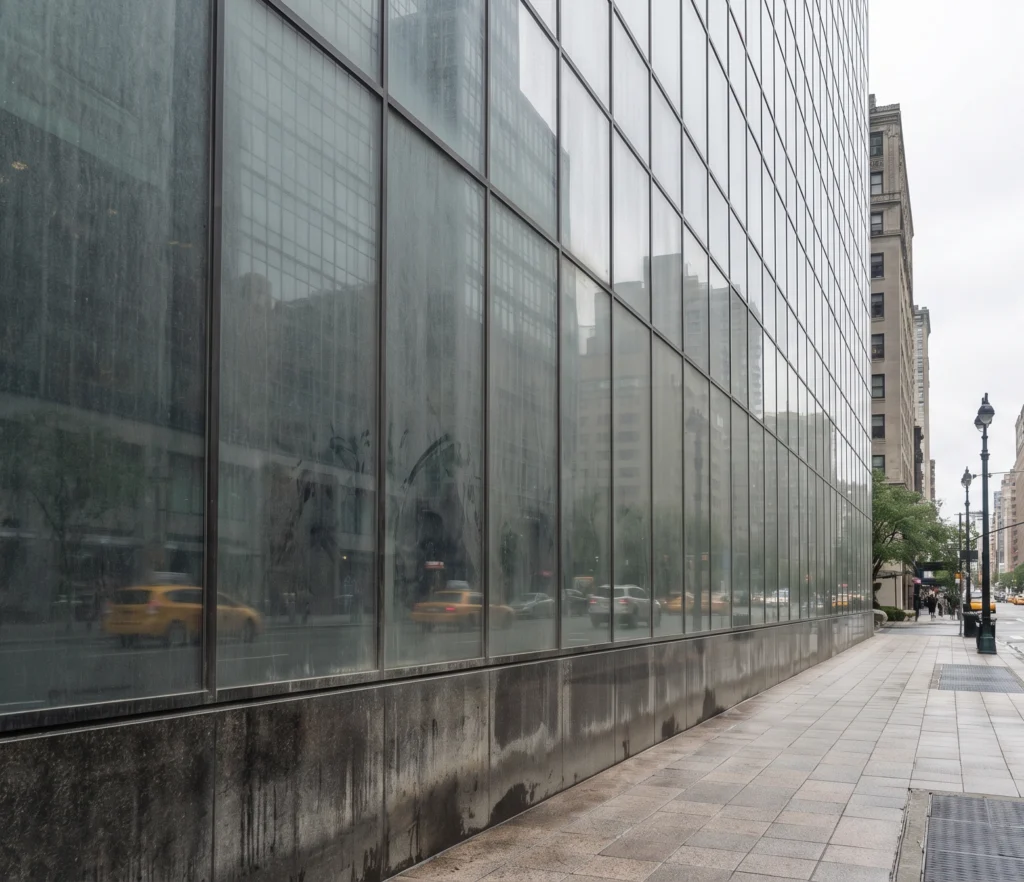
    Commercial facade cleaning removes these contaminants before they cause permanent damage. It also reveals hidden problems – hairline cracks, efflorescence, failing sealant joints – that would otherwise go unnoticed until they become expensive repairs. Property managers walking through Midtown know this firsthand: the buildings that look best are almost always the ones spending the least on emergency restoration work.

    “Why did the dirty building break up with its owner? Because the relationship was getting too crusty.”

    Cleaning Methods: Matching the Technique to the Material

    Not every facade responds to the same treatment. Using the wrong approach on the wrong surface is like washing a silk shirt in a car wash – technically it is cleaning, but the results are catastrophic.

    Here are the primary methods used in professional commercial facade cleaning:

    1. Pressure washing works best on concrete, brick, and stone surfaces. Professionals adjust the PSI based on material sensitivity – hardwoods and masonry can handle around 1,400 PSI, while softer surfaces need much lower settings. Hot water systems that heat water to 140 degrees Fahrenheit or higher are particularly effective at breaking down grease and killing biological growth.
    2. Soft washing combines low-pressure water with biodegradable detergents to safely remove mold, algae, and mildew from painted surfaces, EIFS, stucco, and decorative facades. This is the go-to method for materials that would suffer under high pressure.
    3. Steam cleaning reaches temperatures up to 155 degrees Celsius and excels on historic buildings and delicate materials like terracotta or ornamental stonework. It avoids chemicals entirely and works at low pressure, making it ideal for pre-war buildings across neighborhoods like the Upper West Side.
    4. Chemical cleaning uses acid-based solutions for masonry and alkaline solutions for limestone or marble. Every application must start with a test patch to verify the cleaning agent will not damage the surface or cause unwanted reactions.
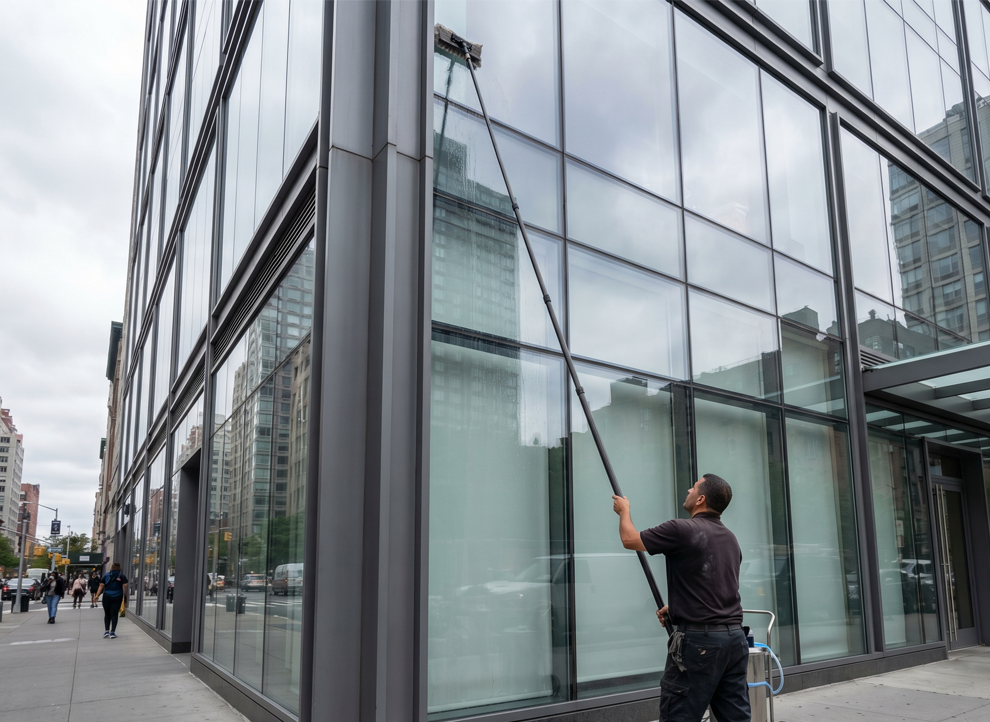
    5. Water-fed pole systems push purified, deionized water through extendable poles. Because the water is mineral-free, it dries without leaving streaks – a practical solution for routine glass maintenance on mid-rise buildings.
    6. Dry ice blasting offers a water-free alternative for facades that cannot tolerate moisture, or where water runoff restrictions make wet methods impractical.

    The critical takeaway is that material identification must come before method selection. A competent commercial facade cleaning provider will always conduct a surface assessment before touching the building. At Big Apple Window Cleaning, for example, every project starts with a detailed evaluation of facade materials, contamination type, and access requirements before any equipment is deployed.

    High-Rise Equipment: What Keeps People Safe Above the Street

    Cleaning a three-story brownstone in Brooklyn Heights is one thing. Cleaning a 40-story glass tower is an entirely different operation that requires specialized equipment and certified personnel.

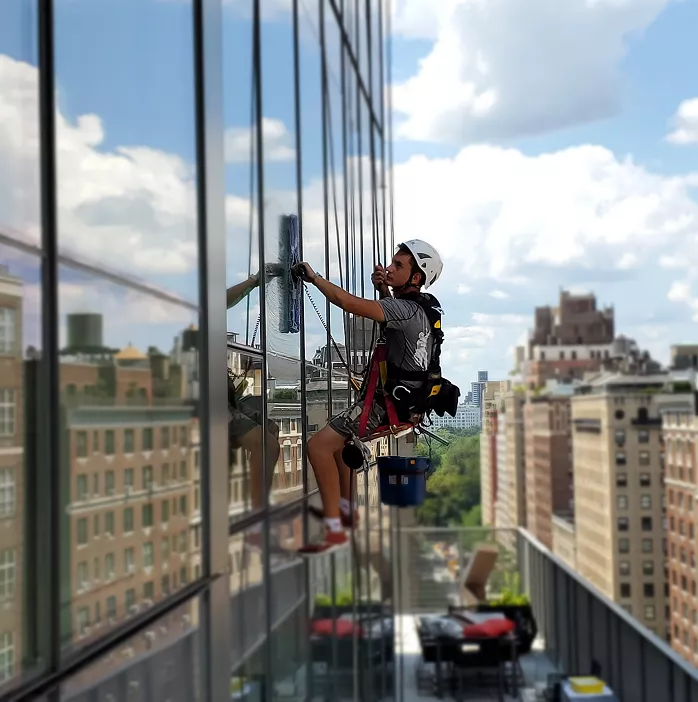
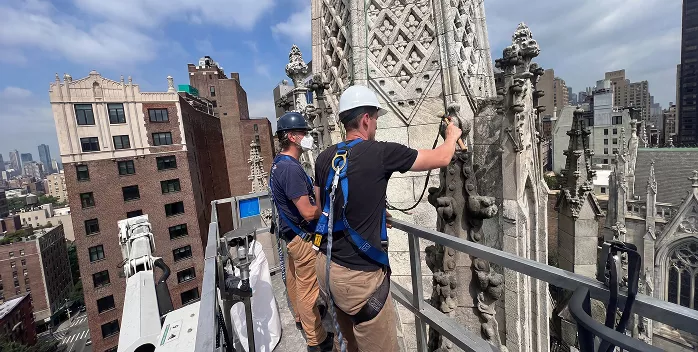
    The standard access methods for high-rise commercial facade cleaning include swing stage scaffolding (suspended platforms), bosun’s chairs for lighter tasks, boom lifts and aerial work platforms for mid-rise structures, and rope access systems using IRATA or SPRAT-certified technicians. Rope access is often the most efficient option in dense urban environments because it requires no ground-level equipment, causes minimal disruption to pedestrian traffic, and allows technicians to reach complex architectural features that scaffolding simply cannot accommodate.

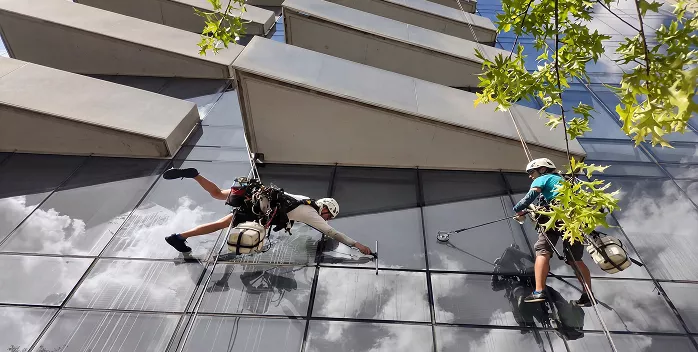
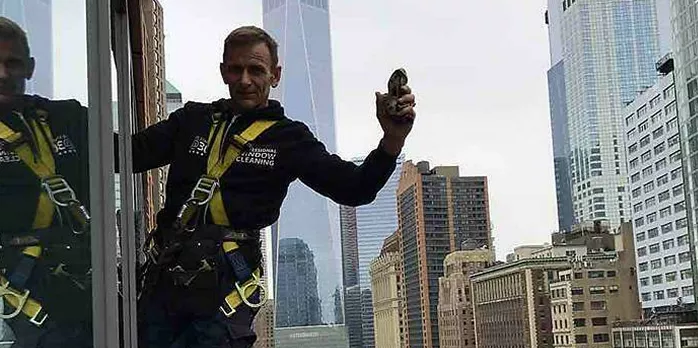
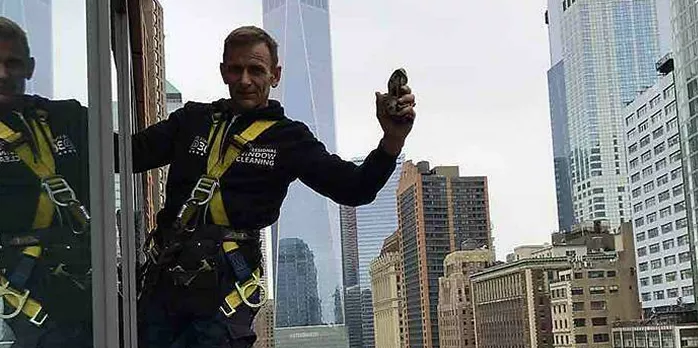
    Group of rope access BAWC technicians in full harness and helmets working on a glass high-rise facade with street level visible below
    A rope access crew works a glass high-rise facade in full SPRAT-standard gear – helmets, dual-rope systems, carabiners, and harnesses. This is what ANSI/IWCA I-14.1 compliance looks like in practice, several hundred feet above the street.

    The equipment itself matters just as much as the access method. Professional crews typically work with commercial-grade pressure washers rated between 2,500 and 4,000 PSI with flow rates exceeding 4 GPM for masonry work. For glass curtain walls, water-fed pole systems extend up to 70 feet and use multi-stage filtration to produce zero-TDS purified water. Steam units operate at pressures between 50 and 150 PSI with adjustable temperatures, giving technicians precise control over the cleaning intensity.

    For buildings equipped with permanent Building Maintenance Units – the motorized platforms you see gliding down skyscraper facades – these systems can also serve as the base platform for robotic cleaning technology, a development that is already changing the industry.

    Local Law 11 and the Five-Year Clock

    If you own or manage a building taller than six stories in New York City, you are subject to the Facade Inspection Safety Program, commonly known as FISP or Local Law 11. This law requires a Qualified Exterior Wall Inspector to examine your building’s exterior every five years and file a report with the Department of Buildings classifying the facade as Safe, SWARMP, or Unsafe.

    An Unsafe classification triggers immediate consequences: you must install a sidewalk shed as pedestrian protection and correct the hazardous conditions within 90 days. Fines start at $1,000 per month for late filings and escalate to $5,000 per year for failure to file entirely. Starting in 2026, new enforcement measures will impose penalties up to $6,000 per month for sidewalk sheds standing longer than 180 days.

    What does this have to do with commercial facade cleaning? Everything. Regular cleaning is the simplest form of preventive maintenance. It removes the pollutants that accelerate material degradation and makes it far easier to spot developing problems between inspection cycles. Buildings that invest in routine commercial facade cleaning are significantly less likely to receive an Unsafe or SWARMP classification – which means fewer sidewalk sheds, fewer fines, and fewer emergency repair bills.

    A 2024 study commissioned by the city and conducted with Mastercard found that businesses located under sidewalk sheds lose between $3,900 and $9,500 in monthly revenue per shed location. Proactive facade maintenance is not just about aesthetics – it is about protecting your bottom line.

    “A building owner walked into his accountant’s office and said, ‘I just saved $50,000 on facade repairs.’ The accountant asked how. ‘I cleaned it before it fell apart.'”

    Wastewater Rules That Can Ruin Your Day

    Here is a detail that surprises almost everyone: when you pressure wash a commercial building, the wastewater cannot legally flow into storm drains. Section 301 of the Clean Water Act prohibits point-source discharge of pollutants into waters of the United States without an NPDES permit. Property owners – not the cleaning contractor – bear the legal responsibility for compliance. Fines can reach $50,000 per day.

    Professional commercial facade cleaning companies handle this through water reclamation systems that capture and filter runoff, berming techniques that contain wastewater for controlled disposal, and discharge into permitted sanitary sewer systems with appropriate pretreatment. Always ask your service provider how they handle wastewater before any work begins.

    The Robots Are Already Here

    In August 2024, Skyline Robotics deployed Ozmo – the world’s first robotic window cleaning system – at 1133 Avenue of the Americas, a 45-story tower near Bryant Park. The robot uses a KUKA robotic arm equipped with LIDAR, force sensors, and AI-powered computer vision to clean windows three times faster than human crews. A human operator on the rooftop supervises the process remotely.

    The technology addresses a real workforce challenge. According to labor data, approximately 75 percent of window cleaners nationally are over 40 years old, while only 9 percent fall between 20 and 30. As buildings grow taller and more architecturally complex, automated systems will likely become a routine part of commercial facade cleaning operations within the next decade.

    Frequency and Cost: Planning Your Budget

    Most commercial buildings benefit from comprehensive facade cleaning every one to three years, depending on location, materials, and pollution exposure. Buildings near highways, construction zones, or industrial areas may need annual attention. Properties in coastal environments face salt corrosion that demands more frequent service.

    For exterior pressure washing of commercial buildings, industry pricing generally ranges from $0.15 to $0.90 per square foot, with the wide spread reflecting differences in building height, material type, access difficulty, and geographic market. In New York City, expect to be at the higher end of that range due to labor costs, permitting requirements, insurance overhead, and the logistical complexity of working in a congested urban environment.

    Spring is typically the best season for scheduling work – it removes winter salt deposits and pollution accumulation before they have a chance to cause lasting damage. At Big Apple Window Cleaning, we recommend scheduling commercial facade cleaning in the spring window between late March and early June, when temperatures are mild enough for most cleaning methods to perform optimally.


    Commercial facade cleaning is one of the highest-ROI maintenance investments a building owner can make. It prevents structural damage, supports regulatory compliance with Local Law 11, protects tenant and customer impressions, and eliminates the cascading costs of deferred maintenance. In a city with over 12,500 buildings subject to facade inspection requirements, staying ahead of the curve is not optional – it is the cost of doing business.

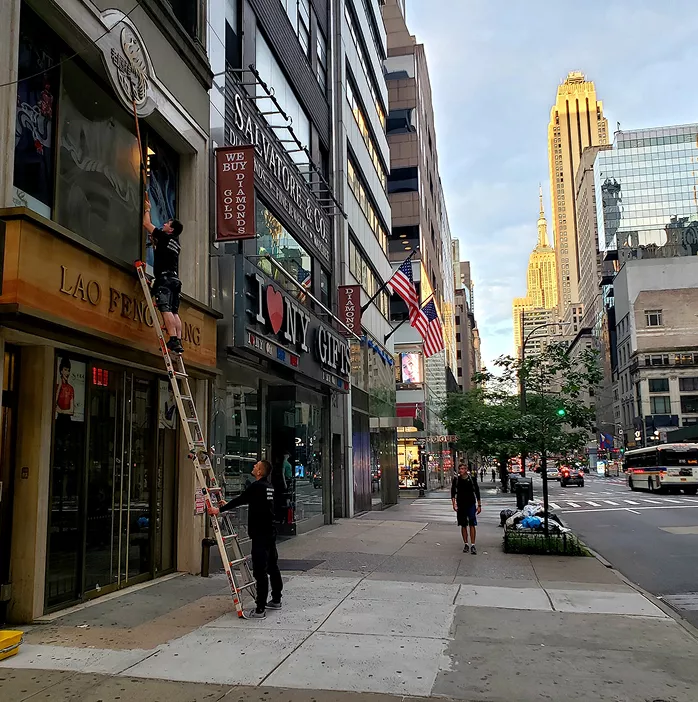
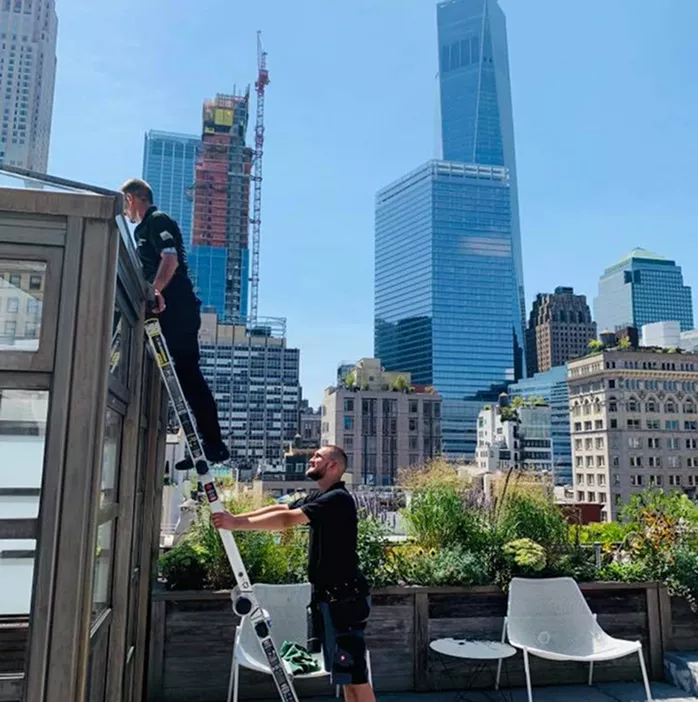
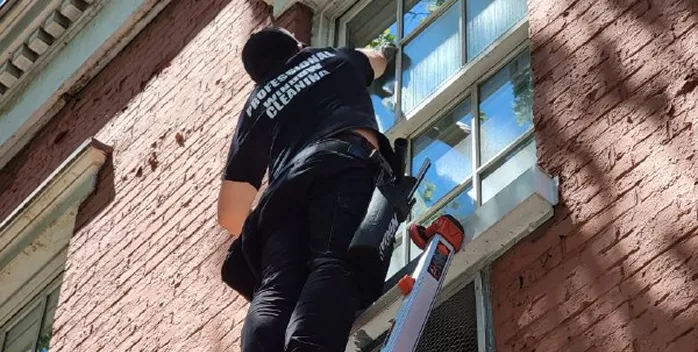
    Extension ladder positioned against a boutique commercial facade with geometric textured tile cladding and black steel-frame windows in Manhattan
    An extension ladder staged against a SoHo boutique facade – geometric tile cladding, black steel frames, blue awning. Material assessment before any cleaning method is selected is non-negotiable on a surface like this one.

    Your building deserves better than a five-year cycle of neglect followed by panic. Big Apple Window Cleaning provides professional commercial facade cleaning services across all five boroughs and Long Island, with SPRAT-certified technicians and the equipment to handle everything from a six-story co-op to a Class A office tower. Get in touch before your facade starts making decisions for you.

    Dayne

    Article by Dayne Watkins

    Dayne is a Senior Copywriter with 8+ years of experience growing Property marketing, and national brands. He's an optimist at heart, taking time to enjoy life's silver linings each day.

    Jun 05, 2026

    Glass Graffiti Repair: How to Save Your Windows Without Replacing Them

    You walk up to your storefront on a Monday morning, coffee in hand, ready to start the week – and there it is. Somebody decided your window was the perfect canvas for their artistic ambitions. Except this is not spray paint you can wipe off with a rag. This is acid-etched or scratched graffiti burned […]

    Explore more
    Jun 04, 2026

    What Does a Professional Window Cleaner Actually Use? The Truth Behind Streak-Free Glass

    You have probably tried the classic combo at least once: a bottle of Windex, a wad of paper towels, and a whole lot of hope. Twenty minutes later, the windows look worse than before – streaky, hazy, and covered in lint. Meanwhile, a professional window cleaner finishes an entire apartment in half the time and […]

    Explore more
    Jun 04, 2026

    Rooftop Skylight Cleaning in New York: What Every Homeowner Should Know Before the Glass Turns Gray

    A skylight can transform a dim brownstone parlor into the brightest room in the house. It pulls daylight down through narrow floor plans, opens up cramped stairwells, and makes a 20-foot-wide row house feel twice its size. But that same glass panel sitting on your roof collects everything the city throws at it – diesel […]

    Explore more