
What Does a Professional Window Cleaner Actually Use? The Truth Behind Streak-Free Glass
Contents
DO YOU HAVE AN URGENT NEED?
Our fast response service can fix your urgent problem. We have teams ready for action.
AND GET A FREE QUOTE
Get monthly window insight
You have probably tried the classic combo at least once: a bottle of Windex, a wad of paper towels, and a whole lot of hope. Twenty minutes later, the windows look worse than before – streaky, hazy, and covered in lint. Meanwhile, a professional window cleaner finishes an entire apartment in half the time and leaves the glass looking invisible. What gives?
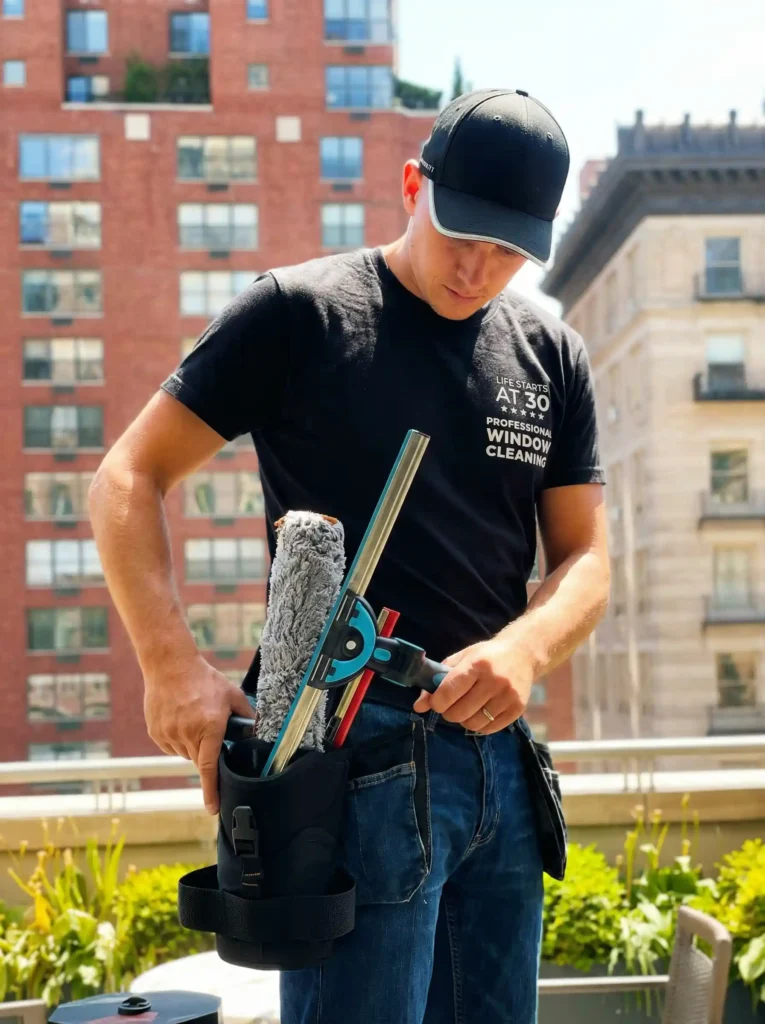
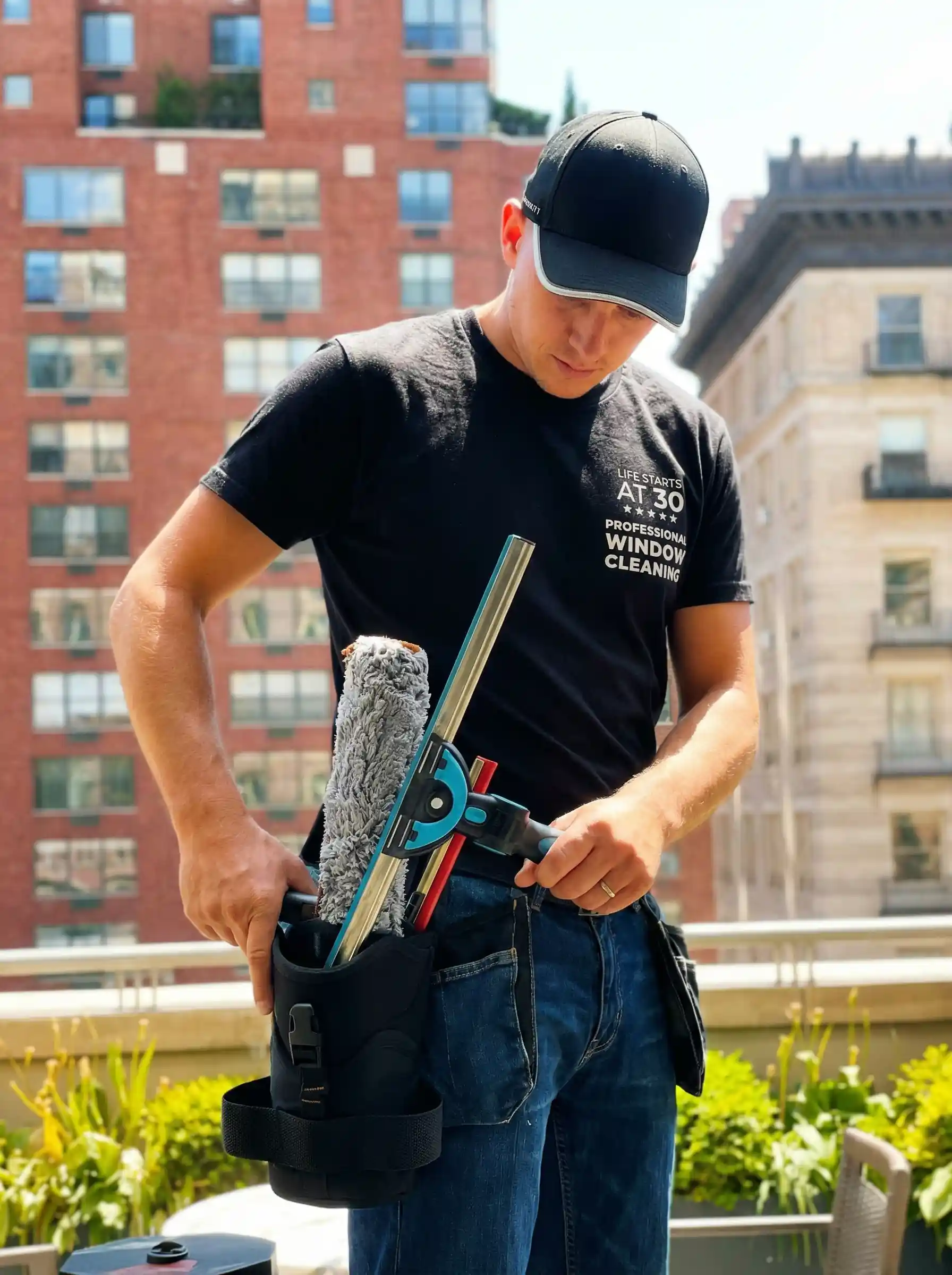
The answer is not some magical secret potion. Professional window cleaners rely on a combination of purpose-built solutions, specialized tools, and techniques refined over decades. Whether you live on the fifth floor of a pre-war brownstone in Brooklyn or in a glass-walled high-rise overlooking the Hudson, understanding what professional window cleaners bring to the job might change how you think about your own windows forever.
The Solution That Is Not Windex
Here is the first thing that surprises most people: professional window cleaners almost never use Windex. The ammonia in household glass cleaners evaporates too fast for a squeegee to work properly. Worse, ammonia can damage tinted windows and modern Low-E coatings – the kind installed in most energy-efficient apartments built after 2010.
So what do the pros actually put in their buckets?
The industry standard starts simple – filtered or distilled water mixed with a few drops of high-quality dish soap, typically Dawn. The proportion matters more than you think: three to five drops per gallon of water. Too much soap leaves a white haze that attracts dust faster than a black sweater attracts cat hair. Too little, and the squeegee drags across the glass instead of gliding.
But serious professional window cleaners go beyond dish soap. The real workhorse of the industry is a product most homeowners have never heard of: Glass Gleam 4 (GG4) by Titan Laboratories. This super-concentrated formula has been the go-to choice for window cleaners for over two decades. Just a quarter of a fluid ounce per gallon of water is all it takes – meaning one gallon of concentrate produces 512 gallons of cleaning solution. GG4 contains polymeric water softeners that tackle hard water minerals, provides exceptional squeegee glide without excess foam, and leaves absolutely no residue behind. It is biodegradable, USDA-approved, and classified as a green product. Professional window cleaners who have switched from Dawn to GG4 report that their clients can actually tell the difference – some have even refused to go back.
For especially stubborn conditions – direct sunlight, temperatures above 75 degrees Fahrenheit, or windy days when solution dries too fast – experienced window cleaners add a wetting agent like Winsol Super Slip to slow evaporation. Another clever additive is Jet Dry, which keeps loosened dirt suspended in the water so it does not redeposit on the glass during squeegee passes.
And for the really tough stuff? Hardened mineral deposits from years of sprinkler overspray, tree sap baked on by the summer sun, or silicone residue left behind by construction crews – these require specialized products like Titan A-1 Hard Water Stain Remover or Oil-Flo Safety Solvent. Around 15 percent of glass restoration jobs involve acid-based treatments. This is not weekend warrior territory.
Tools of the Trade
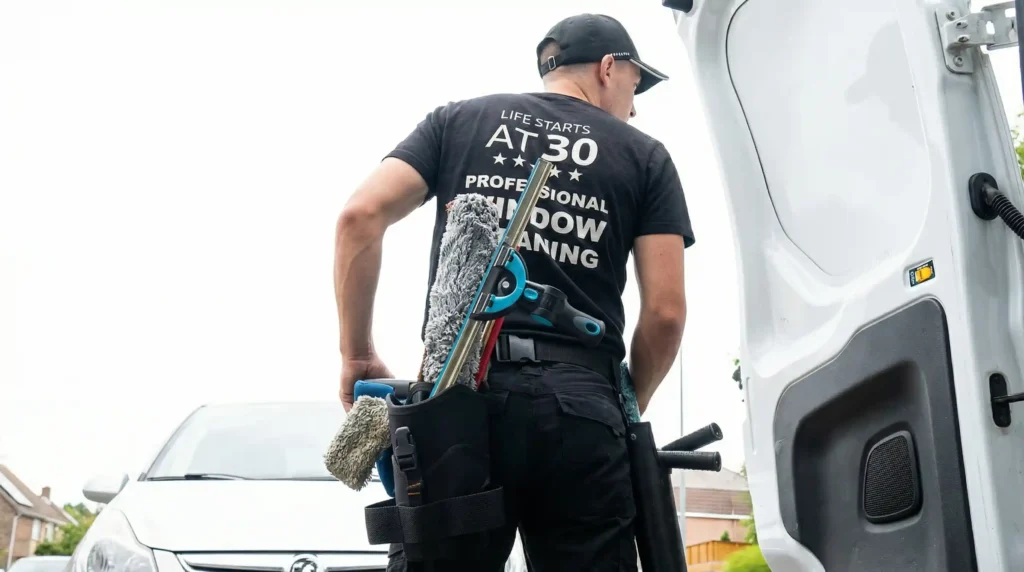
A professional window cleaner’s toolkit might look simple, but every piece has been refined for efficiency. Here is what you will find on a typical belt:
- A professional-grade squeegee with a razor-sharp rubber blade (brands like Ettore, Moerman, or Sorbo – not the dollar-store variety)
- A T-bar scrubber with a microfiber or abrasive sleeve for applying solution
- A scraper fitted with a 0.2mm stainless steel blade for removing paint spots and adhesive residue
- Huck towels – recycled surgical towels made from 100 percent lint-free cotton – for final detailing
- A holster or BOAB (Bucket on a Belt) for hands-free mobility
- Extension poles that can reach 30 to 40 feet from the ground
These are not random accessories. Each tool serves a specific function in a workflow that window cleaners execute almost on autopilot: scrub, squeegee, detail. The difference between a professional finish and a DIY attempt usually comes down to the rubber blade on the squeegee. A fresh blade makes clean, uninterrupted contact with the glass. A worn one skips, chatters, and leaves streaks behind.
The Pure Water Revolution
Perhaps the biggest innovation in the window cleaning industry over the past twenty years has nothing to do with soap at all. It is pure water – and it works exactly as simply as it sounds.
Water-fed pole systems use tap water that has been stripped of all dissolved minerals through reverse osmosis and deionization filters. The result is water with virtually zero total dissolved solids. When this purified water is scrubbed across a window and left to dry naturally, it evaporates without leaving any spots or streaks. No squeegee needed. No chemicals whatsoever.
The technology works through telescopic carbon fiber poles fitted with soft brushes at the tip. Water flows through a hose inside the pole, the brush scrubs away dirt, and the purified water rinses everything clean. Modern poles from manufacturers like XERO and Unger can reach up to 70 or even 90 feet – roughly eight stories – all from the safety of the ground.
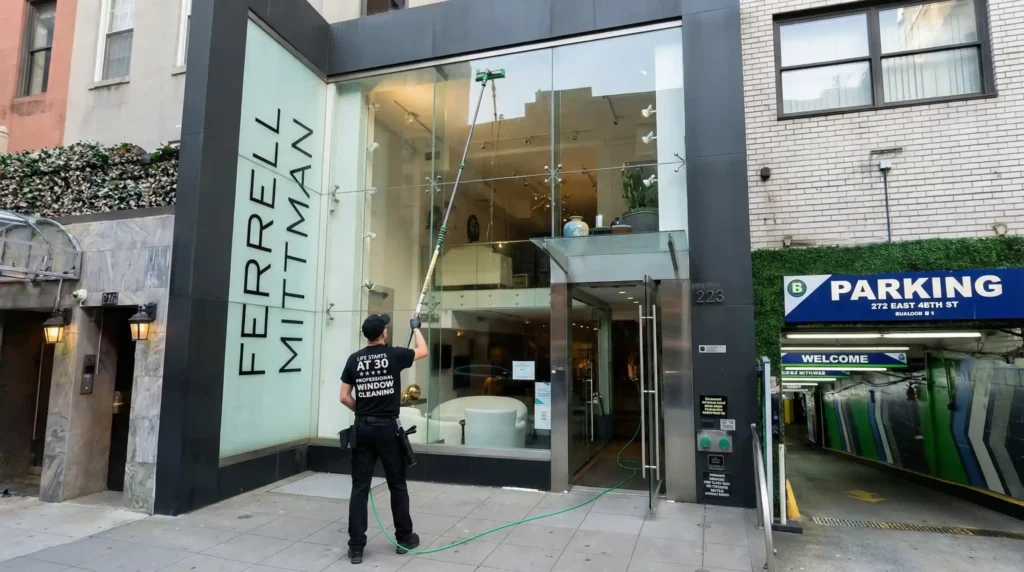
The numbers speak for themselves. According to industry data, water-fed poles reduce ladder usage by approximately 80 percent on residential jobs and can cut overall job time by up to 40 percent. For window cleaners working in dense neighborhoods across Queens, Brooklyn, and Manhattan, where setting up a ladder on a narrow sidewalk is both impractical and risky, this technology has been transformative. Many window cleaners consider it the single most important advancement in their field. At Big Apple Window Cleaning, our residential window cleaning teams use water-fed pole systems regularly to reach upper-story windows safely and efficiently, especially on townhouses and low-rise apartment buildings.
The environmental benefit deserves a mention too. Pure water systems use zero cleaning chemicals – just H2O. No chemical residue drains into storm sewers, and no airborne irritants bother building occupants.
Going Up: How High-Rise Windows Get Cleaned
If you have ever looked up at a Manhattan skyscraper and wondered how anyone cleans those windows, you are not alone. High-rise window cleaning is a world unto itself, governed by strict regulations, serious certifications, and equipment that most people would find terrifying.

The main access methods include rope access, swing stages, bosun chairs, building maintenance units, and boom lifts. Rope access is often the preferred method in dense urban environments because it requires minimal ground-level disruption – no sidewalk closures, no lane shutdowns, no bulky equipment blocking building entrances. Technicians descend from roof anchor points using a dual-rope system: one working rope and one backup safety rope. Both SPRAT (Society of Professional Rope Access Technicians) and IRATA certifications are considered essential in this field.
The safety statistics highlight why professional training matters. According to OSHA data, falls account for 40 percent of fatalities in the construction and cleaning industry, and ladder-related incidents send approximately 164,000 people to emergency rooms every year across all trades. Weather causes operational delays on roughly 15 percent of scheduled workdays. Certified window cleaners operate under ANSI/IWCA I-14.1 safety standards, and OSHA limits rope descent systems to 300 feet above grade with mandatory monthly scaffold inspections for high-rise work.
When Does DIY Stop Making Sense?
Let us be honest – for a couple of ground-floor windows, you probably do not need a professional window cleaner. Mix some dish soap with distilled water, grab a decent squeegee and a microfiber cloth, and work on a cloudy day. Clean one window at a time so the solution does not dry before you can wipe it off. That is basically the professional technique scaled down to kitchen-window size.
But there is a clear line where DIY becomes either ineffective or dangerous, and that is where professional window cleaners earn every dollar they charge:
Anything above the second floor requires equipment and training that most homeowners simply do not have. Hard water stains need acidic treatments that can damage surrounding surfaces if misapplied. Post-construction window cleanup involves removing silicone, paint overspray, and adhesive residue – materials that require professional-grade solvents and razor scrapers used by experienced hands. Older buildings with original single-pane glass demand a gentler approach because aggressive chemicals and abrasive pads can permanently damage the surface. And modern windows with Low-E coatings or factory-applied tints can be ruined by ammonia-based cleaners in a single cleaning session.
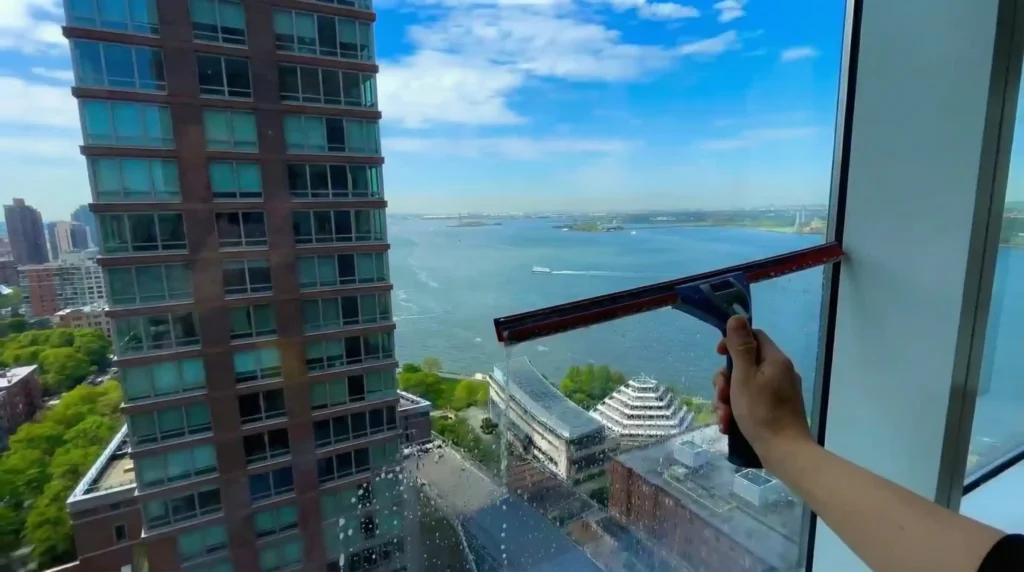
A professional squeegee pass on a high-rise window above the Hudson River – the red-handled tool, the soapy water running down the glass, and the Battery Park City skyline below are all part of a normal Tuesday for a New York City window cleaner.
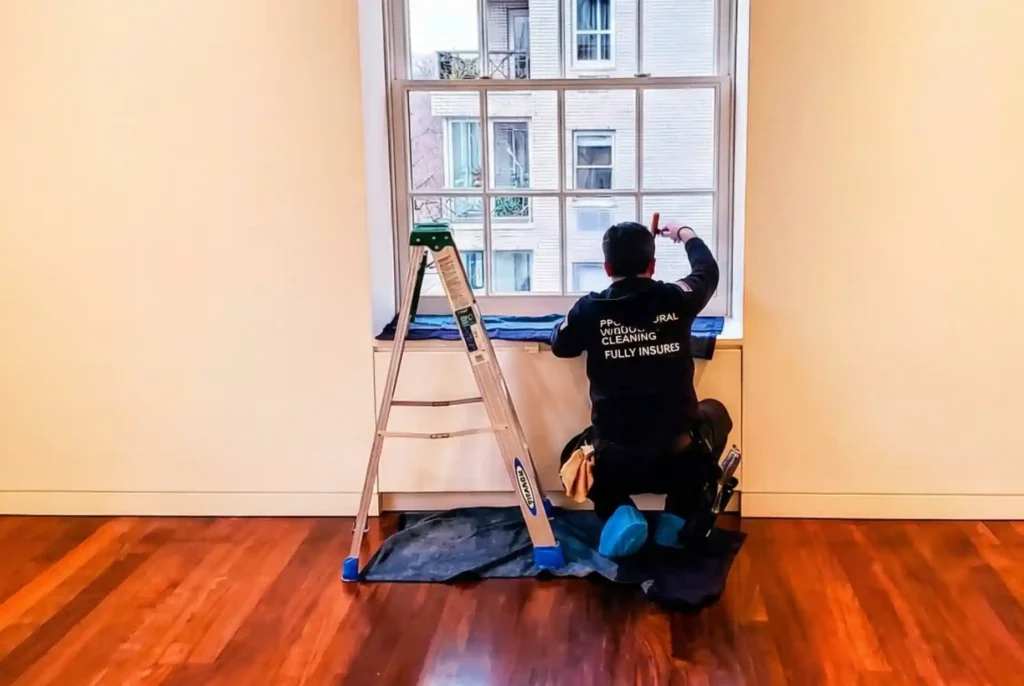
Interior shot of a window cleaning professional kneeling on a protective drop cloth in front of a large divided-light double-hung window in a classic New York City apartment. A stepladder stands to the left, and the technician’s shirt reads “Fully Insured” – relevant for co-op and condo buildings where proof of insurance is required before any contractor begins work.
For residential buildings across the Bronx, Staten Island, and Long Island, where many homes feature a mix of older windows and newer replacements, Big Apple Window Cleaning provides residential window cleaning that accounts for the specific glass types in each property. It is the kind of detail that matters when your building has both 1920s original casement windows on one floor and vinyl replacements on another.
The Green Shift in Window Cleaning
The window cleaning industry has been moving toward sustainability faster than most people realize. Window cleaners at the forefront of this shift have adopted pure water technology that eliminates chemical use entirely for exterior cleaning. Professional concentrates like GG4 reduce packaging waste dramatically – one small bottle replaces hundreds of spray bottles. Microfiber technology has replaced paper towels, which is significant when you consider that over 51,000 trees are cut down daily in North America just to support paper towel consumption.
Certifications like the EPA Safer Choice Program and Green Seal are becoming industry standard. Plant-based surfactants are replacing petroleum-derived ones, and refillable cleaning systems are gaining ground across commercial and residential markets alike.
For eco-conscious building owners and property managers, asking your window cleaners about their environmental practices is not just a nice gesture – it is increasingly a requirement for green building certifications.
A professional window cleaner is not just someone with a squeegee and a good attitude. Behind the seemingly simple job title, window cleaners carry trained expertise, purpose-built chemistry, specialized tools, and safety credentials that take years to earn. The gap between a DIY attempt and professional results is not about effort – it is about knowledge, equipment, and technique.
Whether you are managing a co-op board’s annual maintenance budget, trying to get your brownstone ready for sale, or simply tired of staring through grimy glass every morning, understanding what goes into professional window cleaning helps you make a better decision. And if the view from your living room has been looking a little hazy lately, Big Apple Window Cleaning offers residential window cleaning across all five boroughs and Long Island – because every window deserves to be seen through, not just looked at.
FURTHER READING

Article by Dayne Watkins


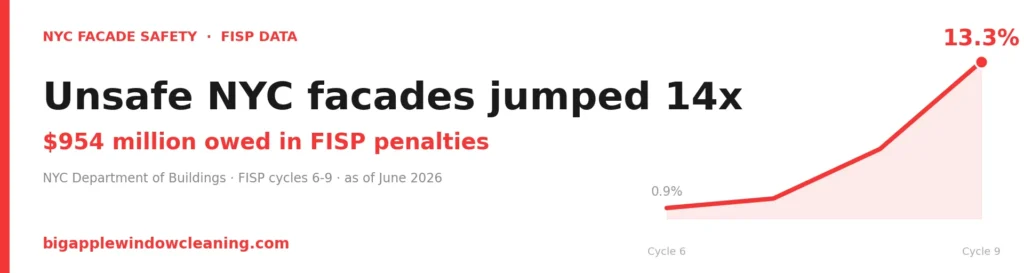
Unsafe NYC Facades Jumped 14x. The $954 Million Reason Owners Hide Them Instead of Fixing Them
On May 16, 1979, a 17-year-old Barnard student named Grace Gold was walking near Broadway and 115th Street when a piece of masonry broke loose from the eighth floor of a Columbia-owned building and killed her. Her death produced Local Law 10 of 1980, the first law in New York City requiring periodic facade inspections […]
Explore more
Roof Lantern Cleaning: A Professional Guide for New York Homeowners
Your roof lantern was supposed to flood the room with light. Instead, it is flooding the room with guilt every time you look up and see a layer of grime that could double as modern art. If you live in Brooklyn or Manhattan, you already know that city air does not play fair with glass […]
Explore more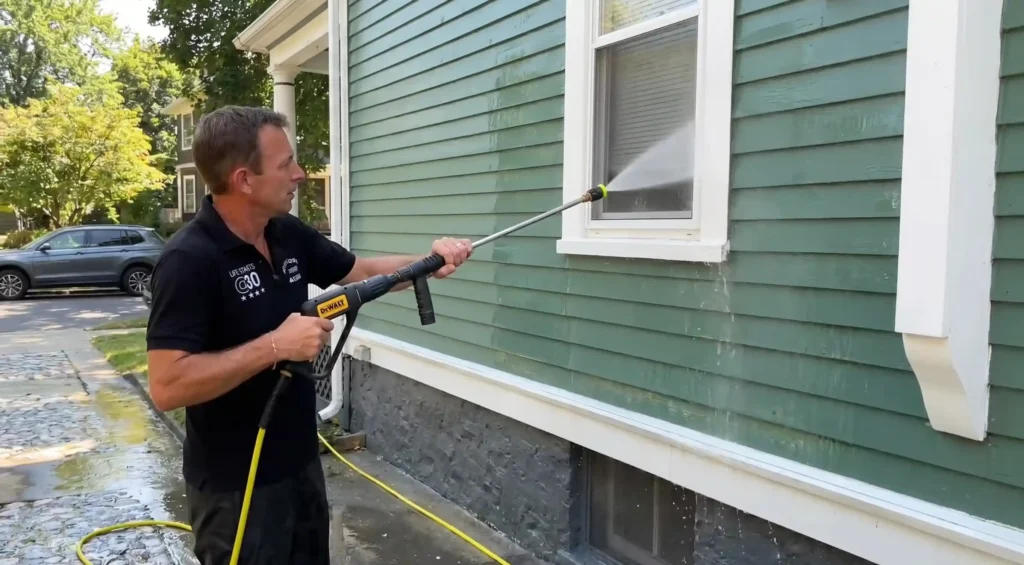
House Facade Cleaning: A No-Nonsense Guide for Homeowners Who’d Rather Not Watch Their Walls Crumble
Your home’s facade does a thankless job. Day after day, it stands between your family and everything the urban environment throws at it – diesel exhaust from delivery trucks, pigeon droppings with the pH of battery acid, mysterious black streaks that seem to appear overnight, and that persistent green fuzz on the north-facing wall that […]
Explore more