Window Cleaning High Rise Buildings in New York Is a Calendar Problem, Not a Cleaning Problem
Contents
DO YOU HAVE AN URGENT NEED?
Our fast response service can fix your urgent problem. We have teams ready for action.
AND GET A FREE QUOTE
Get monthly window insight
Ask any seasoned building manager in Manhattan how often they think about windows and you will get a tired look back. The cleaning itself is the easy part. The hard part is fitting it between a Local Law 11 facade inspection, a co-op board meeting, two storms in April, the spring construction next door, and a tenant who does not want strangers swinging past his bedroom on a Saturday morning.

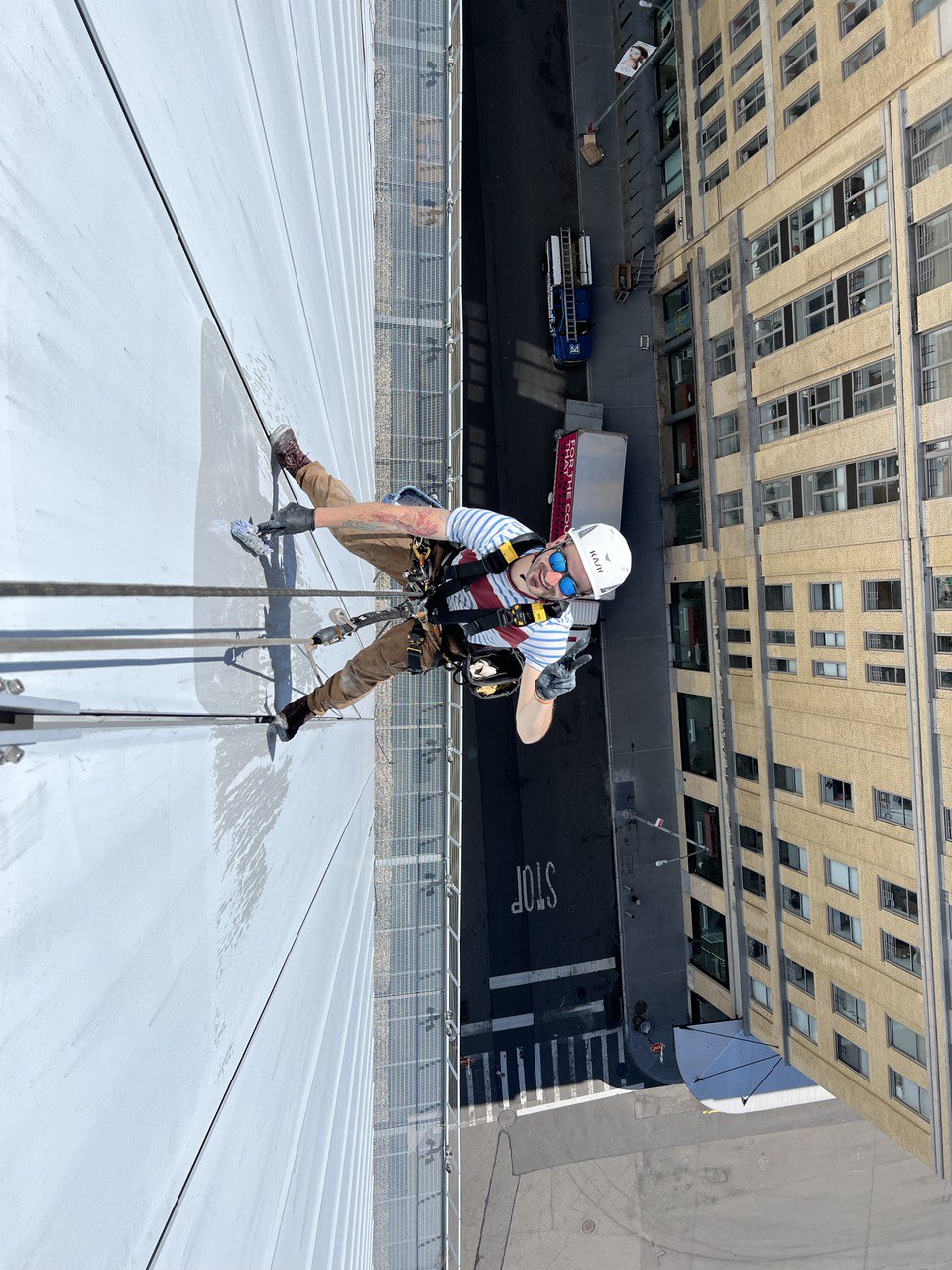
This article is about the part that nobody photographs: the planning, the paperwork, the insurance certificates, the seasonal math, and the slow art of figuring out how often a tower really needs to be touched. Window cleaning high rise buildings in New York looks like a service. It is actually a schedule.
For a closer look at the actual access methods – rope access, BMU systems, aerial lifts, water-fed poles, and interior cleaning – read our guide on how high rise window cleaning works in New York. This article focuses on the other half of the job: scheduling, insurance, Local Law 11 timing, weather, and recurring maintenance contracts.

How Often Is Often Enough
The honest answer is: it depends, and anyone who quotes a single number without seeing the building is guessing.
Most residential towers in Manhattan, Brooklyn, and Queens settle into a rhythm of two to four exterior cleans per year. That range is not arbitrary. It tracks the actual rate at which glass gets dirty in this city, which depends on a handful of variables that nobody except local crews tend to think about.
The trash pickup factor. Buildings on streets with frequent garbage truck stops collect grime faster than buildings on quieter blocks. Diesel exhaust from idling sanitation trucks lays down a sticky film that ordinary rain does not remove. A tower on West 57th Street cleans itself out of necessity more often than a tower set back from a residential side street.
The waterfront factor. Salt air from the Hudson and East River corrodes window seals and leaves a haze that builds up faster than inland grime. Buildings in Battery Park City, Long Island City, and Williamsburg waterfront developments tend to need an extra cycle per year compared to buildings further from the water.
The construction factor. Adjacent construction is the silent killer of clean windows. A site one block away can coat an entire facade with concrete dust in a week. Buildings near active construction zones in Hudson Yards, Long Island City, or anywhere a new tower is going up sometimes need an emergency wash three weeks after the previous one.
The pollen and platanus factor. May and June dump enough pollen onto the city that windows look yellow by the second week of bloom. London plane trees lining Riverside Drive and Central Park West are particularly generous donors. Spring cleans get scheduled around this rather than before it.
For a typical mid-block residential tower in a quiet pocket of the Upper East Side or the Upper West Side, two cleans per year work fine. For a glass-clad office building on a busy avenue with a construction site next door, four cleans per year is the floor, not the ceiling. Window washing high rise buildings on a fixed annual contract with set dates almost always misses the mark; a thoughtful building manager negotiates a contract that allows for one or two flexible visits each year.
| Building situation | Suggested annual cleans | Notes |
| Quiet residential side street | 2 | Spring and fall |
| Major avenue, mixed traffic | 3 | Add a summer touch-up |
| Waterfront tower | 3-4 | Salt air accelerates buildup |
| Adjacent to active construction | 4-6 | Includes emergency washes |
| Glass-clad commercial high-rise | 4 | Quarterly is standard for Class A |
“Schedule the wash before the FISP inspector arrives, not after. The inspector sees more clearly through clean glass, and so does the QEWI.”
A property manager who learned this the second time.
The Local Law 11 Calendar Lives in the Office Drawer
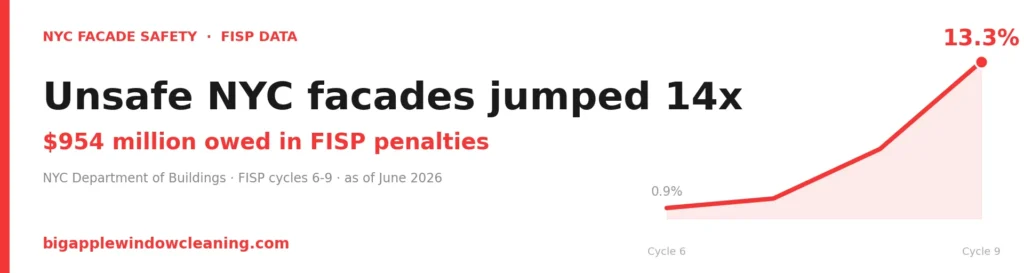
Every five years, every New York City building taller than six stories has to undergo a facade inspection under the Facade Inspection and Safety Program, also known as Local Law 11. Cycle 10 began on February 21, 2025, and runs through February 21, 2030. The current cycle is now divided into three sub-cycles based on the building’s address, and a Qualified Exterior Wall Inspector (QEWI) has to file a report with the Department of Buildings before the deadline.

Smart building management teams synchronize their window cleaning calendar with their FISP cycle. The reason is practical: a clean facade reveals problems that a dirty facade hides. An inspector trying to assess hairline cracks in mortar joints through years of soot is going to flag more uncertainties than an inspector looking at clean masonry. The DOB itself does not require pre-inspection cleaning, but the engineering firms doing the inspections almost universally recommend it. For the official rules and current cycle deadlines, the Department of Buildings maintains the program details at nyc.gov/site/buildings.
Window washing high rise buildings two to four weeks before a FISP inspection is a small expense that has saved more than one building a SWARMP designation that would have cost a fortune to remediate.
The Insurance Conversation Nobody Likes
Here is the part of the story that ought to be on the cover of every property management trade publication. Under New York Labor Law Section 240, also called the Scaffold Law, the building owner and the general contractor are held to absolute liability for elevation-related injuries during covered work. If a window cleaner falls from height while cleaning a high-rise window in New York, the owner is on the hook regardless of the cleaner’s behavior, regardless of the equipment failure source, regardless of almost everything except the worker’s status as a recalcitrant employee.
This is unique to New York. No other state has anything like it. It is also the reason that liability insurance for window cleaning contractors in New York costs two to three times what it costs in Pennsylvania or Connecticut.

What this means in practice: when a building hires a contractor with thin insurance coverage, the building’s own carrier is the one paying out. Many smaller cleaning operations carry general liability policies that look adequate on paper but quietly exclude any work performed above the fourth story. The certificate of insurance the building receives shows a $1 million or $2 million limit, and the building manager assumes that covers everything. It does not. A worker fall from the eighteenth floor of a Murray Hill condo can produce a settlement well into eight figures, and the gap between the policy limit and the actual award is the building’s problem.
Big Apple Window Cleaning carries an $11 million combined insurance package – $10 million in general liability plus $1 million in auto coverage, plus workers’ compensation and bonding – specifically because the company handles window cleaning high rise buildings across all five boroughs and Long Island, and that level of coverage is what serious commercial properties and condo boards actually need to see on a certificate before anyone signs anything.
The way to verify what a contractor’s insurance actually covers is to call the agent listed on the certificate and ask two questions: does the policy cover window cleaning operations specifically, and what is the height limit of that coverage. Half of small contractors fail one or both questions.

The Contract Is the Service
A good contract for high-rise window cleaning has a few things that the cheapest bid usually does not. It specifies access methods (rope access, BMU, davit, aerial lift), names the certifications of the crew (SPRAT or IRATA for rope work, Licensed Rigger for suspended scaffold), defines what happens when weather forces a reschedule (no charge, next available date), spells out which sections of glass are included (lobby storefronts and ground-floor retail are usually a separate agreement), and confirms how the contractor will obtain the roof anchor certifications they need from the building owner under OSHA 1910.27.
Annual contracts usually save 10 to 20 percent over per-visit pricing because the contractor can plan crew rotations, equipment staging, and travel time more efficiently. They also lock in the date slots, which matters more than people think. A building that calls in March looking for a May clean often discovers that every reputable contractor is already booked for the spring. By July the same building is calling around in panic.
“There are two seasons in this business: too windy and too cold. The third season is when we do all the work, and it is shorter than the calendar suggests.”
A foreman with twenty years on Manhattan facades.
Pricing in a Real Range
Pricing for window cleaning high rise buildings varies enough that any single number is misleading, but the order of magnitude is worth knowing. Per-window pricing on a high-rise project in New York runs roughly $40 to $90 per window, depending on access method, drop height, glass type, and condition. Hourly rates for high-rise crews can approach $170 per hour. A typical Class A office tower of 30 to 50 stories on a quarterly contract spends in the low five figures per visit, sometimes more.
Initial cleans after a long dormancy or after construction always cost more than recurring maintenance cleans. Glass that has not been touched in eighteen months may need scraping, steel wool treatment, or chemical wash to remove mineral deposits and adhesive residue. The first clean after a building completes facade restoration work under FISP can cost two to three times what the regular maintenance clean costs, because the crew is removing six to twelve months of accumulated mortar dust, sealant residue, and paint overspray. Building managers who budget for the second-year clean rate during the first year are routinely caught short.

A Story About Doing It Long Enough
Roko Camaj was a window cleaner from Manhasset who spent nineteen years on the World Trade Center. The architect Minoru Yamasaki had designed a special rig for the towers’ unusual narrow windows, and Camaj operated it day after day through wind, snow, summer heat, and the particular silence of being seven hundred feet above the financial district.
His wife, by all accounts, refused to visit the observation deck. She was unnerved by heights and said so. Camaj himself was not. In a 1994 interview with The New York Times he explained that he hooked everything to his rig – gloves, squeegee, tools – except a sponge, because, in his words, a sponge is not going to kill anybody. After enough years the towers were less his workplace than his neighborhood. He knew the windows the way a shopkeeper knows his shelves.
The reason this story belongs in an article about window cleaning high rise buildings is that the relationship between a contractor and a building, when it works, lasts a long time. The same crew comes back season after season, learns the quirks of the davit system, knows which apartments have residents who travel in August and which have a dog that barks at the rope, remembers that the seventh-floor terrace tenant likes a heads-up before the wash starts. That continuity is what good high-rise maintenance actually buys.
Big Apple Window Cleaning provides window cleaning high rise buildings services across Manhattan, Brooklyn, Queens, the Bronx, Staten Island, and Long Island, working with both commercial properties and residential condominium and co-op buildings on recurring contracts that get cheaper, smoother, and better the longer they run.
FAQ
Two to four times per year is the typical range. Quiet side streets and clean inland blocks can usually do well with two cleans, scheduled in spring and fall. Buildings on busy avenues, on the waterfront, or near active construction usually need three or four. The annual cycle works best when one or two visits are flexible rather than locked to fixed dates.
Before. A clean facade lets the QEWI assess masonry conditions accurately and tends to result in a cleaner inspection report. Two to four weeks before the inspection date is the usual recommendation.
Three reasons. First, New York Labor Law Section 240 imposes absolute liability for elevation-related injuries, which makes liability insurance for high-rise contractors several times more expensive than in neighboring states. Second, Department of Buildings permitting and rigger licensing add overhead that does not exist in most other cities. Third, the city’s density and traffic compress the productive workday, so the same crew completes fewer windows per day than they would in a suburban office park.
At minimum, a general liability policy that explicitly covers window cleaning operations at the height of the building. For mid-rise and high-rise work, several million dollars in coverage is standard. The certificate of insurance should name the building owner and management company as additional insureds. The policy details should be verified directly with the insurance agent, not assumed from the certificate.
Yes, with limits. Crews use cool or lukewarm water in winter because hot water on cold glass can crack a pane. Work stops in heavy wind, in active precipitation, and in temperatures cold enough to freeze water on the glass before the squeegee can pass. Manhattan winters typically allow window washing high rise buildings on most days from late November through early March, with a handful of cancelled days for weather.
The owner hires a qualified person, usually a fall protection engineering firm, to inspect and certify each roof anchor point on the building. The certification must confirm that each anchor can hold at least 5,000 pounds in any direction per attached worker. The building keeps the certification on file and provides a copy to any cleaning contractor before rope work begins. Inspection is annual, full recertification is at least every ten years, and the contractor cannot legally start without a current letter in hand.
A reputable contractor carries general liability coverage that addresses property damage, and the contract should spell out the claims procedure. The most common claims are minor: a planter knocked over by a swinging rope, water dripped onto a balcony chair. The rare significant claims, like a broken window pane from improper scraping, are why insurance limits matter. A contractor with $10 million in coverage handles these claims without flinching. A contractor with $1 million flinches a lot.
Almost always. The 2013 Court of Appeals decision in Soto v. J. Crew clarified that routine interior dusting and household-style window wiping fall outside Labor Law Section 240, but high-rise cleaning that requires specialized rope, scaffold, or platform equipment falls squarely within it. For practical purposes, any building owner contracting for high-rise exterior window cleaning should assume the work is covered by the Scaffold Law and verify their contractor’s insurance accordingly.
How High Rise Window Cleaning Works When the Window Lives 800 Feet Above the Sidewalk
Walk down Sixth Avenue on any clear morning in May, and at some point you will look up. You will look up because something tiny is moving against a wall of glass twenty stories above your coffee. That tiny thing is a person, probably wearing a harness, holding a squeegee, and earning a living the […]
Explore moreCasement Window Crank Mechanism: How It Works, Why It Breaks, and What to Do About It
You turn the handle. Nothing happens. You turn it harder – still nothing, or worse, the handle spins freely like it is not connected to anything at all. If you live in a pre-war walkup in Brooklyn or a mid-rise co-op in Manhattan, chances are you have dealt with a broken casement window crank mechanism […]
Explore moreFoggy Windows: What Is Happening Between Your Panes and How to Fix It
You noticed it on a cold morning – a milky haze sitting right in the middle of the glass. You wiped the inside. Nothing changed. You went outside and wiped the exterior. Still there. That haze is trapped between the panes, and no amount of cleaning will touch it. If this scene sounds familiar, you […]
Explore more